


AI Business Growth Systems: Build a Scalable Engine for 2026
What if the fastest way to grow with AI isn’t adding another tool, but fixing the gap between visibility and follow-up? Effective ai business growth systems connect the work that matters: earning attention, capturing inquiries, assessing fit, and responding while interest is fresh.
If your AI tools feel disconnected from revenue, or prospects engage and then go quiet, the issue may not be a lack of technology. It may be a bottleneck in the process. Adding automation before finding that bottleneck can make your operation more complicated without making growth more predictable.
This article explains how to identify a high-impact constraint and build a connected growth process around it. You’ll learn how diagnosis, authority, lead capture, and timely follow-up work together, where AI can support the process, and how to review progress without handing strategic decisions over to software.
From assessing your existing setup to connecting social engagement with qualified conversations, the focus is practical: create a clear path that turns attention into business opportunities, one step at a time.
Key Takeaways
- Build ai business growth systems around qualified conversations, conversion, and retention, not activity metrics alone.
- Connect authority, lead capture, fit assessment, and follow-up so interested prospects have a clear path forward.
- Choose between standalone tools, workflow automation, and an integrated system by considering the bottleneck, available information, and human oversight required.
- Start with a business goal, map the workflow, identify friction, test one change, and compare results with your existing baseline.
- Use diagnosis to guide the next step. AI System Diagnostic evaluates existing digital infrastructure and identifies automation opportunities.
Why AI Business Growth Systems Must Fix the Bottleneck, Not Just Add Tools
More tools don’t automatically create more growth. If a potential customer sees your expertise but can’t find a clear next step, adding an AI content generator won’t fix the gap. It may simply produce more content that leads to the same stalled customer journey.
An integrated AI growth system connects processes, information, and human decisions to move potential customers toward measurable business goals. That’s different from collecting AI tools and hoping they work together. Focus on outcomes such as qualified conversations, conversion, and retention, rather than post volume, impressions, or time saved alone.
Automation helps a process run with less manual effort. But if an inquiry is routed poorly or nobody owns the next step, automation can reproduce that bottleneck faster. A useful introduction to business process automation explains why the process matters: technology supports the workflow, but it doesn’t replace the need to design one.
What makes an AI growth system different from an AI tool?
A standalone content generator can help a consultant draft a post. A connected system considers what happens next: expertise becomes visible, an interested prospect has a clear way to make contact, someone assesses fit, and follow-up moves the conversation forward. AI can support defined steps, but it can’t replace a clear offer or sound judgment about which prospects to serve.
For example, a home renovation firm might use AI to help prepare educational content. It also needs a clear inquiry path and a dependable process for reviewing and responding to requests. Without those links, content output is activity, not a growth engine.
Which growth bottleneck should a business examine first?
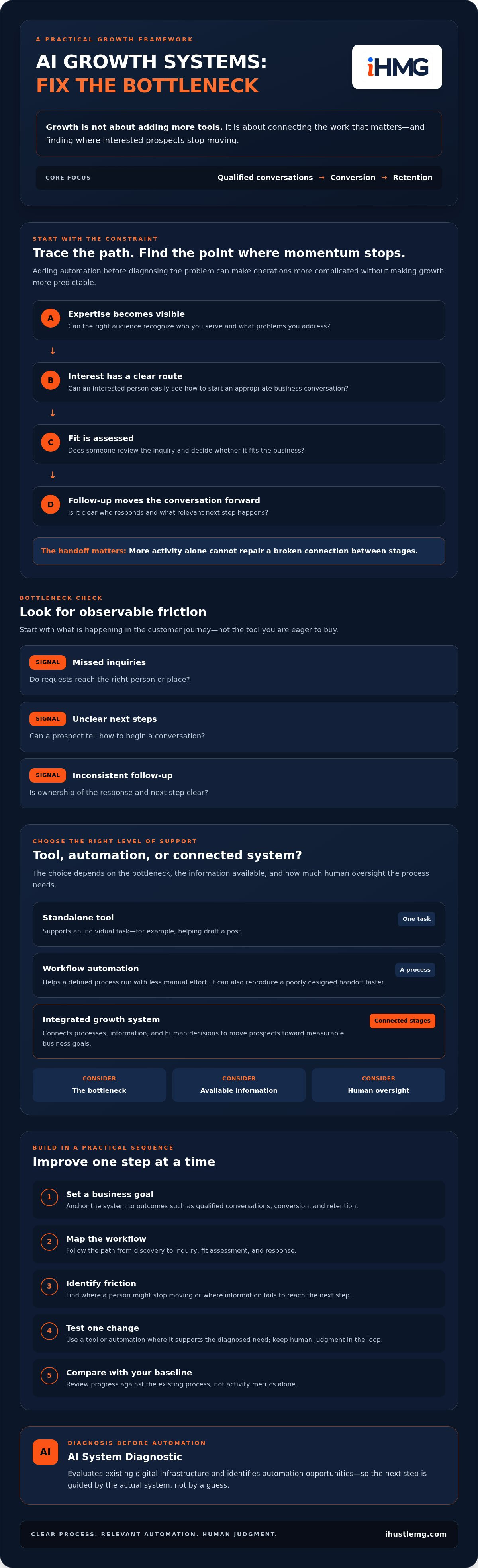
Trace the customer path from discovery to response. Look for where a person might stop moving: after seeing your expertise, while trying to contact you, or after sending an inquiry. Start with a problem you can observe, not the tool you’re eager to buy.
- Missed inquiries: Do requests reach the right person or place?
- Unclear next steps: Can an interested prospect tell how to start a conversation?
- Inconsistent follow-up: Is it clear who responds and what happens next?
These signals help narrow the problem before you choose automation. For a deeper look at finding friction in a lead process, explore this AI business diagnostic tool guide. The aim of ai business growth systems isn’t to automate everything. Identify where potential customers stop moving toward a conversation, then improve that step with appropriate tools and human oversight.
How AI Business Growth Systems Connect Authority, Lead Flow, and Follow-Up
Growth depends on what happens between stages, not just on how much activity each stage generates. A practical path starts when a business makes its expertise visible, gives interested people a clear way to respond, assesses whether the inquiry is a fit, and follows up with a relevant next step.
Connected stages turn attention into a managed conversation. More activity alone can’t repair a broken handoff. AI business growth systems work best when each step passes useful context to the next, while people remain responsible for decisions that require judgment.
How authority and visibility create a stronger starting point
Clear expertise helps potential customers recognize who a business serves and what problems it can address. Consistent positioning builds familiarity, but authority is an input, not a promise of leads or sales. Thought leadership is useful when it speaks to a defined audience and points toward a meaningful next step. Publishing more without that focus can create noise instead of momentum.
For a deeper look at shaping founder positioning, explore this founder authority strategy. The goal is to make expertise recognizable, then connect that visibility to a clear route for interested prospects.
How lead capture and follow-up move interest forward
A social comment or direct inquiry signals interest, but it isn’t necessarily a qualified opportunity. The next step should make it easy to begin an appropriate business conversation. For example, a consultant can record the inquiry, preserve what the person asked about, and assign a follow-up task so the response reflects the original context.
CRM records can clarify that handoff by capturing the inquiry source, relevant details, and next action. AI may help organize information or prompt a defined task, but a person should review fit, intent, and sensitive communication before deciding what to say or do. That balance supports the end-to-end efficiency AI can bring to workflows without treating automation as a substitute for judgment.
iHustle Media Group’s Social Lead Web connects social engagement with qualified business conversations and automated follow-up. It supports one part of a broader growth system, rather than guaranteeing conversion. To explore how the stages fit into a pipeline, read the modern lead generation system guide.
AI Business Growth Systems vs. Standalone Tools: What Should You Build?
Don’t start by automating everything. Match the level of support to the work: a standalone tool handles a contained task, workflow automation moves information or prompts an action, and an integrated growth system connects stages toward a business goal. The benefits of AI in business depend on improving real work, not simply installing technology.
AI doesn’t create strategy, trust, or demand by itself. A tool can help draft a response, but the business still needs a clear offer, reliable information, and someone accountable for deciding whether the response makes sense. Compare options by the problem they address, the information they need, and how you’ll review their impact.
| Approach | Problem addressed | Information needed | Human role | Measure to monitor |
|---|---|---|---|---|
| Standalone tool | A contained, repeatable task | The inputs needed for that task | Check accuracy and approve output | Task completion or review effort |
| Workflow automation | A recurring handoff or reminder | Clear triggers, ownership, and next steps | Handle exceptions and oversee the process | Missed or completed handoffs |
| Integrated growth system | Gaps across connected customer stages | Consistent records and defined process stages | Assess fit, make decisions, and improve the process | Movement toward qualified conversations |
When is a standalone AI tool enough?
A standalone tool can be a sensible first step when a task is contained, repeatable, and easy for a person to review, such as drafting a first version of a routine message. It reaches its limit when the output doesn’t connect to a contact record, next step, or business measure. Before adopting one, check how it handles private information, who owns its outputs, how accuracy will be reviewed, and where human approval is required.
When does a connected growth system make more sense?
Consider a connected workflow when a prospect moves between discovery, inquiry, qualification, and follow-up. If a request arrives through one channel but its context is kept elsewhere, the next person may not know what the prospect asked or what action is due. A system needs reliable information and a clear process owner, not automation alone. Start with one handoff, name its owner, and decide what evidence will show whether it works.
For ai business growth systems, a smaller, well-defined workflow is often a stronger starting point than broad automation. Clarify the process first, then decide whether a tool, an automated workflow, or a connected system best supports it.
How to Build AI Business Growth Systems in a Practical Sequence
Build from evidence, not enthusiasm for a new tool. A disciplined sequence helps you find where work stalls, choose a change you can review, and learn whether it deserves a wider role in your growth process.
- 1. Define the goal. Name the business outcome you want to support, such as making it easier for qualified inquiries to reach a conversation. Keep the goal specific enough to guide process choices.
- 2. Map the workflow. Record how inquiries arrive, where details are stored, who reviews them, and what happens next. Include handoffs between people and systems.
- 3. Diagnose friction. Compare the intended process with what actually happens. Look for observable issues such as incomplete records, unclear ownership, or follow-up tasks that aren’t consistently completed.
- 4. Pilot one change. Select a narrow, repeatable task with an accountable owner. Document the current steps, decide where human review belongs, and introduce one change rather than automating the entire journey.
- 5. Review the evidence. Compare the pilot with a baseline from existing business records. Keep, adjust, or pause the change based on what those records show, then consider whether another workflow is ready.
How should a business diagnose and prioritize growth friction?
Start with the inquiry trail: where it originated, how it was recorded, who received it, and what action followed first contact. Prioritize potential issues by their impact on customers, how often they recur, whether reliable information is available, and whether you can test a focused change.
Separate facts from assumptions. A record showing an inquiry without a documented next step is an observable gap. Assuming a slow response caused a lost opportunity requires more evidence. That distinction keeps a diagnosis useful instead of turning a hunch into an automation project.
How can a business pilot AI without over-automating?
Choose a contained task, document how it’s handled now, and set a measure tied to that task. For example, check whether required inquiry details are recorded or assigned follow-up is completed. Name the person who checks outputs and handles exceptions. Decide in advance what would prompt a pause or revision, such as inaccurate information or review work that outweighs the intended benefit.
For a focused example of a social inquiry workflow, see the social media lead automation guide. If you need help evaluating existing digital infrastructure and automation opportunities, explore iHustle Media Group’s AI System Diagnostic. This evidence-first approach gives ai business growth systems a practical foundation before you expand automation.
How iHustle Media Group Helps Turn AI Growth Strategy Into a System
Once you’ve identified where progress stalls, choose support that matches the gap. A positioning challenge calls for a different response than disconnected social inquiries or uncertainty about which automation opportunities matter. The goal isn’t to adopt every available option. It’s to strengthen the part of your growth system that needs attention.
Which iHustle solution fits which growth-system need?
- Need to assess your current setup? AI System Diagnostic evaluates existing digital infrastructure and identifies automation opportunities. It can help clarify where to focus before selecting tools, without promising a particular outcome.
- Social interest isn’t becoming a business conversation? Social Lead Web connects social engagement with qualified business conversations and automated follow-up. It supports that part of the customer journey rather than replacing the broader growth system.
- Your expertise needs clearer market positioning? Authority Accelerator uses AI-enhanced frameworks to strengthen a professional’s market positioning. It serves as the authority-building component of a wider growth approach, not a guarantee of leads or sales.
These offerings address different parts of an overall approach: strengthen how expertise is positioned, connect social engagement to conversations, and use diagnosis to identify where infrastructure or automation needs attention. The right starting point depends on evidence in your process, not on which tool is attracting the most attention.
What should a business clarify before taking its next step?
Bring a clear picture of your current growth stage and the friction you’ve observed. Note where inquiries originate, how your team records them, which tools or processes are already in use, and where the next step becomes unclear. That context makes it easier to discuss priorities and whether a particular type of support fits.
For businesses in St. Louis, St. Charles, St. Peters, Florissant, Hazelwood, Ferguson, and Chesterfield, iHustle Media Group offers support focused on authority and lead generation through its named offerings. Keep the conversation grounded in the problem you need to solve: which stage needs attention, what evidence points to it, and what would you review to judge whether a change is useful?
Explore iHustle Media Group’s offerings to consider which next step aligns with your ai business growth systems priorities.
Build Your Next Growth Move Around the Real Bottleneck
Scalable growth doesn’t come from stacking AI tools. It comes from connecting the right stages, measuring meaningful progress, and using evidence to decide what to improve next. Start where potential customers lose momentum, then test a focused change with clear ownership and human review.
That’s the foundation of effective ai business growth systems: a practical link between authority, lead flow, and follow-up. iHustle Media Group’s offerings address different parts of that approach. AI System Diagnostic evaluates existing digital infrastructure and identifies automation opportunities. Social Lead Web connects social engagement with qualified conversations and automated follow-up. Authority Accelerator supports professional market positioning through AI-enhanced frameworks.
You don’t need to automate everything at once. Clarify your priority, understand how your current process works, and choose a next step that fits. Explore iHustle Media Group’s AI growth systems to see which option aligns with your business needs. A sharper system starts with one deliberate move, and you can build from there.
Frequently Asked Questions
What are AI business growth systems?
AI business growth systems connect processes, information, and decisions to support measurable business goals. Rather than relying on isolated tools, a business links stages such as sharing expertise, capturing inquiries, assessing fit, and following up. AI can assist with defined tasks in that flow, while people remain responsible for strategy and important decisions. The system’s value comes from how well its parts work together, not how many tools it contains.
How can AI help a business grow?
AI can help a business organize information, support repeatable tasks, and make parts of a customer journey easier to manage. Depending on the tools and process in place, it may help prepare content or flag an inquiry that needs a response. Growth still depends on a clear offer, relevant expertise, and good judgment. Review outcomes such as qualified conversations and completed follow-up, rather than treating more content or automation as proof of progress.
Can AI generate leads for a small business?
AI can support lead generation, but installing a tool alone doesn’t guarantee inquiries or sales. It may help a small business make expertise visible, capture interest, or organize follow-up when those steps are clearly defined. A business still needs a relevant offer and a straightforward way for prospects to make contact. For example, Social Lead Web is designed to connect social engagement with qualified conversations and automated follow-up.
How do you build an AI growth system for a service business?
Start by defining a business goal, then map how a potential customer moves from discovering your expertise to contacting you and receiving a response. Identify a specific point of friction, establish a baseline from existing records, and pilot one focused change with a responsible human reviewer. Service businesses in St. Louis and nearby communities can also assess whether local support fits their needs, including options from iHustle Media Group.
What is the difference between AI automation and an AI business growth system?
AI automation uses technology to assist with or perform a defined task, such as organizing information or prompting a follow-up action. An AI business growth system connects tasks and decisions across stages, guided by a business goal and clear oversight. Automation can be one component of the system, but it won’t fix an unclear handoff or missing process owner on its own. Define the workflow before deciding what to automate.
Does a small business need custom software to use AI for growth?
No. A small business can begin by reviewing its existing processes and considering whether available tools support a well-defined task or handoff. First, find the bottleneck, clarify who owns the process, and decide how a person will review AI-assisted work. Custom software isn’t automatically required for a useful starting point. An AI System Diagnostic evaluates existing digital infrastructure and identifies automation opportunities without implying custom software development.