


AI for Professional Services: A Practical Guide for 2026
What if AI could give you more room to do the work clients actually value, without making your service feel less personal? That’s the opportunity behind ai for professional service providers: not replacing expertise, but using it more effectively.
The hesitation makes sense. AI can produce inaccurate answers, and adding another disconnected tool won’t fix a scattered marketing, lead-handling, or operations process. The goal isn’t to automate everything. It’s to find repeatable work AI can support, then keep professional judgment in control where accuracy, context, and client trust matter.
This practical guide shows you where AI can strengthen a professional services business, how to compare applications by business value, effort, and risk, and how to move from small experiments toward connected workflows. You’ll also learn where human review belongs and how to avoid handing over decisions that require your expertise. The result is a clearer path to using AI as part of a business system, not just another tool on your screen.
Key Takeaways
- Use ai for professional service providers to support repeatable knowledge work while keeping expert decisions and client relationships in human hands.
- Map AI assistance, workflow automation, and human judgment across visibility, inquiry handling, onboarding, client work, and follow-up.
- Compare potential use cases by business value, repeatability, data sensitivity, and the level of human review they require.
- Run a focused pilot: choose one workflow, set a baseline, test the process, review outputs, and refine before expanding.
- Connect AI to a broader growth system, using an AI System Diagnostic to identify opportunities across existing digital infrastructure.
Why AI Matters for Professional Service Providers, and Where It Adds Value
Professional services run on expertise, judgment, and trust. They also involve a steady flow of information: inquiries to understand, documents to review, knowledge to organize, and follow-up to manage. AI can support parts of that work, but adding a tool simply because competitors are doing it is not a strategy. The useful question is whether it addresses a real bottleneck without weakening the service clients value.
AI can help organize information, generate or analyze content, and support repeatable workflows, but the professional remains accountable for evaluating the output and delivering the work. That distinction matters. Assistance can expand capacity; it doesn’t transfer responsibility.
What does AI for professional services actually mean?
Artificial intelligence describes technology that performs tasks associated with human capabilities such as learning, reasoning, or understanding language. For a broader foundation, see What is Artificial Intelligence? Generative AI is a category that creates new material, such as text or summaries, in response to instructions. Large language models, or LLMs, are trained on language patterns so they can interpret prompts and produce human-like text.
Consider an incoming client inquiry. Conventional automation can send the same acknowledgment whenever a form is submitted. AI assistance could help draft a response based on the inquiry’s details, while a professional checks its accuracy, tone, and suitability before sending. The first follows a preset rule. The second generates a tailored suggestion.
That suggestion is a starting point, not a professional conclusion. AI can miss context, misread information, or produce confident-sounding errors. A consultant still decides what advice fits the client’s situation; an accountant still reviews work before it is delivered. The tool may help prepare or organize the work, but the professional evaluates and owns the result.
Why service providers are exploring AI now
Knowledge often lives in scattered documents, email threads, and the experience of individual team members. Meanwhile, routine steps can consume time that would be better spent understanding a client’s needs, shaping a recommendation, or building a trusted relationship. AI is relevant when it makes useful knowledge easier to access or supports a process that otherwise relies on repeated manual effort.
For an owner-led firm, that might mean turning a set of approved service details into a first draft for review, organizing notes after a discovery conversation, or helping prepare a consistent follow-up. These are not replacements for expertise. They can reduce the friction around applying it.
Start with the business problem, not the technology. Ask:
- Which repeated task slows down client work or follow-up?
- Could AI support it without exposing sensitive information or making an unchecked decision?
- What must a professional review before the output reaches a client?
If there’s no clear answer, don’t automate for appearances. A focused use case should strengthen the system around your expertise, making knowledge and repeatable processes easier to use while preserving the human judgment that earns client trust. That is the practical promise of ai for professional service providers.
Where AI Fits in a Professional Services Workflow
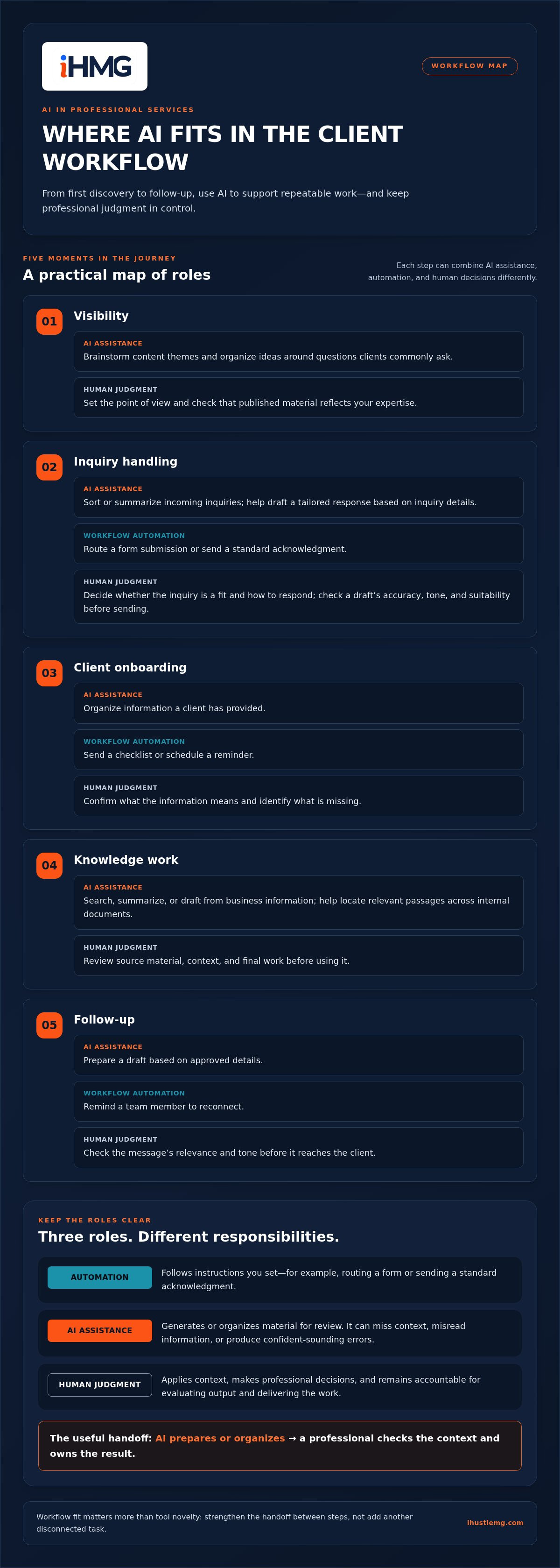
AI is most useful when it supports a clear step in the work, from the first sign of interest to client follow-up. Picture a small consultancy: potential clients discover its expertise, submit inquiries, share information during onboarding, receive advice, then hear from the firm again. At each point, AI assistance, workflow automation, and human decisions play different roles.
Workflow fit matters more than tool novelty: a useful application strengthens the handoff between steps instead of creating another disconnected task.
- Visibility: AI can help brainstorm content themes or organize ideas around questions clients commonly ask. A professional sets the point of view and checks that published material reflects their expertise.
- Inquiry handling: AI may help sort or summarize incoming inquiries. Automation can route a form submission or send a standard acknowledgment, while a person decides whether the inquiry is a fit and how to respond.
- Client onboarding: Automation can send a checklist or schedule a reminder. AI may help organize information a client has provided, but the professional confirms its meaning and identifies what’s missing.
- Knowledge work: AI can assist with searching, summarizing, or drafting from business information. Professionals review the source material, context, and final work before using it.
- Follow-up: Automation can remind a team member to reconnect. AI may help prepare a draft based on approved details, while a person checks its relevance and tone before it reaches the client.
These roles are related, but not interchangeable. Automation follows instructions you set. AI generates or organizes material for review. Human decisions apply context, judgment, and responsibility. A strong workflow defines where one role ends and the next begins.
AI for knowledge work and client service
Suppose a client asks a question that draws on several internal documents. AI could help locate relevant passages or prepare a summary for the consultant to review. That can make existing knowledge easier to use, but it doesn’t guarantee that the summary is complete or that it captures a client’s specific circumstances. The professional checks the underlying information, considers nuance, and shapes the response before delivering it.
AI for marketing and business development
For business development, AI may support a content plan by grouping topics or turning approved ideas into draft formats. It can also assist with the next step after social engagement: moving a conversation toward an inquiry and follow-up. For a practical example of that workflow, explore this social media lead automation guide.
But capable tools can still produce a broken experience. If a social inquiry is captured but never reaches the person responsible for responding, the gap between visibility and conversation wastes attention. Likewise, an onboarding form that doesn’t inform the next client interaction creates extra work rather than reducing it. Map who receives each handoff, what information travels with it, and what action comes next.
That’s the system-level opportunity in ai for professional service providers: connect useful assistance to the real movement of work. If you’re mapping where that movement breaks down, an AI System Diagnostic can evaluate existing digital infrastructure and identify automation opportunities.
Which AI Use Cases Should a Professional Services Firm Prioritize?
Don’t start with a tool. Start with the workflow problem you need to solve. A recurring task with a visible bottleneck and a straightforward review step is often a stronger candidate than a high-stakes decision that depends on subtle client context.
Prioritize a clear workflow problem before selecting an AI tool. For each candidate, compare business value, repeatability, data sensitivity, human review, and implementation effort. Use relative descriptions such as low, medium, or high, based on your firm’s own needs. These labels aren’t industry benchmarks; they’re a way to make trade-offs visible and compare opportunities consistently.
A practical value, effort, and risk test
Ask whether the task happens regularly and where it gets stuck. Then check whether the information needed is accessible and appropriate to use for that task. Finally, name the person who owns the process and who reviews the output. If ownership or review is unclear, the workflow isn’t ready to scale.
Candidate workflow | Business value and repeatability | Data sensitivity | Human review and effort
Internal meeting-note summary | May save time if the team repeatedly turns notes into action items | Depends on the content; client-sensitive details require care | A team member checks accuracy and assigns follow-up; effort may be limited if the process is consistent
Drafting a standard service overview | Useful when staff often prepare similar explanations | Lower if based on approved, non-sensitive business information | A professional reviews claims and tone; effort depends on how well source material is organized
Preparing individualized client advice | Potentially valuable, but the task requires context and judgment | May involve sensitive client information | High professional review is essential; greater consequences call for tighter controls
Use the comparison to identify a sensible pilot, not to manufacture a return forecast. A low-sensitivity internal task may be easier to test than a client-facing recommendation. A repeated workflow can still be a poor candidate if useful information is scattered or review takes longer than doing the task directly.
Which tasks should stay under professional judgment?
Keep nuanced advice, sensitive client decisions, and final deliverables under meaningful professional oversight. The right level of automation depends on what could happen if an output is incomplete or wrong, as well as what clients expect from your service. AI may help prepare or organize work, but it shouldn’t silently make consequential decisions on your behalf.
Before testing a use case, document what information it can use, what it can produce, who checks the result, and who makes the final decision. For a closer look at evaluating business systems and potential gaps, use this AI business diagnostic tool guide.
For ai for professional service providers, the practical priority is the intersection of a real bottleneck, repeatable work, appropriate information, and a review process your team can sustain. An AI System Diagnostic can help assess existing digital infrastructure and identify automation opportunities before you expand.
How Professional Service Providers Can Adopt AI Without Losing Control
Control doesn’t come from avoiding AI. It comes from deciding where it fits, who owns the work, and how outputs are checked. A small, bounded pilot gives you a way to learn from real work before connecting more tools or changing a client-facing process.
Use this rollout to turn an idea into a measured test, not an assumption that AI will automatically save time or improve service.
Start with one bounded workflow
Choose a frequent task with a clear beginning and end, such as preparing an internal summary from approved information. Record how the work is done now, including handoffs and review. Set a limited test scope, decide what information is appropriate to use, and name the person accountable for checking the output.
- Choose one workflow. Describe the task, its trigger, the people involved, and what a completed result looks like. Avoid testing several unrelated processes at once.
- Define a baseline. Note how the task currently moves through the firm. Depending on the workflow, track time spent, corrections, delays, missed handoffs, or feedback from the people doing the work.
- Set the test boundaries. Specify what the AI may assist with, what information it may use, and what it must not decide or send without review. Keep the pilot limited enough that a person can inspect each result.
- Test with an owner in place. Have the named reviewer compare outputs with the source material and the intended task. Record errors, useful results, extra work, and points where the process becomes unclear.
- Review and refine. Compare the pilot with the baseline. Adjust the instructions, handoffs, or review steps if the results create rework or weaken the experience. Expand only when the workflow is dependable for its purpose.
Measure, govern, and improve the pilot
Pick indicators that match the task rather than chasing a broad efficiency claim. A team testing internal summaries might track correction frequency and completion time; a team testing inquiry handling might examine whether each inquiry reaches the right owner and receives a suitable next step. Include quality and user experience, not just speed.
Write down the operating rules so the pilot doesn’t depend on assumptions:
- Ownership: Name who oversees the workflow and who approves client-facing outputs.
- Review: State what the reviewer checks, such as factual accuracy, context, tone, and completeness.
- Acceptable use: Record which information may be used and consider privacy, client expectations, and applicable organizational requirements.
- Escalation: Define what happens when information is incomplete, an output seems unreliable, or a decision needs professional judgment.
If outputs require more correction than the original process, pause and adjust. The pilot is useful even when it reveals that a workflow needs cleaner inputs or a stronger handoff before AI belongs in it. For a focused look at connecting AI to lead stages and follow-up, see this AI sales pipeline automation blueprint.
For a structured review of your existing digital infrastructure and automation opportunities, explore an AI System Diagnostic. That deliberate approach helps ai for professional service providers grow from a controlled test into a connected process without putting expert judgment on autopilot.
Build a More Connected Growth System with iHustle Media Group
The practical path is clear: identify a workflow or growth constraint, test a focused improvement, measure how it performs, and keep expert review in the process. From there, connect what works to the rest of the business. AI creates more value as part of a coherent system than as a stack of tools that don’t share context or support the same objective.
For professional service providers, the gap may sit in different places. Your digital presence may attract attention without creating a clear next step. Inquiries may arrive but lack consistent follow-up. Or your market expertise may be hard to communicate consistently. The right next move depends on the constraint you’re trying to address.
Match the business need to the right iHustle system
iHustle Media Group focuses on AI-driven lead generation and authority-building systems. Each offering connects to a distinct business need:
- AI System Diagnostic: If you need to understand where your current digital setup is creating friction, this evaluates existing digital infrastructure and identifies automation opportunities. It can help bring the system into focus before you expand automation.
- Social Lead Web: If social visibility is generating interest but the next step feels disconnected, this connects social media visibility with qualified business conversations and automated follow-up.
- Authority Accelerator: If your expertise needs a stronger, more consistent market presence, this uses AI-enhanced frameworks to strengthen professional positioning and credibility.
These systems address different parts of business growth. Their value comes from matching the need to the right function, then understanding how that function fits with the rest of your client journey. A stronger presence, for example, matters most when people can also take a clear next step toward a business conversation.
Make the next move with a clear business objective
Before choosing a solution, write down one specific constraint. Is it hard to identify automation opportunities in your current digital infrastructure? Are social inquiries missing a dependable path toward follow-up? Does your market positioning fail to reflect the depth of your expertise? A clear answer helps you focus the discussion on the business system, not novelty.
Then define what you’ll want to evaluate: the current process, where attention or information gets stuck, and what a useful improvement would look like. Keep professional judgment in the design, especially anywhere a prospect or client experiences the process. That way, the goal isn’t simply to add AI. It’s to create a more connected way for people to discover your expertise and move into a meaningful business conversation.
iHustle Media Group serves businesses in the St. Louis area, helping professional service providers connect AI-driven lead generation and authority-building systems to business needs. If you’ve identified the workflow or growth constraint you want to address, explore iHustle Media Group and consider how ai for professional service providers can fit into a system built around your expertise.
Make Your Next AI Move Deliberate
Your next advantage won’t come from adding AI everywhere. It will come from choosing what your clients should experience as your business grows. Decide where a smoother process should create more room for personal attention, clearer communication, or stronger expertise. Let that standard guide your next technology decision.
That’s a more useful starting point for ai for professional service providers: build systems that support the kind of service you want to be known for, rather than chasing technology for its own sake. iHustle Media Group focuses on AI-driven growth systems that connect business development and professional authority to broader business goals.
Ready to turn a business objective into a more connected growth system? Explore how iHustle builds AI-driven growth systems, and take the next step with purpose. Your expertise stays at the center, and the right system can help you put it to work with greater focus.
Frequently Asked Questions
Can AI replace a professional service provider?
No. AI can assist with defined tasks, but it can’t take full responsibility for interpreting a client’s circumstances, making judgment calls, or standing behind advice. A tax firm, for example, might use AI to sort routine source documents while an accountant evaluates unusual transactions and explains their implications. Treat AI as support for bounded work, not a substitute for the expertise and accountability clients rely on.
How can professional service providers protect confidential client information when using AI?
Set a clear information policy before putting client material into an AI tool. Avoid entering identifiable or confidential details unless your firm has approved that use and understands how the tool handles submitted data. Where possible, use anonymized examples or remove details that aren’t needed for the task. Make the policy easy to follow, and train staff to pause when they’re unsure whether information is appropriate to share.
Should a professional tell clients when AI was used?
Consider the role AI played, your client’s expectations, and the terms of the engagement. If AI materially shaped a deliverable, informed an important recommendation, or changed how client information was handled, explain that use in plain language. A brief disclosure can clarify what the technology contributed and what you personally reviewed. Avoid implying that AI made a professional decision on your behalf, and follow applicable rules for your work.
How can a small professional services firm start using AI without a technical team?
Start with a familiar task and a tool your team already knows how to use, rather than trying to build a complex system. For example, test AI on an internal draft using non-sensitive information, then check whether the result is genuinely useful. Keep the test small and record what the team learns. For ai for professional service providers, a clear use case and simple review process matter more than technical sophistication.
How can a firm tell whether an AI workflow is working?
Compare the process with how the work was done before. Track measures that fit the task, such as time to complete, corrections needed, missed handoffs, or whether staff find the workflow easier to use. Include quality, not just speed. If a draft takes less time to produce but requires extensive fixes, the workflow may need better inputs or a different role for AI.
Can AI help professional service providers build credibility?
AI can support the work behind a consistent, useful market presence, but credibility still depends on substance. Review every claim, add insight grounded in your experience, and share examples that demonstrate how you think. Professionals serving clients across St. Louis, St. Charles, St. Peters, Florissant, Hazelwood, Ferguson, and Chesterfield can use clear, relevant expertise to help prospective clients understand what sets their practice apart.