


AI Lead Generation Agency: How to Choose a System That Converts
More AI tools won’t fix a lead flow that breaks between attention and follow-up. An AI lead generation agency should improve the path from visibility to a qualified sales conversation, not simply add another platform to your stack.
If social engagement rarely turns into real opportunities, look at what happens after someone shows interest. Manual prospecting, slow follow-up, and disconnected tools can keep your team busy without creating a dependable process. More automation is not automatically the answer. Start with a system built around your audience, offer, lead sources, and sales process.
This article explains what an AI lead generation agency should improve, how to compare its approach by business outcomes rather than tool lists, and when a systems-first model makes sense. You’ll learn how connected follow-up can turn existing attention into qualified conversations, how a diagnostic can reveal friction before you add tactics, and why authority-building matters when attracting relevant prospects. The goal is a clearer, more measurable lead-flow system with less reliance on manual chasing.
Key Takeaways
- Judge an AI lead generation agency by how it advances relevant prospects, not by the AI tools or activity metrics it promotes.
- Map the journey from attention to capture, follow-up, qualification, and a clear next step so each interaction has a purpose.
- Compare approaches across lead sources, capture, follow-up, qualification, and reporting to separate useful outcomes from busywork.
- Define your ideal customer, service area, offer, and active channels before choosing a system, especially if you serve St. Louis and nearby communities.
- Explore how Social Lead Web connects social visibility with follow-up, while AI System Diagnostic can identify friction in existing digital infrastructure.
What an AI Lead Generation Agency Should Actually Improve
More reach isn’t the same as more business. An AI lead generation agency should connect the steps between attracting attention, capturing interest, and moving a suitable prospect toward a sales conversation. That’s the practical purpose of lead generation: creating and capturing interest from potential customers, then giving that interest a clear next step.
Impressions, clicks, and follower growth can show that people noticed you. They don’t show whether the right prospects took action, received a relevant response, or progressed through your pipeline. Look for evidence that conversations are relevant and consistent, and that you can track whether prospects move forward.
AI can help organize incoming signals and support repeatable workflows, such as routing an inquiry or prompting follow-up. But it can’t clarify an unclear offer, replace a thoughtful understanding of your customers, or exercise human judgment when a prospect’s needs call for a personal response. Technology should strengthen the process, not become the process.
How does AI lead generation differ from traditional agency work?
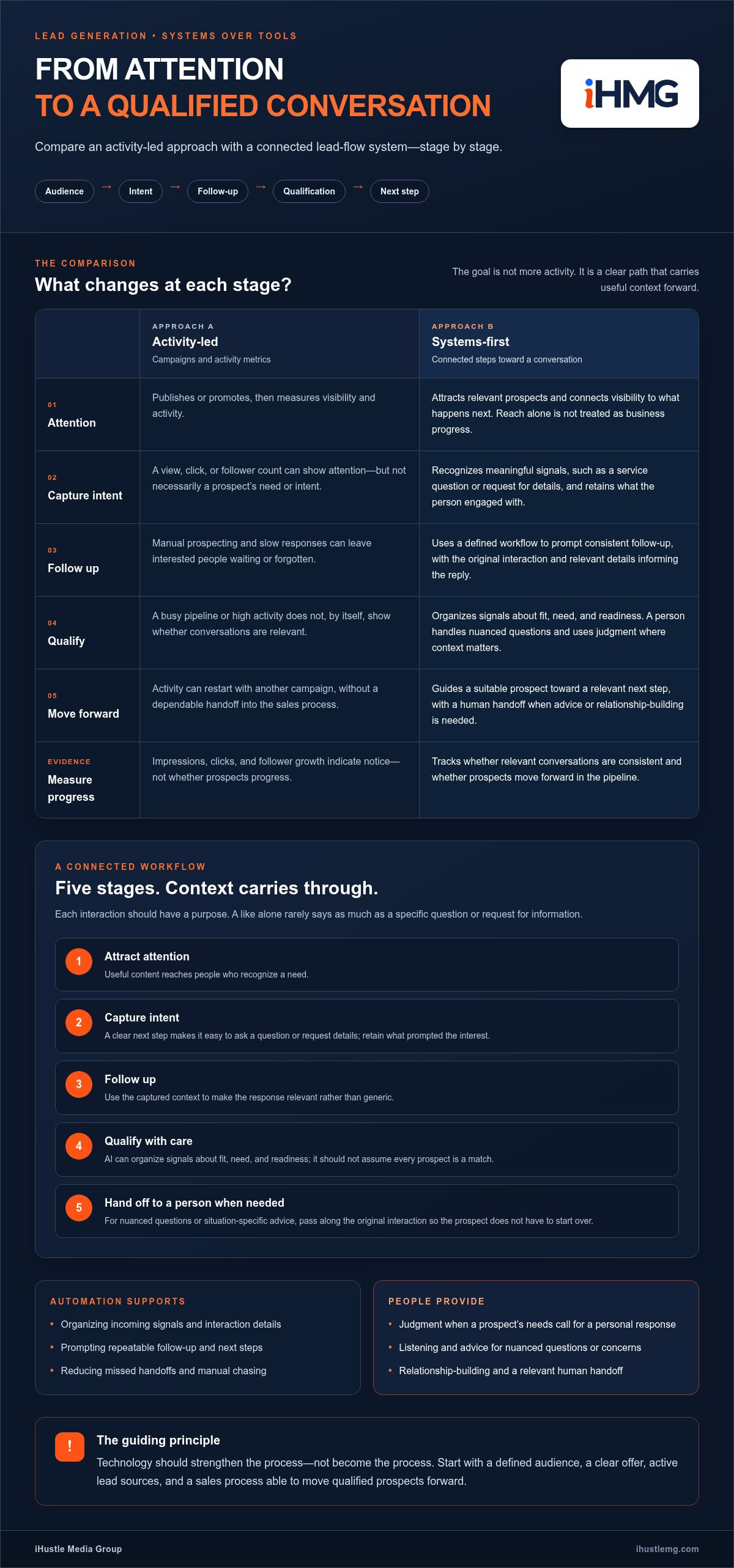
Traditional agency work may focus on individual campaigns: publish, promote, measure activity, then start again. A systems-first approach connects that activity to what happens next. A person responds, their interest is captured with context, follow-up begins, and the prospect is guided toward a relevant next step.
For example, someone who asks about a service in response to a social post has shown more intent than someone who simply viewed it. A useful workflow preserves that context, so follow-up can address the person’s question instead of sending a generic message. Automation can make responses more consistent, but communication should still feel relevant and human. The aim isn’t to automate every exchange. It’s to reduce missed handoffs and manual chasing.
Which businesses benefit from a systems-first approach?
Service professionals can benefit when their expertise and social visibility prompt potential clients to ask questions, request details, or express interest. Founders and consultants may also value a dependable follow-up process when manual outreach competes with serving clients and running the business.
Fit depends on the whole sales environment: how your business earns revenue, where leads come from, how follow-up works today, and how many new conversations your team can handle. A system can organize interest, but it can’t rescue an unclear offer or compensate for an undefined audience. Start with a specific customer, a compelling reason to engage, and a sales process capable of moving qualified prospects forward.
How an AI Lead Generation Agency Moves Interest Toward a Qualified Conversation
A prospect’s interest can disappear between a social comment and your next available moment to respond. An AI lead generation agency should design a connected path from interaction to useful next step, while keeping people in control of the relationship.
The workflow has five stages: attract attention, capture intent, follow up, qualify, and move the prospect forward. Each stage should carry context into the next. A comment about a specific service, a question about how it works, or a request for more information gives follow-up a reason to feel relevant. A like alone rarely provides that context.
From social visibility to lead capture
Useful content draws the attention of people who recognize a need. A clear call to action then makes it easy to express interest, such as inviting someone to ask a question, request details, or take another defined next step. The aim isn’t to turn every interaction into a lead. It’s to recognize when someone signals genuine intent.
Capture details that make a response useful: what the person engaged with, what they asked, which service interests them, and any information they choose to share about their needs. This context helps shape a reply that acknowledges the actual conversation rather than dropping the person into a generic sequence. For more on structuring this process, see the social media lead automation guide.
Follow-up, qualification, and human handoff
Once interest is captured, a defined follow-up workflow helps ensure it isn’t forgotten when the team gets busy. AI can organize interaction details, prompt consistent next steps, and surface signals about fit, need, and readiness. It can help prepare the conversation, but it shouldn’t make unsupported assumptions or decide that every prospect is a match.
People remain essential. If a prospect has a nuanced question, raises a concern, or needs advice that depends on their situation, route the conversation to someone who can listen and respond with judgment. The handoff should include the original interaction and relevant details, so the prospect doesn’t have to start from scratch.
That balance matters: automation supports consistency, while a person handles nuance and relationship-building. Harvard Business Review’s guidance on getting more from your marketing AI reinforces why technology needs to serve a clear strategy. Businesses looking to connect social engagement with follow-up can explore iHustle Media Group’s lead-flow systems.
How to Compare AI Lead Generation Agencies Without Buying Hype
“AI-powered” isn’t a result. An AI lead generation agency should explain how its strategy connects your audience and offer to a lead source, capture point, follow-up process, and next step. Before adding tools, assess what you already use and where prospects are getting lost. A diagnostic approach can identify friction in existing digital infrastructure before new tactics add complexity.
Use this framework to compare the actual workflow, not the pitch:
| Area | What to look for | Weak signal |
|---|---|---|
| Strategy | A clear link between audience, offer, channel, and sales process. | A generic AI plan without a defined customer or goal. |
| Lead source | A specific explanation of where prospects come from, including whether the focus is existing social visibility. | Lead volume promised without explaining its source or relevance. |
| Capture | A clear way to record an interested prospect and the context behind the interaction. | Likes or clicks reported as captured leads. |
| Follow-up | Defined next steps, timing, and ownership across automated and human responses. | Automation described as a feature, with no explanation of who handles exceptions. |
| Qualification | A practical way to assess fit, need, and readiness. | Every response treated as sales-ready. |
| Reporting | Visibility into relevant conversations and movement through the pipeline, alongside activity metrics. | Impressions and messages reported without showing what happened next. |
What should an AI lead generation agency be accountable for?
Expect clear ownership: which steps the system supports, what your team handles, and how a prospect moves from first signal to human conversation. Deliverables such as workflows or automated messages describe what gets set up. Activity measures such as clicks and replies show what happened. Neither alone proves business progress. Reporting should help you see whether conversations are relevant and whether prospects advance through your sales process.
How do AI lead generation services differ from adjacent agency models?
Different models solve different problems. A broad marketing agency may coordinate brand and campaign activity; paid campaign management centers on advertising. Appointment-setting programs focus on arranging meetings, while a systems-led approach may convert interest already present in a business’s social channels. Authority building strengthens how a professional is positioned and trusted; lead capture turns a prospect’s interest into an actionable conversation. These approaches can support one another, but they aren’t interchangeable.
Be cautious of sweeping AI promises, metrics without definitions, or unclear ownership of follow-up. A sound approach makes the workflow understandable and shows where technology assists rather than obscures the work.
What Local Service Businesses Should Map Before Choosing an AI Lead Generation Agency
For service businesses in St. Louis, St. Charles, St. Peters, Florissant, Hazelwood, Ferguson, and Chesterfield, a lead-generation system has to reflect how local customers find and choose a provider. Before selecting an AI lead generation agency, map the essentials: who you serve, where you serve them, what offer you want them to act on, and which channels already bring people into conversation.
A consultant whose prospects respond to professional insights on social media has a different starting point from a home-service business receiving inquiries through its website. The right system should fit your audience and lead sources, not force your business into a generic workflow. For a broader framework, see this lead generation system guide.
A practical readiness checklist for regional businesses
Before adding automation, make sure the basic route from interest to sales conversation is clear. Write down your primary customer, strongest service offer, and service area. Then trace what happens when someone responds to a post, submits an inquiry, or asks for details.
- Customer and offer: Can you explain who you help and what they can engage you to do?
- Service area and channels: Do you know where you serve and which channels currently attract relevant prospects?
- Response ownership: Who handles each inquiry, and what should happen if that person is unavailable?
- Progress visibility: Can you tell whether a new inquiry received a response and moved toward a sales conversation?
If those answers are unclear, automation may simply make a confusing process move faster. Define the handoffs first.
When should a business diagnose its existing lead flow?
Look for recurring missed inquiries, tools that don’t share useful information, and uncertainty about who owns follow-up. These are signs to document the current process before introducing more automation. Record where each inquiry arrives, who sees it, what response follows, and where progress becomes hard to track.
This map helps reveal whether the bottleneck is lead capture, follow-up, or a disconnected process, rather than assuming that more activity is the answer. For additional perspective, read the AI business diagnostic tool guide.
Ready to identify friction in your current lead flow? Explore an AI System Diagnostic to assess automation opportunities in your digital infrastructure.
How iHustle Media Group Connects AI Lead Generation to Authority and Follow-Up
Lead generation works best when visibility, trust, and follow-up operate as one system. iHustle Media Group provides Social Lead Web, AI System Diagnostic, and Authority Accelerator. Each addresses a different point in the prospect journey, from recognizing your expertise to taking a meaningful next step.
A connected system: visibility, diagnosis, and conversion
Authority helps potential clients understand what you know and why your perspective matters before a sales conversation begins. Authority Accelerator uses AI-enhanced frameworks to strengthen professional market positioning and build a clearer foundation for attracting relevant prospects. Visibility and credibility still need a path to action.
That’s where Social Lead Web fits. It connects social visibility with qualified conversations and automated follow-up, helping carry an interested person’s engagement toward a relevant next step. A prospect who asks about your service should not be treated like someone who simply viewed a post. The interaction’s context can inform follow-up, while human judgment remains important as needs and questions become more specific.
The system also needs to fit the infrastructure already in place. AI System Diagnostic evaluates existing digital infrastructure to identify opportunities for automation and improvements to lead flow. Rather than adding tools by default, a diagnostic perspective can reveal where the process needs attention and which handoffs need to work better.
Together, these offerings support different stages: authority makes expertise easier to recognize, social lead flow connects engagement to follow-up, and diagnosis helps identify process friction. The aim is a more connected, intentional route from professional visibility to a qualified conversation.
What to expect from a systems-first next step
Start with the bottleneck. Are relevant prospects seeing your expertise but not responding? Are inquiries arriving without consistent follow-up? Or are existing tools making it difficult to understand what happens after a person shows interest? Pair that challenge with a clear business outcome, such as creating a more dependable path from social engagement to a sales conversation.
A useful systems-first approach takes your existing audience, lead sources, offer, and sales process into account. It focuses on connecting what’s already working and addressing gaps that slow prospects down, rather than treating AI as a strategy by itself. That’s the distinction to look for in an AI lead generation agency: a system built around how your business attracts and serves prospects.
Explore a connected approach to authority, social lead flow, and follow-up with AI-driven lead generation with iHustle Media Group.
Build a Lead System That Moves Prospects Forward
The right AI lead generation agency doesn’t just add technology to your marketing. It connects the steps from visibility to qualified conversations, makes follow-up more consistent, and gives you a clearer view of how prospects move through your sales process. Choose based on the system’s fit with your audience, offer, and capacity, not on an AI label or a stack of activity metrics.
That’s the systems-first approach behind iHustle Media Group’s offerings. Social Lead Web connects social visibility with qualified conversations and follow-up. AI System Diagnostic identifies opportunities to improve existing digital systems, while Authority Accelerator supports professional positioning so prospects can better recognize your expertise. Together, these offerings address both the path to a conversation and the foundation that helps attract relevant prospects.
Start by identifying where your lead flow stalls and what you want to improve. Then explore AI-driven lead generation with iHustle Media Group and choose a system built around your business.
Frequently Asked Questions
What does an AI lead generation agency do?
An AI lead generation agency uses strategy, automation, and AI-supported workflows to help attract prospects, capture their interest, and move suitable leads toward a sales conversation. The useful measure isn’t how many tools it deploys. It’s whether the process connects audience, offer, lead capture, follow-up, and qualification. For example, Social Lead Web connects social visibility with qualified conversations and follow-up, while people stay responsible for judgment and relationship-building.
How does an AI lead generation agency find qualified leads?
It should identify potential prospects through relevant audience and intent signals, then support a process for capturing context and assessing fit. A social interaction about a specific service can reveal more than a general like, especially if a prospect shares a need or asks a question. AI can help organize that information and guide consistent next steps, but qualification still depends on your offer, criteria, and understanding of who you can serve.
Can AI generate leads without paid advertising?
Yes. AI can support lead flow from organic channels, such as social content that attracts relevant prospects and prompts them to ask a question or take a defined next step. Automation can help capture the interaction and support follow-up without relying on paid advertising. Results still depend on having a clear offer, an audience with a reason to engage, and a process for responding and moving suitable prospects forward.
How is an AI lead generation agency different from a traditional marketing agency?
The distinction is often the focus, not the label. A traditional marketing agency may coordinate campaigns or broader marketing activity, while a systems-led approach connects lead sources to capture, follow-up, qualification, and reporting. That doesn’t make every traditional agency the same. Compare what happens after someone engages: are you only measuring campaign activity, or can you see how relevant prospects move toward a sales conversation?
Is AI lead generation effective for consultants and service businesses?
It can be a good fit when expertise and visibility create genuine prospect interest, but manual follow-up makes it hard to respond consistently. Consultants and service businesses can use AI-supported workflows to organize inquiries and keep next steps clear. The system should reflect the business’s audience, offer, service area, and capacity. This applies to professionals serving St. Louis, St. Charles, St. Peters, Florissant, Hazelwood, Ferguson, and Chesterfield.
How do I measure whether an AI lead generation system is working?
Track whether the system creates relevant conversations and helps prospects progress through your sales process. Pair those outcome measures with operational indicators such as captured inquiries, follow-up completion, and response ownership. Impressions, clicks, and message volume may help explain activity, but they don’t show whether a prospect is a fit or took a meaningful next step. Use reporting that makes both the workflow and its outcomes understandable.
What should I look for when choosing an AI lead generation agency?
Look for an AI lead generation agency that can explain its process from audience and offer through lead source, capture, follow-up, qualification, and reporting. It should assess your existing systems before recommending more tools, define which steps are automated, and clarify what your team handles. Be cautious of broad AI promises or activity metrics without clear definitions. A diagnostic approach can identify friction before changes are made.
Can AI automate social media follow-up without making it feel impersonal?
Yes, if automation uses the context of the interaction and supports a relevant next step instead of sending the same message to everyone. For example, a person asking about a particular service should receive a response that acknowledges that interest. AI can help organize and route interactions, while a person handles nuanced questions and relationship-building. Review messages and handoffs to ensure the communication still sounds appropriate for your business.