


Authority Accelerator Program: What It Is and How It Builds Market Credibility
What if more content isn’t the answer to a credibility problem? If your expertise is hard to distinguish and your marketing feels like a string of disconnected tactics, the Authority Accelerator program offers a structured way to strengthen how the market understands your value.
That challenge is familiar to founders, consultants, and service professionals: consistent activity doesn’t automatically make you the obvious choice. Authority grows when your positioning, proof, and communication reinforce one another, so people can recognize what you know and why it matters.
This article explains how iHustle Media Group’s Authority Accelerator uses AI-enhanced frameworks to support expert positioning and build a stronger market presence. You’ll learn how authority-building works, identify positioning and credibility gaps that may be holding your business back, and assess whether a structured system fits your goals. The focus is on a practical question: can the right audience quickly understand what you do, whom you help, and why your perspective matters?
Key Takeaways
- Strong expertise can go unrecognized when your audience, message, and evidence don’t clearly align.
- More publishing isn’t a strategy by itself. Distinguish coordinated authority-building from content-only activity and scattered tactics.
- Use a practical self-assessment to pinpoint whether your biggest gap is audience clarity, positioning, proof, or consistency.
- The Authority Accelerator program uses AI-enhanced frameworks to support expert positioning and strengthen professional market presence.
- Positioning, credibility signals, and visibility work together to make your expertise easier for the right audience to recognize.
What Is an Authority Accelerator and Its Purpose?
You can have deep expertise and still be overlooked. If prospective clients struggle to describe what you’re known for or why your perspective matters, the issue may not be a lack of skill. Your expertise may simply need to be communicated in a way that makes its relevance clear to the market.
An Authority Accelerator program is a strategic program for founders, consultants, and other professionals who want to strengthen their market presence and credibility. It helps make expertise easier for the right audience to understand by connecting professional knowledge with clear positioning and credible communication. The purpose is not to manufacture popularity, but to make your value more recognizable.
The word “accelerator” points to a structured, focused approach. A Seed accelerator is designed to help develop companies; an authority-focused program applies that general idea of structured development to professional presence. The goal is to make expertise more legible and relevant, not simply to increase the amount of attention a person receives.
Market authority is more than visibility
Visibility helps people discover you. Credibility gives them reasons to take your expertise seriously. Authority develops when your audience can see what you know, understand how it applies to their needs, and build confidence in your point of view over time.
Attention alone can be a weak signal. A consultant might attract a broad audience with general business advice, yet remain indistinct to the specific companies seeking help with a specialized challenge. A clearer focus on that challenge may reach fewer people, but it gives relevant prospects a stronger reason to recognize the consultant’s expertise.
Popularity and authority aren’t interchangeable. Visibility without relevance can create activity without recognition, while claims without credible support can leave people unconvinced. A strategic approach considers whether the right audience can connect your message to a problem you’re equipped to address, not just whether people see it.
Who benefits from a structured authority strategy?
A structured strategy can suit professionals whose expertise is difficult to explain consistently across conversations, content, and other market touchpoints. Founders and service providers in specialized markets often need to communicate a distinct point of view while competing with alternatives that may look similar from the outside.
For example, a founder may understand a complex operational issue but describe the business in broad terms that don’t show which customers it serves best. A clearer authority strategy can help sharpen that explanation and guide how the founder presents relevant expertise. It doesn’t replace the substance of the work; it helps make that substance easier to recognize.
Not everyone needs a formal program. A professional with a clear message, trusted reputation, and consistent way of communicating may already have a workable approach. An Authority Accelerator is a strategic option for those who want more structure. iHustle Media Group’s program uses AI-enhanced frameworks to support expert positioning and elevate professionals’ market presence and credibility.
How Authority Building Connects Positioning, Credibility, and Visibility
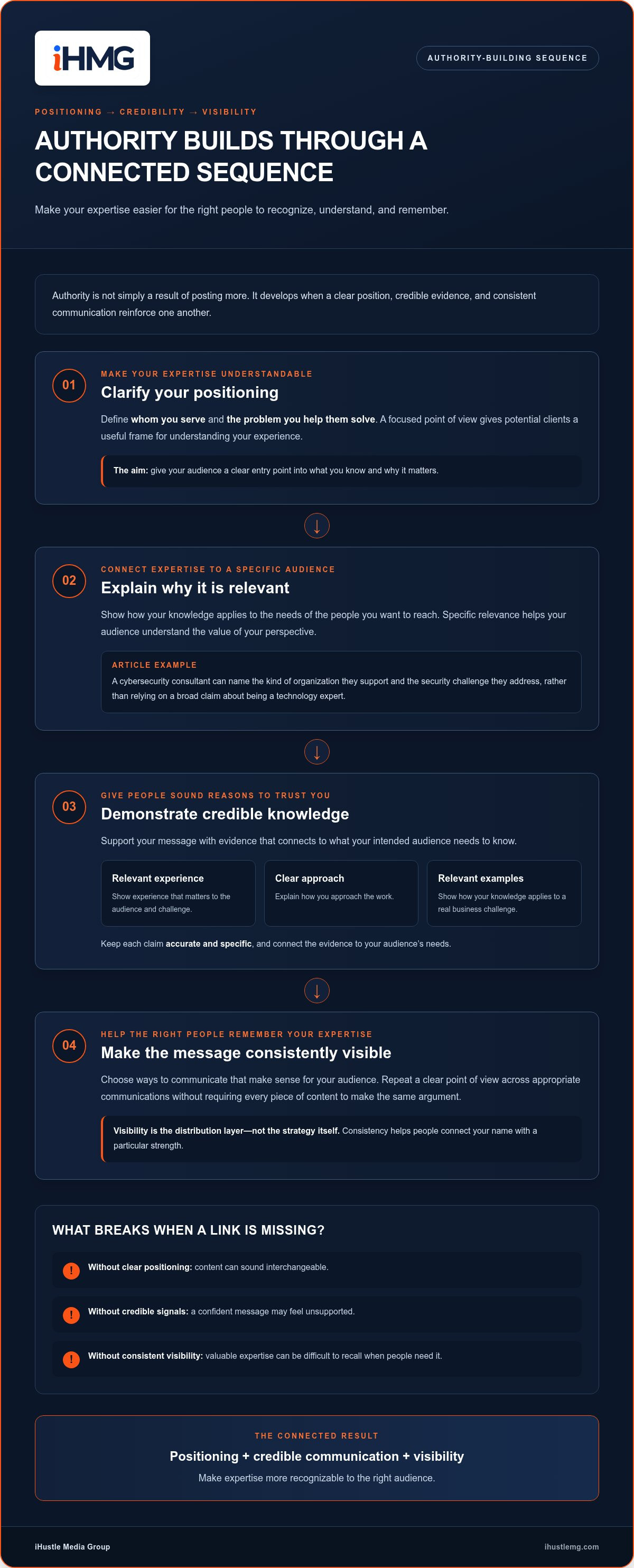
Authority doesn’t come from posting more often and hoping the right people notice. It builds through a connected sequence: clarify your expertise, explain why it matters to a specific audience, demonstrate credible knowledge, then make that message consistently visible.
Each step strengthens the next. Without clear positioning, content can sound interchangeable. Without credible signals, a confident message may feel like an unsupported claim. Without consistent visibility, even valuable expertise can be difficult for people to recall when they need it.
Consistent positioning makes your expertise easier for the right people to recognize, understand, and remember.
Positioning makes expertise easier to understand
Start by defining whom you serve and the problem you help them solve. A focused point of view gives potential clients a useful frame for understanding your experience. For example, a cybersecurity consultant can explain which kind of organization they support and what security challenge they help address, rather than relying on broad claims about being a technology expert.
This doesn’t mean narrowing your capabilities to a single sentence forever. It means giving your audience a clear entry point. For broader context on how founders shape a market-facing position, explore this founder authority strategy.
Credibility needs proof and consistent communication
Once your audience understands your relevance, give them sound reasons to trust your expertise. Useful signals can include relevant experience, a clear explanation of your approach, or examples that show how your knowledge applies to a real business challenge. Keep each claim accurate and specific, and connect the evidence to what your intended audience needs to know.
Consistency matters, too. If your public message shifts from one broad topic to another, people may struggle to connect your name with a particular strength. Repeating a clear point of view across appropriate communications helps reinforce what you do, without requiring every piece of content to make the same argument. For related execution ideas, see thought leadership automation.
Visibility is the distribution layer, not the strategy itself. Choose ways to communicate that make sense for your audience, then use them to reinforce the same core expertise. AI-enhanced frameworks can support expert positioning, but they don’t replace sound judgment or substantiate claims on their own. The Goodwill Industries International website, for example, describes career development and training in a different context, illustrating how structured learning can support skill development. Market authority still depends on demonstrating relevant expertise and communicating it clearly.
For professionals who want a structured approach to connecting these elements, iHustle Media Group’s Authority Accelerator program uses AI-enhanced frameworks to support expert positioning and strengthen market presence and credibility. The framework helps organize the work; market response still depends on the relevance and substance of your expertise.
Authority Accelerator Program vs. Content-Only Marketing: What Is the Difference?
Content can put your ideas in front of people, but publishing alone doesn’t give those ideas a clear role in the market. The difference is the organizing logic: are you producing material as a standalone activity, applying separate tactics, or aligning your communications around recognizable expertise?
An Authority Accelerator program adds strategic structure to that work. It helps clarify how you want your expertise to be understood, rather than promising fame, instant trust, or a guaranteed level of attention. Content, automation, and AI can support the process, but they can’t replace expertise, sound judgment, or accurate claims.
| Approach | Strategic focus | Consistency | Credibility signals | Intended role |
|---|---|---|---|---|
| Content-only activity | Produce individual posts, articles, or other material. | May depend on available time or new ideas. | Can be present, but may not connect clearly across content. | Share information and maintain activity. |
| Isolated tactics | Use separate visibility or marketing actions without a shared positioning focus. | Can vary from one tactic to another. | May be fragmented or difficult for an audience to interpret. | Address a specific communication need. |
| Coordinated authority strategy | Align communication around relevant expertise and a clear audience. | Reinforce a consistent professional message. | Connect accurate expertise signals to audience needs. | Make expertise easier to understand and recognize. |
Why publishing more is not the same as building authority
Imagine a consultant who publishes about leadership one week, productivity the next, and unrelated industry news after that. Each piece may be useful, yet the mix doesn’t necessarily help a prospective client understand what the consultant is especially qualified to address. More output can create more activity without making the core expertise more memorable.
Frequency has a role, but it works alongside relevance and consistency. A focused set of ideas, communicated in a way that fits the intended audience, gives people a clearer thread to follow. Visibility can contribute to familiarity, as discussed in Why Visibility Is The New Credibility, but attention alone isn’t proof of expertise.
When a program adds structure, and when it may not
Structure may be useful if your positioning changes across channels, your communication is sporadic, or your expertise lacks clear and relevant credibility signals. These are signs that the challenge may involve more than simply finding another topic to publish.
A program isn’t the answer to every marketing problem. If your positioning is already clear and your execution is consistent, you may need a narrower adjustment rather than a broad authority strategy. If you’re still diagnosing wider operational gaps, iHustle Media Group’s AI System Diagnostic evaluates your current digital infrastructure and identifies automation opportunities to optimize lead flow and operational efficiency. The Authority Accelerator uses AI-enhanced frameworks to support expert positioning and strengthen market presence and credibility. Its purpose is strategic clarity, not automatic influence.
How to Assess Your Authority Gaps Before Choosing a Program
Before adding another marketing activity, find the point where your expertise stops translating into recognition. Is the right audience seeing your work but missing what makes it relevant? Is your message hard to repeat? Or do you know what to say but struggle to communicate it consistently? Those are different gaps, and they call for different priorities.
Use this four-part check to assess your current market presence. Review your website, social profiles, introductions, and other public-facing communication as a prospective client would. For experts serving St. Louis and nearby communities, the same test applies whether your audience is local or reaches beyond the region: does your message make your value easy to understand?
Run a four-part authority self-check
- Audience: Can your ideal clients quickly tell that your expertise is relevant to their needs? Name the people you serve and the challenge they want to address.
- Positioning: Do your key communications express a recognizable point of view, or does the description of your work change from place to place? Look for a clear thread across your introduction, website, and public content.
- Proof: Can you point to relevant experience, examples, or other accurate signals that support your expertise? Use evidence that connects to the audience’s concerns, and don’t overstate what it demonstrates.
- Consistency: Do you communicate your core expertise often enough for people to recognize the connection between your ideas and your work? Consider whether you have a manageable approach for keeping the message active.
Read the pattern, not just the individual answers. If people see your name but can’t associate it with a clear specialty, recognition may be the gap. If your materials describe different strengths or audiences, focus on message clarity. If your positioning is sound but communication keeps dropping off, follow-through may be the priority.
Turn the findings into a strategic priority
Don’t try to repair every marketing activity at once. Choose the gap that most directly blocks the audience from understanding your expertise, then define a practical sign of progress. That might be using a consistent description across your public materials or hearing prospective clients accurately explain whom you serve and what problem you address.
Quick checklist: If your audience can’t identify whom you help, fix positioning. If they can’t see why your expertise matters, strengthen relevant proof. If they understand both but rarely encounter a consistent message, address follow-through.
These indicators help you assess strategic movement, not guarantee new business, media attention, or a specific market response. A structured Authority Accelerator program may fit if your assessment points to connected positioning and communication gaps. If one narrow issue stands out, a focused adjustment may be enough. For professionals who want to build a more deliberate approach to expert positioning, explore iHustle Media Group’s Authority Accelerator.
How iHustle Media Group’s Authority Accelerator Supports Expert Positioning
A strong service doesn’t explain itself. Founders, consultants, and service professionals still need to make their expertise clear to the people they want to reach. iHustle Media Group’s Authority Accelerator is a strategic authority-building program designed to elevate a professional’s market presence and credibility using AI-enhanced frameworks.
The focus is expert positioning: helping shape how a professional’s knowledge and relevance are understood in the market. For a business owner serving St. Louis or nearby communities, that means making it easier for a prospective client to grasp what the business is known for and why that expertise matters. The program provides a structured approach to this work.
What the program is designed to address
Your self-assessment can help you decide where structure may be useful. If your audience is unclear about what you do, your positioning may need focus. If your message is clear but doesn’t communicate why your expertise is relevant, the challenge may be how you present your professional credibility. If both are in place but your communication is inconsistent, follow-through may be the weak point.
The Authority Accelerator program supports professionals working through connected positioning and presence challenges. Its AI-enhanced frameworks support the strategy; they don’t replace your professional judgment, create expertise on your behalf, or make the market respond automatically. Your knowledge and accurate representation of it remain central.
This distinction matters. AI can be part of a framework for organizing authority-building work, but a framework is not a substitute for choosing a meaningful audience, expressing a clear perspective, and communicating claims responsibly. The program supports expert positioning and strengthens market presence and credibility through AI-enhanced frameworks.
Decide whether the Authority Accelerator fits your next move
A structured program may be worth exploring if you’ve identified more than one related gap, such as unclear positioning combined with inconsistent communication or credibility signals that don’t connect to your audience’s needs. It may also suit you if your expertise is solid but difficult to communicate consistently across your market presence.
By contrast, if you already have a focused message and a reliable way to communicate it, your next step may be narrower. Use your assessment to identify the main obstacle, then compare that need with the program’s purpose: supporting expert positioning and elevating market presence and credibility through AI-enhanced frameworks. That keeps the decision grounded in your goals rather than the appeal of a new tactic.
If a structured approach aligns with the gap you’ve identified, Explore the Authority Accelerator.
Turn Your Expertise Into a Clear Next Move
Your next step doesn’t have to be another burst of content or a complete marketing overhaul. Start by choosing the one perception you want to change: what should the right people understand about your expertise that they may be missing now?
That answer gives your authority-building efforts direction. It can guide how you explain your work, which proof you bring forward, and where you focus your communication. The Authority Accelerator program uses AI-enhanced frameworks to support expert positioning and is designed to elevate professional market presence and credibility. The value is in applying structure to your goals, not expecting technology to create trust on its own.
If a more deliberate approach fits the gap you’ve identified, take a closer look at the program and consider how it aligns with the way you want to be known. Explore the Authority Accelerator and take your next step with focus.
Frequently Asked Questions
What is an Authority Accelerator program?
An Authority Accelerator program is a structured approach to helping professionals make their expertise more recognizable and credible in the market. For example, a founder might use one to sharpen how they describe their specialty before updating a website or planning public communications. iHustle Media Group’s Authority Accelerator supports expert positioning with AI-enhanced frameworks.
How does an Authority Accelerator program build market credibility?
It supports credibility by helping a professional communicate expertise in a way that feels relevant and consistent to the intended audience. A consultant, for instance, can make their experience more meaningful by explaining how it relates to a client’s specific challenge, rather than relying on broad claims. Credibility still depends on the accuracy of what the professional says and the substance behind it. A program can provide structure, but trust and business results depend on more than a framework.
Is an Authority Accelerator program the same as a content marketing course?
Not necessarily. A content marketing course generally focuses on learning content skills or methods, while an authority-building program focuses on how a professional is positioned and understood in the market. The two ideas can overlap, since communication may help express expertise, but more content isn’t automatically the goal. Before choosing an approach, identify whether you need to improve production skills or clarify the connection between your expertise, audience, and professional reputation.
Can an Authority Accelerator program help a consultant stand out in a niche?
It can support clearer niche positioning by helping a consultant explain whom they serve, which challenge they address, and what perspective informs their work. A consultant serving independent medical practices, for example, might distinguish their expertise by focusing on a particular operational challenge rather than describing themselves only as a general business consultant. The goal is a sharper, more relevant professional message, not a claim that no competitors share similar expertise.
How do I know if I need an authority-building program?
Consider one if prospective clients have trouble describing your specialty, your public message shifts between platforms, or your expertise is difficult to support with relevant examples. Ask a trusted colleague to review your introduction and explain what they think you’re known for. If their answer differs from your intended positioning, you’ve identified a useful clarity gap. If your message is already clear and consistently communicated, a broad program may not be necessary.
Does using AI automatically make a business an authority?
No. AI is a tool, not evidence of expertise or a substitute for professional judgment. It can support frameworks for organizing positioning, but it can also produce generic or inaccurate material if its output isn’t reviewed carefully. A business still needs relevant knowledge, a clear point of view, and truthful communication. Treat AI-assisted work as a starting point: check that every statement reflects your actual experience and speaks to the audience you intend to reach.
Can local experts in St. Louis benefit from authority positioning?
Yes. Local experts can use clear positioning to help prospective clients understand what they specialize in and when that expertise is relevant. A St. Louis consultant, for example, can explain the kind of organization they serve and the challenge they address, making their value easier to recognize in a local market. This can matter for professionals serving St. Louis, St. Charles, St. Peters, Florissant, Hazelwood, Ferguson, and Chesterfield, as well as clients beyond those communities.