


Automated Client Acquisition System: Build a Repeatable Growth Engine
What if the problem isn’t a lack of leads, but the gaps between when prospects notice you, reach out, and get a response? An automated client acquisition system should connect those handoffs, not turn every interaction into a script.
If social engagement, inquiries, and follow-up live in separate workflows, promising prospects can slip through the cracks. Manual outreach takes time, and without visibility into where people stall, it’s hard to know what to fix.
This article explains how to connect visibility, lead capture, follow-up, and qualification into a measurable process. You’ll learn what a complete acquisition system includes, how to spot bottlenecks, and which metrics to check before choosing tools. For businesses in St. Louis, St. Charles, St. Peters, Florissant, Hazelwood, Ferguson, and Chesterfield, the same principle applies: choose automation that fits your offer and team, and keep human judgment at the center of the sales conversation.
Key Takeaways
- Map visibility, lead capture, follow-up, qualification, and human-led conversion to see how prospects move toward a sales conversation.
- An automated client acquisition system should make handoffs more consistent, not automate every interaction or confuse activity with qualified demand.
- Audit your current process before scaling: track inquiry sources, response time, qualified conversations, next steps, and where prospects drop off.
- Choose changes based on offer clarity, the buyer journey, your tools, team capacity, and the level of human oversight you need.
- When evaluating support, consider whether you need to connect social engagement to conversations, identify automation gaps, or strengthen market credibility.
What Is an Automated Client Acquisition System, and What Should It Connect?
Getting attention is not the same as creating qualified sales conversations. A post can earn engagement, a website can attract visitors, and a contact form can collect inquiries. Prospects may still fall through the cracks if no clear process connects those moments.
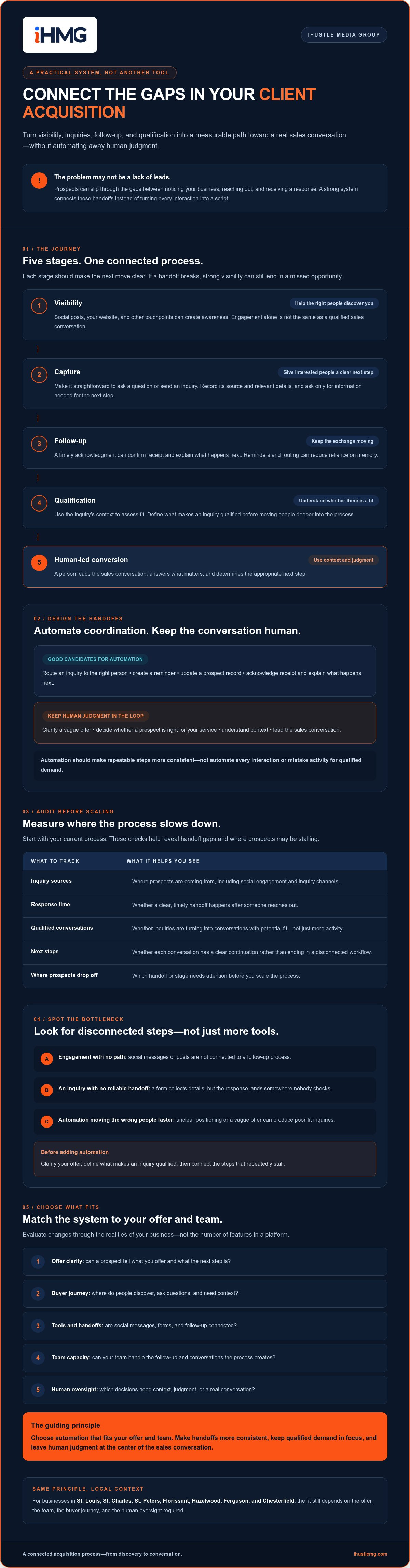
An automated client acquisition system links five stages: visibility, capture, follow-up, qualification, and human-led conversion. Visibility helps the right people discover your business. Capture gives interested prospects a clear next step and records their inquiry. Follow-up keeps the exchange moving, while qualification helps determine whether there’s a fit. A person then uses context and judgment to lead the sales conversation.
That’s infrastructure, not a single platform, campaign, or sequence of automated messages. Marketing automation can handle repeatable marketing tasks, but an effective system also needs a clear offer, reliable handoffs, and a way to see what happens next. For a broader view of how these parts support sustainable growth, explore building a modern lead generation system.
How Is a System Different from a Lead Generation Tool?
A tool performs a task. A system connects tasks into a workflow you can follow and measure. For example, a form can collect an inquiry, but if the response lands in an inbox nobody checks, the form hasn’t created a reliable handoff.
The same problem can arise when social messages, contact forms, and follow-up are managed separately. Automation can make repeatable steps more consistent, but it can’t clarify a vague offer or decide whether a prospect is right for your service. Keep those decisions grounded in human judgment.
Which Businesses Benefit Most from Acquisition Automation?
Automation can help service providers whose buyers need trust, context, or a conversation before deciding. The right setup depends on whether your offer is clear, inquiries arrive often enough to justify a structured process, and your team can handle the follow-up and sales conversations it creates.
If inquiries are mostly a poor fit, or prospects can’t tell what you offer, automation may simply move the wrong people through the process faster. First, clarify your positioning and define what makes an inquiry qualified. Then connect the steps that repeatedly stall. Businesses in the St. Louis area can also assess gaps in their digital infrastructure before adding more automation.
How an Automated Client Acquisition System Moves Prospects from Attention to Conversation
A prospect’s path rarely follows a straight line. Someone might discover a service through a social post, return later through a website, then send a question after seeing a clear next step. An automated client acquisition system should preserve that context and make the next move clear, rather than push every prospect through the same script.
Think of the journey as a sequence of handoffs: discovery leads to an invitation to act; an inquiry is captured with its source and relevant details; a timely response acknowledges what the person asked; qualification establishes whether there’s a potential fit; and a human-led conversation determines the next step. If one handoff breaks, even strong visibility can end in a missed opportunity.
Where Should Automation Enter the Prospect Journey?
Automate repeatable coordination, not every interaction. A workflow can route an inquiry to the right person, create a reminder, update a prospect’s record, or send a first response that confirms receipt and explains what happens next. These steps reduce reliance on memory while leaving room for a real conversation.
Put clear calls to action where people are already engaging. A social post might invite a prospect to ask a question or share a relevant need; a website page might offer a straightforward way to inquire. At each touchpoint, explain what information you’re asking for and how you’ll use it to follow up. Ask only for details relevant to the next step.
Social media can be one entry point, but it isn’t an acquisition strategy by itself. A post or direct message needs a path into a follow-up process where the inquiry can be understood and acted on. For more channel-specific ideas, see this guide to social media lead automation.
What Should Happen After a Prospect Responds?
Record enough context to make the next interaction useful: where the inquiry came from, what the prospect said they need, and what next step they agreed to. A team member can review those details before replying, rather than sending a generic message that ignores the person’s question.
Follow-up should reflect the prospect’s action and expectations. If they ask for a response by email, use that channel. If they request time to review information, respect that before checking in. A reminder can help your team follow through; messages sent only to increase volume can undermine trust.
For businesses looking to connect social visibility with lead conversations and follow-up, Social Lead Web is one option to explore.
Automation vs. Manual Follow-Up: How to Scale Without Sounding Like Spam
More automation doesn’t automatically mean more qualified clients. It can make a process more consistent, but it can also send irrelevant messages faster if targeting, offer details, or prospect information are weak. The goal is to reduce preventable delays while keeping communication useful and human.
Compare workflows by consistency, visibility, effort, and personalization. The trade-offs depend on your inquiry volume, team capacity, and how much context each prospect needs.
| Workflow | Potential advantage, depending on context | Potential limitation, depending on context |
|---|---|---|
| Manual | Can support personal, context-rich replies when inquiry volume is manageable. | May require substantial staff time and make follow-through harder to track as inquiries grow. |
| Fragmented | Separate tools may suit a simple process with clear ownership and reliable manual handoffs. | May obscure inquiry status or leave gaps between forms, messages, and follow-up. |
| Connected | Can improve workflow consistency and visibility when repeatable steps are well defined. | Can scale irrelevant outreach or preserve bad data if the process and records aren’t maintained. |
Which Acquisition Tasks Are Best to Automate?
Start with predictable coordination: routing an inquiry, recording its source, creating a follow-up reminder, or prompting a team member to take the next step. These tasks are repeatable and easier to standardize than nuanced sales conversations.
Automated messages need accurate context, a relevant reason for reaching out, and an easy way for the recipient to respond. A confirmation that acknowledges an inquiry is different from a generic sequence sent regardless of what the prospect asked. Message volume doesn’t prove stronger relationships or better-fit leads. Measure whether the process supports meaningful conversations.
How Can Automation Protect Trust and Personalization?
Set a human review point before sending communication about sensitive details, complex objections, or needs that call for judgment. A team member should be able to check the prospect’s message and interaction history, then decide what response fits.
Make the sender clear. Keep wording relevant, follow-up frequency respectful, and the response path simple. Track negative replies and opt-outs alongside positive responses. If they increase, review targeting, message relevance, and contact frequency instead of automating more aggressively.
A well-designed automated client acquisition system handles dependable handoffs and leaves relationship-building to people. Automate the repetition, and keep the judgment.
How to Audit and Measure Your Client Acquisition System Before Scaling
Adding automation before you understand the current process can make a weak handoff harder to see. Audit the journey first, then use evidence from your own business to decide what to improve. An automated client acquisition system should make progress and friction visible, not just produce more activity.
- Map the stages. Write down how prospects discover you, inquire, receive a response, get qualified, and move to a sales conversation or another next step.
- Inspect each handoff. Check where information gets lost, responsibility is unclear, or a prospect waits without a defined next action.
- Set a baseline. Choose a representative time period and record what happens at each stage before changing the process.
- Pick one bottleneck. Prioritize the point causing the clearest delay, lost context, or repeated manual work.
- Test a focused change. Adjust one process where practical, then compare the same measures against your baseline.
Which Metrics Reveal Acquisition Bottlenecks?
Use measures tied directly to the prospect journey. Track inquiry source to see where interest began; response time to understand how quickly your team follows up; qualified conversations to gauge how many inquiries appear to fit your offer; and agreed next steps to see whether conversations keep moving. Stage-level drop-off shows where prospects stop progressing.
Separate leading indicators, such as response time and completed follow-up tasks, from outcomes, such as qualified conversations and sales. Faster responses may improve process consistency, but they don’t prove automation caused revenue growth. Compare results with your own baseline, using the same definitions and time period. A high inquiry count alone says little about lead fit or conversion effectiveness.
How Should You Prioritize Improvements?
Start where the evidence points. If inquiries wait for a response, clarify ownership or improve the follow-up process. If conversations happen but prospects don’t understand the offer, revisit positioning. If people need more confidence before engaging, strengthening professional authority may be more relevant.
Resist changing several stages at once. A focused test makes it easier to see whether a change addressed the bottleneck or simply shifted it elsewhere. Keep recording the same measures and note relevant context, such as changes to the offer or sales process.
If you want help examining your existing infrastructure and identifying automation opportunities, explore the AI System Diagnostic. To assess your current gaps, request an AI system diagnostic.
Choosing an Automated Client Acquisition System That Fits Your Growth Stage
The right setup isn’t necessarily the one with the most features. It’s the one that addresses a real bottleneck without adding steps your team can’t maintain. Before choosing an automated client acquisition system, assess five factors:
- Offer clarity: Can a prospective client quickly understand who you help and what you offer?
- Buyer journey: What does someone need to learn or discuss before deciding?
- Current tools: Where do inquiries and follow-up information live now?
- Team capacity: Who will review inquiries and handle sales conversations?
- Human oversight: Which steps can be standardized, and which need personal judgment?
If your process is clear but a handoff keeps slipping, improving the existing workflow may be the best first move. If you can’t tell where leads stall, a diagnostic may help uncover gaps before you add automation. If prospects need more confidence in your expertise, authority-building support may better address the underlying challenge. More technology won’t fix an unclear offer or a sales process no one owns.
When Does Social Lead Web Fit an Acquisition Strategy?
Social Lead Web is designed to connect social media visibility with qualified conversations and automated follow-up. It may be relevant when engagement is happening but the path from social interest to a meaningful inquiry needs to be clearer.
It isn’t paid ad management or a universal replacement for sales conversations. Before deciding whether it fits, confirm which channels are supported, what setup requires, and how the process aligns with your team’s follow-up capacity. Don’t assume capabilities that haven’t been confirmed.
When Should You Start with Diagnosis or Authority Building?
AI System Diagnostic evaluates existing digital infrastructure and identifies automation opportunities. Consider it when your tools and handoffs feel unclear, or when you want to identify gaps before deciding what to change.
Authority Accelerator uses AI-enhanced frameworks to strengthen professional market presence and credibility. It may be relevant when the acquisition challenge isn’t only follow-up, but also how clearly your expertise and value come across. For related positioning guidance, read about founder authority strategy.
Start with the challenge, not the tool. If you’re weighing whether to refine a workflow, examine your infrastructure, or strengthen your market presence, consider which option fits your goals and team capacity. iHustle Media Group offers Social Lead Web, AI System Diagnostic, and Authority Accelerator for businesses in St. Louis, St. Charles, St. Peters, Florissant, Hazelwood, Ferguson, and Chesterfield.
Build a Growth Engine You Can Improve
A stronger acquisition process doesn’t come from adding automation everywhere. It comes from connecting the right stages, making handoffs visible, and protecting the human judgment that turns an inquiry into a useful sales conversation.
Start with your current journey. Find where prospects lose momentum, establish a baseline, and improve the clearest bottleneck before scaling. A well-matched automated client acquisition system should fit your offer, your team’s capacity, and the way buyers make decisions.
For businesses looking to connect social visibility with qualified conversations and automated follow-up, Social Lead Web may be worth exploring. If you first need to understand your existing infrastructure and identify automation opportunities, AI System Diagnostic offers a way to examine those gaps.
Every business has a different path from attention to trust to action. Request a conversation about your client acquisition system to discuss which approach may fit your needs. Take the next step with clarity, and build a process your team can strengthen over time.
Frequently Asked Questions
What is an automated client acquisition system?
An automated client acquisition system connects the steps that move a potential client from discovering a business to having a qualified sales conversation. It typically links visibility, inquiry capture, follow-up, qualification, and human-led conversion. Automation can support repeatable tasks, such as routing an inquiry or prompting a follow-up, while people handle decisions that need context. The aim is a trackable process, not a pile of tools or automated messages.
How does an automated client acquisition system work?
It guides and tracks a prospect’s journey from first contact to an agreed next step. For example, someone responds to a business’s social content, submits an inquiry, receives an appropriate acknowledgment, and is routed for review. A team member checks the stated need, decides whether there’s a fit, and continues the conversation. The system records key handoffs so the business can see where prospects progress or stall.
Can client acquisition be automated without sounding impersonal?
Yes. Automate coordination, not the parts of communication that need human judgment. A useful first response can acknowledge what someone asked and explain what happens next, while a team member handles nuanced needs, objections, or sensitive information. Use accurate context, a clear sender identity, and respectful follow-up frequency. Make it easy to reply or opt out where appropriate, and review negative responses as a reason to improve the process.
What should I automate first in client acquisition?
Start with repetitive tasks that create delays or get missed, such as recording inquiry sources, routing new inquiries, setting follow-up reminders, or updating prospect records. Before automating a message, make sure its purpose and context are clear and that the recipient has an easy way to respond. If your offer or target customer is unclear, address that first. Automation can make a sound process more consistent, but it won’t fix weak positioning.
How do you measure whether an acquisition system is working?
Track measures tied to each stage: where inquiries originate, how long responses take, how many inquiries become qualified conversations, whether next steps are agreed, and where prospects drop off. Compare results with your own baseline over a consistent period. These measures can reveal delays and process changes, but they don’t prove automation alone caused revenue growth. A high inquiry count is not enough to establish lead quality or sales effectiveness.
Is an automated client acquisition system the same as lead generation software?
No. Lead generation software may support a specific task, such as capturing inquiry details, while an acquisition system connects that task to visibility, follow-up, qualification, and a sales conversation. Several tools can contribute, but the system is the workflow and handoffs between them. A simple process may need only a few well-managed steps; the priority is clear ownership and visibility, not adding software for its own sake.
Does iHustle Media Group provide paid ad management or custom software?
No. iHustle Media Group doesn’t provide paid ad management or custom software development. Its offerings include Social Lead Web, which connects social visibility with qualified conversations and automated follow-up; AI System Diagnostic, which evaluates existing digital infrastructure for automation opportunities; and Authority Accelerator, which supports professional market presence and credibility. The company serves businesses in St. Louis, St. Charles, St. Peters, Florissant, Hazelwood, Ferguson, and Chesterfield.
For help choosing a practical next step, contact iHustle Media Group to discuss your client acquisition goals.