


Automated DM Sales Script: Templates That Turn Conversations into Leads
What if the DM that wins a lead doesn’t sound like a sales script at all? The best automated dm sales script isn’t a canned pitch sent to every new follower. It’s a flexible conversation path that responds to why someone engaged, asks a useful qualifying question, and makes the next step clear.
If replies arrive late or your copy feels generic, prospects can lose interest before a real conversation starts. Automation shouldn’t replace human connection with robotic messages. It should help you respond consistently, offer relevant context, and move interested people forward without depending on manual follow-up. The goal isn’t more messages. It’s a clearer path from attention to intent.
In this guide, you’ll learn how to structure a natural DM sequence, tailor opening messages to the trigger, qualify interest before inviting a sales conversation, and follow up without damaging trust. You’ll also find templates for turning comments and story replies into clearer lead conversations, plus a look at how a connected system like Social Lead Web can link engagement, conversation, and follow-up.
Key Takeaways
- Shape your automated dm sales script around the prospect’s context, not a one-size-fits-all pitch.
- Use a clear sequence from engagement trigger to relevant question, qualification, and next step.
- Adapt your message to whether someone replied to a story, asked a question, or is continuing an earlier conversation.
- Handle objections and silence with context-aware responses that keep the conversation natural.
- Document triggers, message paths, and human handoff points to make follow-up more repeatable.
What makes an automated DM sales script useful instead of pushy?
An automated DM sales script is a flexible framework for replying to a person’s specific action, asking a relevant question, and guiding the conversation toward a suitable next step. It uses decision points rather than sending the same pitch to everyone. Automation can support a genuine conversation, but it can’t create relevance by itself.
Trust depends on whether your reply reflects what the person actually did. A message that acknowledges their question or the topic they engaged with feels more useful than a copy-and-paste offer that ignores their reason for reaching out. Direct marketing provides the broader context: a message is directed to an audience member, so its relevance and purpose deserve careful attention. In a DM, the exchange is immediate and personal, making context especially important.
What a sales script should accomplish in a direct message
Give each message one job: acknowledge the person, understand what they need, qualify their interest, or invite an appropriate next step. Trying to do all four at once turns an opening reply into a mini sales page. Keep the first interaction focused on the prospect, not a full explanation of your services.
Choose a question that is easy to answer and connected to the trigger. For example, after someone responds to a post about improving lead follow-up, you might ask, “Are you looking to improve response time, or make follow-up more consistent?” Their answer helps you decide whether to share a relevant resource, ask a clarifying question, or offer a sales conversation. One well-chosen question moves the exchange forward without making it feel like an interrogation.
Why canned pitches lose the prospect’s attention
Compare “Thanks for engaging! Book a call to grow your business” with “You mentioned that follow-up gets missed. Is the bigger challenge capturing inquiries or deciding who to contact next?” The first could be sent to anyone; the second reflects a stated concern and invites a focused reply. Specificity gives the prospect a reason to respond.
Keep friction low. A first reply loaded with links, sweeping claims, and several questions asks the prospect to do too much before they’ve received anything useful. Start with the detail that matters, then let their response determine what comes next. If they don’t answer, don’t treat silence as permission to send a string of increasingly urgent pitches.
Automation should support a conversation, not impersonate personal attention. A framework can select a response based on someone’s action or answer, while a person handles nuance, uncertainty, or a request that falls outside the prepared path. That boundary protects the experience and the business. The aim isn’t to make every message look hand-typed; it’s to make each reply appropriate, clear, and honest about what happens next.
Before writing copy, map the decision behind it: what did the person do, what do you need to learn, and which next step fits their response? That logic separates a useful script from a message blast dressed up as a conversation.
Build an automated DM sales script: opener to next step
A useful script is a sequence of decisions, not a block of copy sent regardless of the reply. Build the path around what prompted the message, then let the person’s answer determine whether automation continues or a human takes over.
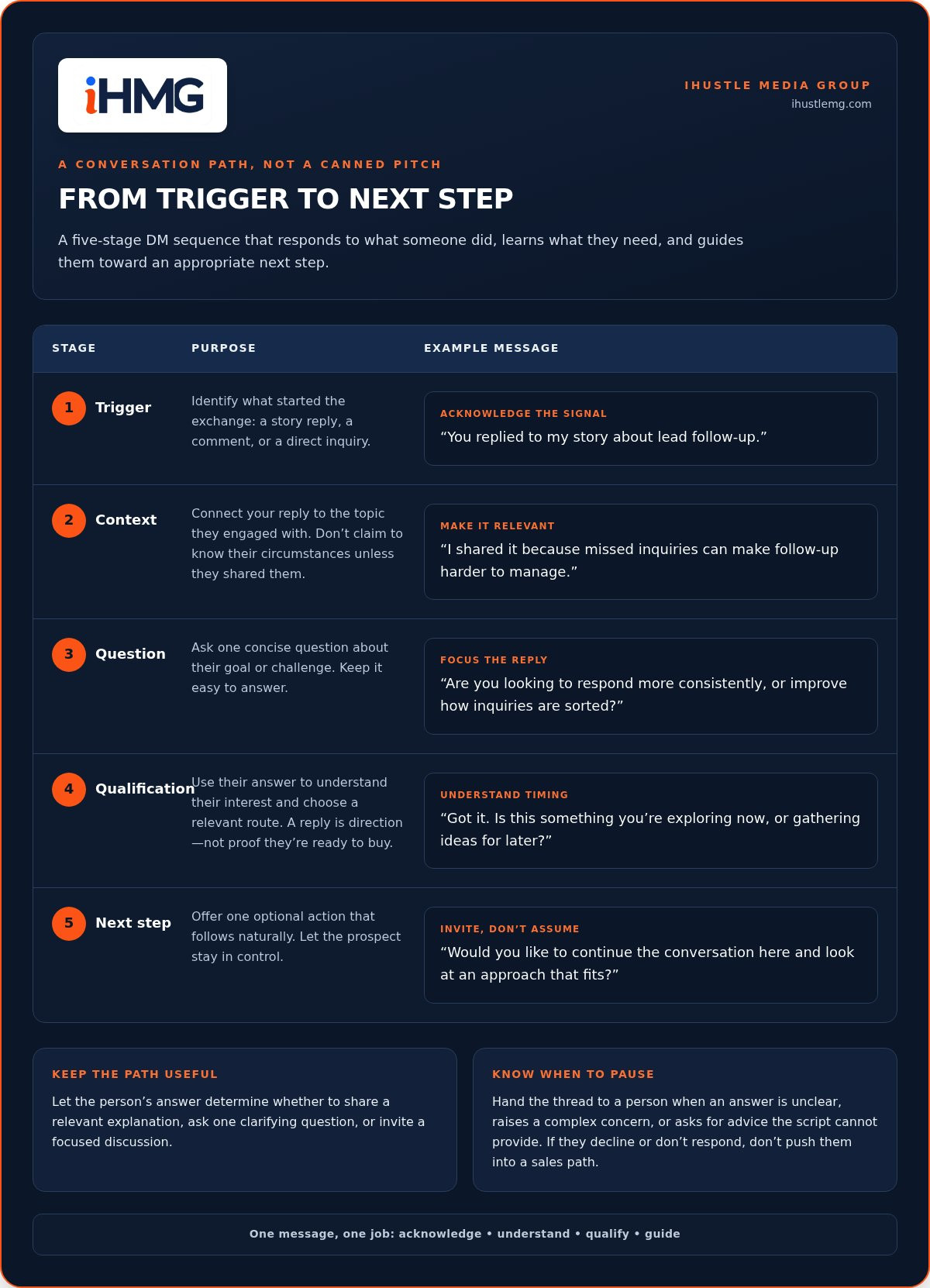
A five-stage DM sequence moves from trigger to context, question, qualification, and a next step that fits the prospect’s response. Give each stage a clear purpose. Keep the wording brief enough to feel conversational, and make the route forward clear without assuming the person is ready to buy.
Write an opener that reflects the prospect’s action
Start with a real signal: a story reply, a comment, or a direct inquiry. Acknowledge that action before introducing a business purpose. Don’t imply you know the person’s goals, history, or circumstances unless they’ve shared that information.
- Trigger: Identify what started the exchange. Sample: “You replied to my story about lead follow-up.”
- Context: Connect your reply to that action. Sample: “I shared it because missed inquiries can make follow-up harder to manage.” Keep this relevant to the topic they engaged with, not a claim about their business.
- Question: Ask one concise question about their goal or challenge. Sample: “Are you looking to respond more consistently, or improve how inquiries are sorted?” A focused question is easier to answer than a list of discovery prompts.
- Qualification: Use the answer to understand the person’s interest and choose a relevant route. Sample: “Got it. Is this something you’re exploring now, or gathering ideas for later?” Treat the reply as direction, not proof they’re ready to buy.
- Next step: Offer one optional action that follows naturally. Sample: “Would you like to continue the conversation here and look at an approach that fits?” If they decline or don’t respond, don’t push them into a sales path.
Qualify interest before inviting a conversation
Qualification isn’t a quiz. It helps you understand whether the person wants information, is considering a change, or has a specific question. Use their answer to route them to a useful explanation, ask one clarifying question, or invite a more focused discussion. Make the invitation specific and optional so the prospect stays in control.
Pause automation when an answer is unclear, raises a complex concern, or asks for advice that depends on details the script doesn’t have. Hand the thread to a person rather than forcing a prepared response. The handoff should be clear internally, and the human reply should pick up from what the prospect actually said.
A connected process matters as much as polished copy. Social Lead Web bridges social media engagement to qualified conversations and automated follow-up, connecting these stages in a lead process. Explore how this social engagement-to-conversation system fits your approach.
Which DM script fits each prospect and conversation stage?
One script won’t fit every person who enters your inbox. The source of engagement tells you what they already know and what your next message should do. A story response may need context; a direct question deserves an answer; someone returning to an earlier discussion may be ready to pick up where you left off.
Use this comparison to match the opening move to the conversation, then adjust the next step to the prospect’s reply.
| Context | Message goal | Sample prompt | Next step |
|---|---|---|---|
| Story response | Continue the topic they engaged with | “Thanks for replying to my story about follow-up. What part stood out to you?” | Share a relevant insight or ask one clarifying question |
| Inbound question | Answer directly, then understand their need | “Yes, a follow-up system can help organize inquiries. What are you hoping to improve?” | Respond to their goal or offer a focused discussion |
| Previous conversation | Reconnect without assuming progress | “We talked about making social inquiries easier to manage. Is that still something you’re exploring?” | Continue from their update or let the conversation rest |
Adapt the message to the source of engagement
For a story reply, refer briefly to the specific topic, not a personal detail you don’t know. If someone asks a direct question, answer it before adding a follow-up; making them pass a qualification test to get basic information creates needless friction. A comment can move to a private conversation when the public exchange gives a clear reason, such as a request for more detail. Don’t turn every comment into an unsolicited pitch.
The right automated dm sales script accounts for both the entry point and what the person has said since. Use the trigger to open the door, then let their response guide the route. This is also the logic behind a broader social engagement to revenue process: engagement becomes valuable when it connects to a relevant conversation and follow-up.
Choose a next step that matches buying readiness
When someone is still exploring, keep the next move light: answer a question, share a useful explanation, or ask what they’re trying to solve. When they’ve explained a clear goal and shown interest in addressing it, a direct invitation to discuss fit can be appropriate. For example: “Would a focused conversation about your inquiry flow be useful?” That’s clearer than a vague “Let’s connect,” and it leaves the choice with them.
Don’t route every reply to the same calendar link. A curious prospect may need context, while someone with a defined challenge may welcome a business conversation. If the answer is ambiguous, ask one short follow-up instead of guessing. The next step should feel like a natural continuation, not a destination chosen before the prospect spoke.
How to handle objections, silence, and follow-up without sounding robotic
Automation feels impersonal when it ignores what someone said. A well-built automated dm sales script treats hesitation as information, not resistance to defeat. Respond to the concern, understand what would be useful, and leave the prospect free to continue or stop.
Respond to hesitation without arguing
Use a simple sequence: acknowledge the concern, clarify what’s behind it, then offer a relevant option. If someone says, “I’m not ready to discuss this,” don’t answer with a stronger pitch. Try: “That makes sense. Is there a particular detail that would help, or would you rather pause here?”
The first response respects their position. The question gives them a choice, not another obstacle to get past. If they ask for information, answer that specific question. If they decline or don’t want to continue, stop the sales sequence rather than treating their response as an invitation to persuade them.
Use silence and performance data as useful signals
Silence doesn’t tell you exactly why someone didn’t reply. The timing may have been off, the message may not have been relevant, or they may simply not want to continue. If a follow-up is appropriate, add useful context instead of repeating “Just checking in.” For example: “I thought this short explanation of inquiry follow-up might clarify the point we discussed. No need to reply if it’s not a priority.” Avoid repeated nudges that offer nothing new.
Review the quality of the conversation alongside its outcomes. Message volume alone can make a weak script look busy. Track these measures separately:
- Reply rate: How often people respond to the opening or follow-up message. This can indicate whether the prompt invites a reply, but it doesn’t show that the conversation is qualified.
- Qualified conversations: How often replies reveal a relevant need, goal, or challenge. This helps assess whether the script attracts useful exchanges rather than casual responses alone.
- Next-step acceptance: How often qualified prospects accept a relevant next step, such as continuing the discussion. This indicates whether the invitation fits the conversation.
Read these measures together. A high reply rate with few qualified conversations may point to an opener that gets attention but lacks the right context. Qualified replies with low next-step acceptance may suggest the invitation arrives too early or feels too broad. Change one element at a time, such as the opener or follow-up wording, so you can see what influenced the pattern.
For a wider view of how conversations connect with follow-up, use this guide to social media lead automation. If you’re ready to connect social engagement with qualified conversations and automated follow-up, explore Social Lead Web.
Turn your automated DM sales script into a repeatable lead system
A script is only one component of lead generation. It can start a relevant exchange, but a repeatable system also needs to capture the inquiry, track what happens next, and make follow-up consistent. Without that wider process, even thoughtful messages can lead to dropped conversations.
Document how each path should work so the experience doesn’t depend on someone remembering what to do next. For every trigger, record the audience, message purpose, approved response options, qualification signals, and the point where a person should take over. Keep the guidance practical: a team member should be able to see which path applies and what action follows.
Create a simple script review and handoff routine
Review actual conversation outcomes regularly. Look for replies that show confusion, answers that don’t fit the prepared options, and messages that sound generic when read in context. Revise the wording or decision path based on what the conversations reveal, then observe the results before making another change.
- Record the purpose: State what the message is meant to do and who it’s for.
- Define the handoff: Note when a human should respond, such as when a question needs a tailored answer or the person is ready for a detailed discussion.
- Review the path: Check whether real replies lead to a useful answer or an appropriate next step.
- Check platform policies: Before deploying platform-specific automation, review current rules and use an approach that follows them.
A service business in St. Louis, for example, might receive a DM asking about a service after someone responds to a post. The script can acknowledge the inquiry and ask what the person needs help with; a team member can then take over if the answer requires details the automated path doesn’t cover. Businesses serving St. Louis, St. Charles, St. Peters, Florissant, Hazelwood, Ferguson, and Chesterfield can use the same principle: start a relevant exchange, then handle the qualified inquiry appropriately.
Connect individual messages to a larger lead flow
Map what happens after each reply: does the person need an answer, a clarifying question, a human follow-up, or a relevant invitation? Give each inquiry a clear place in your lead process, so conversations don’t remain isolated in message threads. Script quality measures how well the words fit the interaction; process quality measures whether the business captures and follows through on the opportunity.
Social Lead Web is iHustle Media Group’s system for bridging social engagement to qualified conversations and automated follow-up. It connects the message to a broader flow rather than treating copy as the whole strategy. For a wider framework, explore this guide to automating social media lead generation.
If you’re ready to connect social engagement with a more structured conversation flow, explore Social Lead Web.
Build a DM process that grows with your business
Your next step isn’t to add more messages. It’s to make each conversation part of a process your team can learn from, refine, and sustain. Use your automated dm sales script as a starting framework, then improve it as real prospect needs reveal where the conversation flows smoothly and where it stalls.
That shift turns social engagement into more than a moment of attention. iHustle Media Group focuses on AI-driven lead systems and authority building, and Social Lead Web bridges social engagement with qualified business conversations. The opportunity is to connect the messages prospects receive with a broader, intentional lead flow.
Explore Social Lead Web and connect engagement to qualified conversations. Start with a clear system, keep human judgment where it matters, and build a stronger path from interest to action.
Frequently Asked Questions
Can automated Instagram DMs get an account flagged?
Yes, risky automation can put an Instagram account at risk, especially if it sends unsolicited bulk messages or uses tools that scrape the platform or require your password. Use automation through Meta’s official API and build around user-initiated interactions. Meta’s messaging rules also limit when and how businesses can send automated replies, so review current requirements before launching or changing a DM flow.
How many follow-up DMs should I send if someone does not reply?
There’s no universal follow-up count, but a practical starting point is one courteous follow-up that adds context, then stop if there’s no response. For example, share a relevant detail they may find useful rather than sending “Just checking in” again. Don’t treat silence as interest or keep restarting the sequence. If the person replies later, resume based on what they actually say.
What is the difference between an automated DM and a chatbot?
An automated DM is a message sent or delivered through a rule or trigger, such as a response to an inquiry. A chatbot is an interactive system that can handle a sequence of replies and route people based on their answers. The terms can overlap: a chatbot may send automated DMs, while a simple automated message may not offer a continuing conversation. Choose the level of interaction your process can support well.
Should I tell people when they are receiving an automated DM?
Be transparent when a person could reasonably mistake an automated exchange for an individual’s live response. A brief introduction such as “I’m the virtual assistant for our team” sets expectations without making the message cumbersome. Make it easy to request a person, especially if the question needs judgment or a tailored answer. Clear expectations protect trust better than trying to make automation appear human.
Does an automated DM sales script work for B2B services?
Yes, an automated dm sales script can support B2B conversations when it starts from a relevant business action and avoids pushing a generic pitch. A firm serving businesses in St. Louis, St. Charles, St. Peters, Florissant, Hazelwood, Ferguson, or Chesterfield could use a prospect’s question about inquiry follow-up to begin a focused exchange. Keep qualification tied to the prospect’s business goal, and route complex needs to a person.
What should I measure to know whether my DM script is working?
Track performance by the audience and trigger that started each conversation, not just as one blended account-wide number. For example, compare story replies with direct inquiries, then note which messages lead to a substantive business discussion or an agreed next action. Review a sample of conversations for confusion or unanswered questions too. A high volume of replies can still mask a weak fit between the message and the audience.
Can one automated DM script work across every social platform?
No. You can reuse the underlying conversation logic, but the wording, triggers, and allowed automation differ by platform. Instagram and Facebook Messenger automation should follow Meta’s current API and messaging requirements; LinkedIn and X have their own restrictions, particularly around unsolicited automated messages. Adapt each flow to the platform instead of copying it unchanged. Review the relevant policies before deployment, since platform rules can change.
Ready to connect social engagement with qualified conversations and automated follow-up? Explore Social Lead Web.