


Expert Positioning Framework: Turn Your Expertise into Market Authority
Expertise doesn’t create market authority on its own. A clear position, backed by proof, does. An expert positioning framework helps you turn broad experience into a distinct message the right people can recognize, understand, and repeat.
If your skills span several areas, choosing one memorable focus can feel like narrowing your value. If your messaging lists services without showing what makes your perspective different, more self-promotion won’t solve the problem. You need a position grounded in real experience and relevant to a specific audience.
This article gives you a practical framework to define who you help, what you want to be known for, and why your expertise matters to them. You’ll learn how to shape a clear positioning statement, support it with credible proof, and turn it into consistent authority-building activity. Whether you’re building your presence in St. Louis, St. Charles, St. Peters, Florissant, Hazelwood, Ferguson, or Chesterfield, the goal isn’t a sharper slogan. It’s a proof-to-market system that makes your expertise easier to recognize and trust.
Key Takeaways
- Build your expert positioning framework from real work, relevant expertise, and demonstrated outcomes, not claims you can’t support.
- Clarify the audience, problem, and distinctive value that make your expertise relevant and easy to describe.
- Pressure-test your position against the audience’s current options to spot overlap, weak distinctions, and possible confusion.
- Carry the same core message across your bio, service explanation, presentations, and articles, adapting the format without changing the point of view.
- Use a simple draft, validate, document, express, and review sequence to put your position into practice and keep it grounded.
Why Expertise Alone Does Not Create Expert Positioning
You can be highly capable in private and still be hard to recognize in the market. Clients may value your work, your credentials may be impressive, and your services may cover a wide range. But if people can’t quickly connect your expertise to a problem they need solved, they may struggle to explain why they should choose you.
Expert positioning closes that gap. It deliberately links what you know and have demonstrated with an audience’s needs and the way you want to be understood. Credentials establish a foundation. A service list shows what you do. Neither automatically tells someone what distinctive contribution you make or when they should think of you.
This isn’t about shrinking your experience to fit a catchy tagline. It’s about making one relevant strength clear enough to recognize and repeat, while keeping your wider capabilities available to support the work.
What is an expert positioning framework?
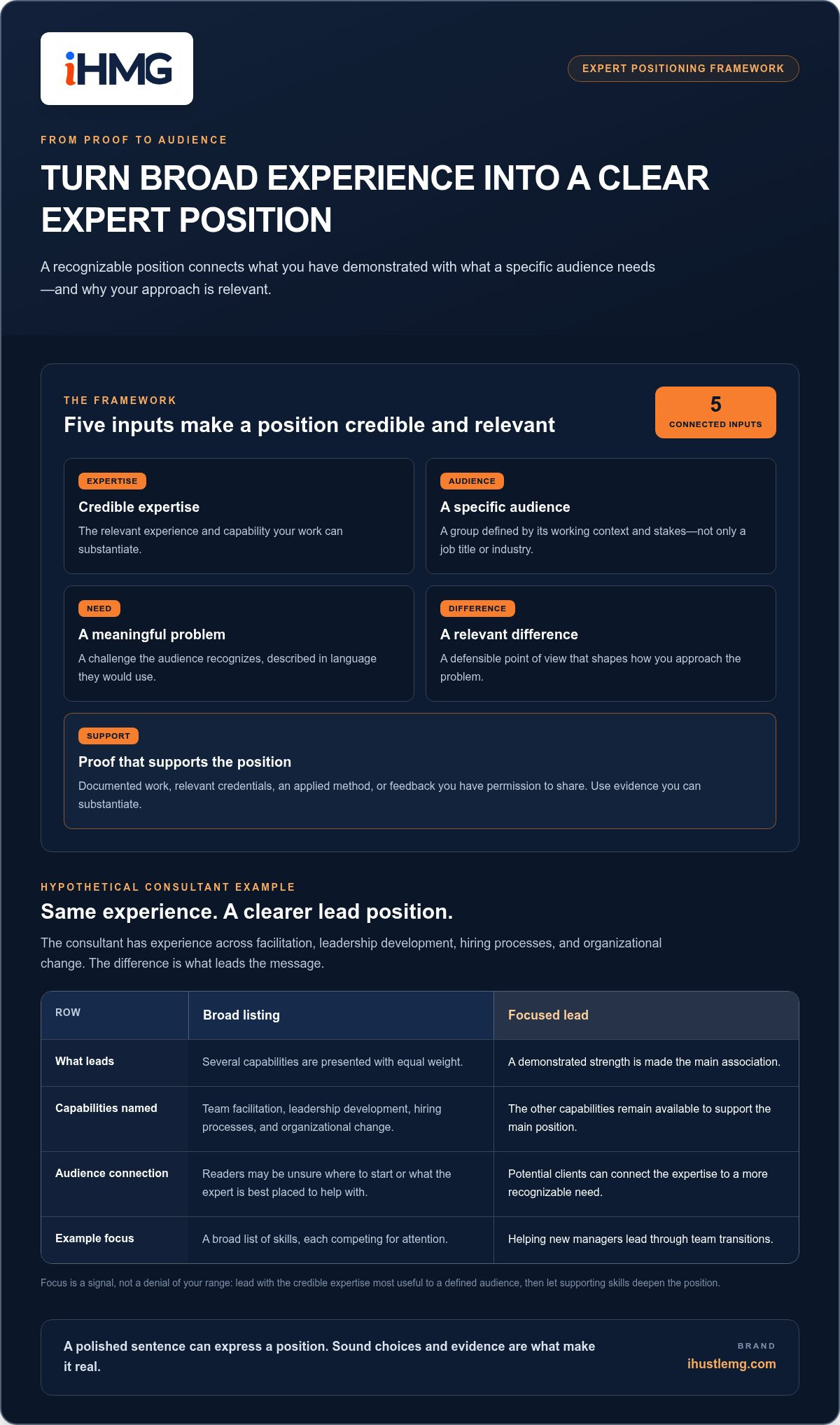
An expert positioning framework is a set of connected decisions that defines how an expert’s experience serves a particular audience and earns a distinct place in that audience’s mind. It connects five inputs: credible expertise, a specific audience, a meaningful problem, a relevant difference, and proof that supports the position.
It’s not a tagline-writing formula. A polished sentence can express a position, but it can’t create one without sound choices behind it. Those choices build on the broader principles of Positioning (marketing): deciding whom you serve, what matters to them, and how you want to be perceived in relation to alternatives. For an individual expert, the position must also be grounded in personal experience and evidence, not just a market category.
Think of the framework as a decision system. It guides what you emphasize, what you leave out of your lead message, and which examples make your claims credible.
Why broad expertise can become difficult to recognize
Listing every capability can feel thorough. To a prospective audience, it can make your strongest market association harder to find. When a profile mentions strategy, training, operations, leadership, and communications with equal weight, readers have to decide for themselves what the expert is best placed to help with. Many won’t do that extra work.
There’s a second trap: your expertise feels obvious to you because you see how your skills connect. An unfamiliar reader doesn’t have that context. They encounter individual words, services, and claims, then form an impression from what’s clearest. Internal familiarity is not external understanding.
Hypothetical consultant example: A consultant has experience in team facilitation, leadership development, hiring processes, and organizational change. Listing all four equally may leave a potential client unsure where to start. If the consultant’s demonstrated strength is helping new managers lead through team transitions, leading with that contribution creates a more legible position. The other capabilities still matter; they support the main association rather than competing with it.
Focus is a signal, not a denial of your range. Choose the expertise that is both credible and useful to a defined audience, then let supporting skills deepen that position. That’s how capability becomes recognizable.
Build an Expert Positioning Framework from Proof to Audience
Start with what your work can substantiate, not the identity you wish to claim. A useful expert positioning framework moves from evidence to audience, then connects a specific need with a defensible point of view. Each choice sharpens the next: your track record helps identify where you’re credible, and the audience’s context shows which parts of that record matter most.
Identify the expertise and proof worth leading with
Before choosing a headline or writing a positioning statement, scan your work for patterns. Note the problems people bring to you repeatedly, the experience that equips you to address them, and the evidence that shows what your work involved. Evidence might include documented project details, relevant credentials, a method you’ve applied, or feedback you have permission to share. Use only what you can substantiate.
Separate facts from aspirations. “I want to be a leading voice” is an ambition, not proof; “I’ve led teams through this type of change” is a claim that should be supported by relevant experience. Choose evidence that matters to the audience you intend to serve. A long list of credentials can add noise if it doesn’t explain why you’re equipped to address their problem.
Choose an audience, problem, and point of view
Define the audience by its working context and stakes, not just labels such as job title or industry. What situation are they in? What becomes harder, slower, or riskier if the problem persists? Describe that challenge in language they would use, then connect it to the expertise and proof you’ve already identified.
Your point of view is the principle that shapes how you approach the problem. It should be clear and defensible, not provocative for its own sake. For instance, a leadership adviser might believe that manager development should be tied to the real decisions people face at work, rather than delivered as abstract theory. The perspective becomes credible when it aligns with the adviser’s experience and approach.
Build the framework in sequence:
- Inventory evidence: Record recurring problems, relevant experience, and supportable proof.
- Select an audience: Identify the group whose context fits that evidence.
- Name the problem: State a consequential challenge in the audience’s terms.
- Define your difference: Explain the relevant expertise and perspective you bring.
- Attach proof: Match each central claim to evidence that makes it believable.
Then capture the logic in a short internal brief. For example: “I help [audience in a specific context] address [problem] by applying [relevant expertise and point of view]. My position is supported by [evidence].” Treat this as a strategic reference, not a slogan guaranteed to attract clients. For professionals in the St. Louis area who want structured support to develop their position, iHustle Media Group’s Authority Accelerator uses AI-enhanced frameworks to position experts as leaders in their niches.
Pressure-Test Your Expert Positioning Against Real Alternatives
A position can sound compelling in a planning document and still fail in the market. Test it against what your intended audience already does, the alternatives they might consider, and the adjacent types of expert they could mistake you for. The goal isn’t to claim you’re better at everything. It’s to make a relevant difference clear and supportable.
Start with the audience’s status quo. They may be handling the problem internally, delaying action, using a familiar process, or seeking help from another professional category. These are real alternatives, even when they aren’t direct competitors. Your position should explain why your approach matters in that decision context.
How to tell whether your position is genuinely distinctive
Ask what someone would compare you with before considering your offer. Then identify a difference grounded in relevant experience, a specific approach, or a clear point of view. A more dramatic adjective isn’t a meaningful distinction. “The leading expert” or “the only solution” requires evidence and careful market research. If you can’t support the comparison, remove it or state the difference more precisely.
| Check | Pressure-test prompt |
|---|---|
| Audience | Who is this for, and what context are they in? |
| Problem | What consequential need are they trying to address? |
| Claimed distinction | What relevant expertise, approach, or perspective sets this position apart? |
| Supporting proof | What experience or documented evidence supports each central claim? |
| Possible confusion | Could someone mistake this for a different audience, problem, or expert category? |
Fill in each row using plain language. Then compare the distinction with the audience’s status quo and common alternatives. If the wording could describe almost any expert in the category, sharpen the specific approach or audience need. If the claim depends on an unverified competitor comparison, category label, or market statistic, verify it before publishing or remove it. A position built on shaky claims creates risk instead of authority.
How to test whether people understand and believe it
Share the brief with a few representative people from the audience. Ask them to explain, in their own words, who you help, what problem you address, and why your approach is relevant. Don’t lead them toward the answer. Their language will reveal whether the position is clear or only makes sense to you.
Listen for misreadings. If people identify the wrong audience, confuse your work with an adjacent category, or can’t name the value, revise the message. Then audit each central claim: can you point to relevant experience or credible evidence? This expert positioning framework is ready to use when the distinction is understandable, meaningful against real alternatives, and supported without exaggeration.
Turn the Framework into Consistent Expert Authority Signals
A position only becomes recognizable when people encounter it consistently in the places where they learn about you. That doesn’t mean publishing everywhere or repeating the same sentence until it loses meaning. It means making your audience, the problem you address, and your point of view clear across a few high-value touchpoints, with evidence woven into each one.
Think of authority signals as evidence-bearing communication, not a volume-based content checklist. A bio can name relevant experience. A service overview can explain how your approach addresses the audience’s problem. An article or presentation can demonstrate your thinking in action. Each has a different job, but together they should reinforce the same position.
Which authority assets should express the same position?
Start with three assets: your professional introduction, your service overview, and one public-facing piece that lets people experience your expertise. Choose an article, presentation, or another format that suits how your audience looks for insight. Each asset should answer a practical question: why is this expert relevant to this audience and this challenge?
- Professional introduction: State who you help and the problem or context you understand, then use a relevant detail to support that focus.
- Service overview: Explain the audience’s need, how your work addresses it, and what expertise informs your approach.
- Public-facing asset: Teach or explain something that demonstrates your perspective, rather than relying on labels such as “thought leader” or “top expert.”
Adapt the depth to the format. A short introduction needs a direct signal; an article can unpack the reasoning behind it. Don’t force every asset to use identical wording. Keep the strategic core stable while making each piece useful on its own. For a broader founder-focused perspective, explore this founder authority strategy. For execution context, the thought leadership automation guide discusses how authority activity can be supported through systems.
How to review and refine positioning over time
Set a review point when something material changes: your audience, offer, expertise, or market context. Don’t rewrite your position just because a new trend is attracting attention. A change should reflect a real shift in your work or stronger evidence about what your audience needs.
Use audience questions and comprehension feedback as diagnostic signals. If people consistently ask what you do, mistake your focus, or overlook the relevance of your experience, identify which asset or phrase is creating friction. Update that specific element, then check that the central message still aligns across your touchpoints.
The expert positioning framework gives these signals a shared reference point, so public communication stays coherent as it evolves. iHustle Media Group’s Authority Accelerator program uses AI-enhanced frameworks to position experts as leaders in their niches and support market presence and credibility.
Put Your Expert Positioning Framework into Practice
A positioning brief only creates value when it changes how you communicate. Move it from strategy into use through a simple sequence: draft the core position, validate it with people who represent your intended audience, document the decisions and supporting evidence, express the position across relevant touchpoints, then review it when circumstances change.
Keep the brief practical. It should help you make choices, not become another polished document that sits unused. When collaborators help shape your bio, service explanation, presentations, or articles, the brief gives them a shared reference for what to emphasize and what to avoid.
What to include in a practical positioning brief
Capture the details that connect your expertise to a real audience need. Keep each point concise enough to guide decisions, but specific enough to prevent generic messaging.
- Intended audience: Describe the people you want to reach through their work context, priorities, or situation.
- Priority problem: State the challenge they need to address and why it matters to them.
- Credible expertise: Note the relevant experience and capabilities that equip you to help.
- Defensible point of view: Explain the principle or approach that shapes how you address the problem.
- Proof examples: Record evidence you can use to support your claims, such as relevant experience, documented work, or feedback you have permission to share.
- Market misunderstanding: Identify an assumption or common interpretation your position should clarify or correct.
Use the brief to guide expression, not to force identical wording everywhere. It should make it easier for you and your collaborators to keep the underlying message aligned while adapting its length, tone, and detail to each format.
How the Authority Accelerator supports expert positioning
Some experts can build and maintain this system independently. Structured strategic support can be useful when your expertise spans several areas, your public message feels fragmented, or you need a clearer process for turning positioning into consistent authority-building activity.
iHustle Media Group’s Authority Accelerator uses AI-enhanced frameworks to position experts as leaders in their niches. It’s designed to support market presence and credibility, connecting strategic positioning with the authority signals you develop over time. The program complements relevant experience and proof with a structured way to work on how your expertise is positioned.
To develop your expert positioning with strategic support, explore iHustle Media Group and learn more about the Authority Accelerator.
Make Your Next Move Deliberate
Your position isn’t a finish line. It’s a decision-making tool. Use it to choose which opportunities fit, what perspective to share, and where your expertise can make a meaningful contribution. When a new opportunity doesn’t serve the audience or problem you’ve chosen, decide whether it strengthens your direction or pulls focus from it.
The right expert positioning framework should keep working as your experience grows. iHustle Media Group’s Authority Accelerator uses AI-enhanced frameworks to position experts as leaders in their niches, while its AI System Diagnostic evaluates existing digital infrastructure and identifies automation opportunities. Together, strategic positioning and an understanding of your systems can inform how you develop your market presence. For professionals and business owners in St. Louis, St. Charles, St. Peters, Florissant, Hazelwood, Ferguson, and Chesterfield, a clear position can also help make local relevance easier to communicate.
To give your expertise a clearer strategic direction, explore the Authority Accelerator. Your strongest position doesn’t require you to know everything. It starts with choosing what matters most and making that contribution visible.
Frequently Asked Questions
How do I create an expert positioning statement?
Write one sentence that names the people you serve, the challenge they face, and the relevant way you help. For example: “I help first-time department heads prepare for difficult team conversations using practical meeting and feedback tools.” Treat this as a working draft, not final marketing copy. Ask someone in your intended audience what they think you do after reading it, then revise unclear terms.
How is expert positioning different from personal branding?
Expert positioning defines the specific contribution you want an audience to recognize. Personal branding is the broader impression people form through your communication, conduct, and public presence. Positioning gives that broader impression a strategic center. For example, a founder may be known for a direct communication style, while their position clarifies the particular business challenge they understand and the perspective they bring to it.
Can I position myself as an expert in more than one area?
Yes, if the areas make sense to the same audience or serve connected needs. Organize them under a clear primary association, then show supporting specialties as related capabilities. A finance adviser might focus on helping independent firms manage cash flow, while also drawing on forecasting and pricing expertise. If two areas serve very different audiences, give each a distinct message rather than blending them into one confusing introduction.
How do I prove my expertise without sounding self-promotional?
Make the work the focus. Explain a decision, share a useful method, or describe how you approached a real challenge while protecting private information. Refer to credentials or feedback only when they help clarify your relevance. For example, instead of calling yourself “a trusted adviser,” explain the kind of planning problem you help clients examine and show the questions that guide your process.
How often should I review my expert positioning?
Review it on a schedule you can maintain, such as during a regular planning cycle, and sooner if your work changes substantially. Check whether recent conversations reveal a recurring misunderstanding, whether your services still match the audience you intend to reach, and whether your examples support the claims you make. Avoid rewriting your position after every new idea; look for a meaningful pattern before changing direction.
Does an expert positioning framework work for consultants and founders?
Yes. Consultants can use it to clarify the problem their expertise addresses, while founders can connect their perspective to the needs their company serves. For example, a consultant working with organizations in St. Louis or St. Charles can make their audience and specialty clear without relying on a broad “business expert” label. Founders in St. Peters, Florissant, Hazelwood, Ferguson, or Chesterfield can use the same logic to explain their relevance to a defined market.