


Fix Lead Conversion Leaks: The 2026 AI-Driven System Checklist
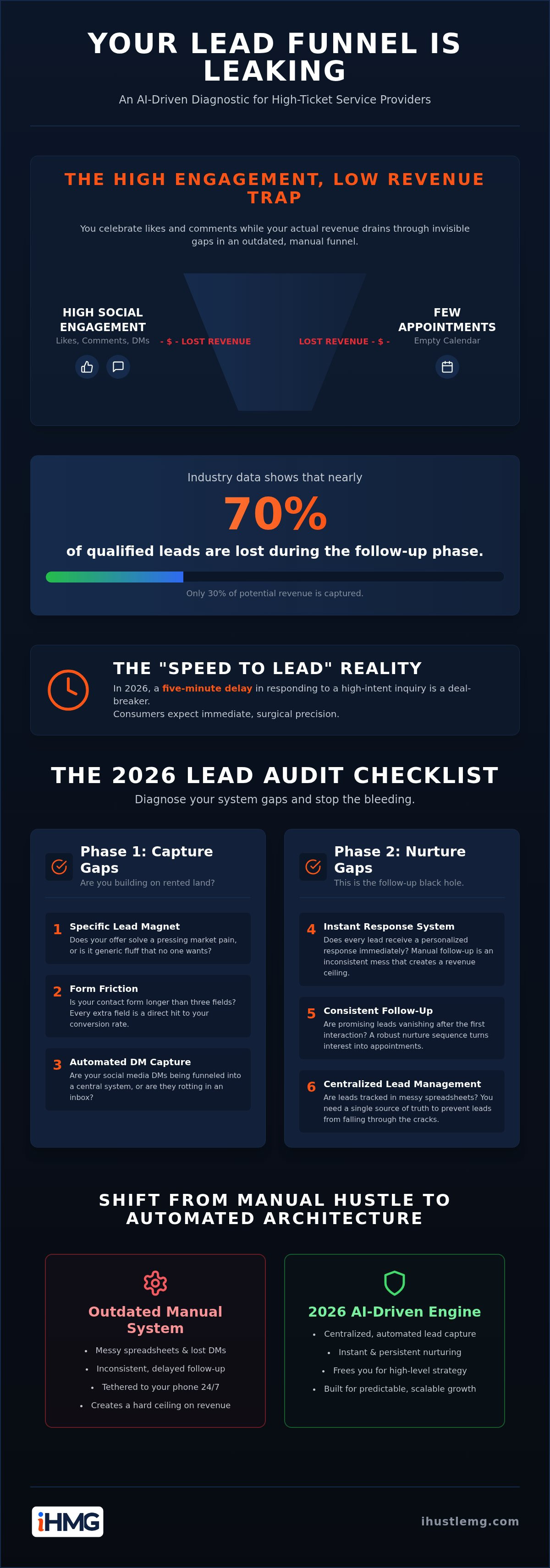
High social media engagement is a vanity metric that's quietly bankrupting your potential. You celebrate the likes and comments while your actual revenue drains through invisible gaps in an outdated, manual funnel. It's a common trap for high-level service providers in the St. Louis area who fail to fix lead conversion leaks before they scale. Industry data shows that nearly 70% of leads are lost during the follow-up phase because manual systems simply can't keep up. You've likely spent years building an audience, yet you still find yourself drowning in manual DM follow-ups. Messy spreadsheets shouldn't be the backbone of a premium brand.
If you're tired of working for your system instead of having your system work for you, it's time for a pivot. This article provides a comprehensive 2026 AI-driven checklist designed to stop the bleeding and install a predictable, automated engine. We'll explore how to identify your specific failure points and replace them with high-performance architecture. From the AI System Diagnostic to the Social Lead Web framework, you're about to see exactly how to turn passive observers into your next high-ticket clients and solidify your market authority.
Key Takeaways
- Identify the structural weaknesses in your funnel that turn potential revenue into wasted effort.
- Implement a systematic approach to fix lead conversion leaks by bridging the gap between high social engagement and actual sales.
- Master the "Speed to Lead" reality where response delays are deal-breakers, using automation to meet 2026 consumer expectations.
- Transition from manual DM management to a robust lead engine that converts interest into appointments while you focus on high-level strategy.
- Build a leak-proof infrastructure that establishes your brand as the dominant authority in the St. Louis service market.
The Invisible Drain: Identifying Lead Conversion Leaks in 2026
A lead conversion leak isn't just a missed email or a forgotten DM. It's the catastrophic gap between a prospect's "I'm interested" and their final "I'm buying." In 2026, this gap is where your revenue goes to die. If you aren't moving to fix lead conversion leaks, you're essentially running a charity for your competitors. You've built the audience, but you're failing the hand-off.
Speed isn't a luxury anymore; it's the baseline for survival. The "Speed to Lead" reality dictates that a five-minute delay in responding to a high-intent inquiry is a deal-breaker. Consumers expect immediate, surgical precision. If you're checking your inbox "when you have a minute," you've already lost the client to someone with an automated engine. Most service providers in St. Charles or Chesterfield are still relying on manual checks. They're losing profit to a clock they can't beat.
Don't confuse a traffic leak with a system leak. A traffic leak means you're attracting the wrong audience, which is a marketing failure. A system leak means you have the right people, but your process is broken. You don't need more eyes on your content; you need a better architecture to capture the eyes you already have. Manual follow-up is the number one profit killer for local pros who value their time but haven't yet automated their growth.
Symptoms of a Leaking Lead Engine
Your social media might be buzzing, but if your calendar is a ghost town, your system is failing. This disconnect is the first red flag of a structural weakness. You'll notice specific patterns that signal your revenue is draining away:
- High "likes" and "comments" that never translate into booked appointments or signed contracts.
- The "I'll get back to you" abyss, where promising leads vanish into thin air after the first interaction.
- Inconsistent revenue spikes followed by long, stressful droughts despite your constant outreach efforts.
The Cost of Inaction: Calculating Your Monthly Profit Leak
The Lead Leakage Ratio is the percentage of qualified inquiries that fail to reach a discovery call due to process friction and manual delays. It's a metric that most business owners ignore until it's too late. A 10 percent improvement in your conversion rate often generates more bottom-line profit than a 50 percent increase in raw traffic. More traffic just puts more pressure on a broken pipe. To fix lead conversion leaks, you must stop the "Manual Hustle" that's currently acting as a ceiling on your scalability. For St. Louis business owners, this isn't just about money; it's about the psychological toll of being tethered to a phone 24/7. You can't scale a business that relies on your personal speed to stay afloat.
The 2026 Lead Audit Checklist: Diagnosing Your System Gaps
Stop guessing. Most St. Louis entrepreneurs treat their lead funnel like a black box. They see traffic go in and nothing come out; yet they continue to pour more money into the top. To fix lead conversion leaks, you must adopt a diagnostic approach that scrutinizes every stage of the journey. You aren't just looking for mistakes. You're looking for friction.
Capture Gaps: The Entry Point Leaks
Your Top-of-Funnel (TOFU) isn't about views; it's about data ownership. If you're just getting "reach" on social media without capturing intent, you're building on rented land. You need to know if you're actually capturing data or just entertaining an audience that will never buy. Strategic leaders fix lead conversion leaks by replacing manual effort with automated precision at the first point of contact.
- Specific Lead Magnet: Does your offer solve a pressing St. Peters market pain, or is it generic fluff that no one wants?
- Form Friction: Is your contact form longer than three fields? Every extra field you add is a direct hit to your conversion rate.
- Automated DM Capture: Are your social media DMs being funneled into a central system, or are they rotting in an inbox?
Nurture Gaps: The Follow-Up Black Hole
The Middle-of-Funnel (MOFU) is where the "Speed to Lead" reality hits hardest. Manual follow-up is an inconsistent mess that creates a revenue ceiling. You need a system that responds while you're focused on high-level architecture. If you aren't sure where your process is breaking down, using an AI business diagnostic tool is the most efficient way to find hidden bottlenecks.
- Instant Response: Does every lead receive a personalized response within 60 seconds of inquiry?
- Multi-Channel Reach: Are you utilizing a combined Email and SMS sequence to stay top-of-mind?
- Authority Building: Does your follow-up position you as the expert, or does it feel like a desperate sales pitch?
Finally, evaluate your Bottom-of-Funnel (BOFU). The transition from a prospect to a booked call must be frictionless. If a lead has to wait for a manual calendar link, they'll find a competitor who is ready now. This is the "Authority Gap." If your system looks amateur, your leads won't trust you with their business. Performing a thorough AI System Diagnostic reveals exactly where this trust is breaking down in your current funnel.
Architecture Over Effort: Building Leak-Proof Lead Infrastructure
Most St. Peters business owners pride themselves on "the hustle." They mistake constant activity for progress. But hustle is a finite resource that eventually hits a ceiling. To fix lead conversion leaks, you must stop relying on personal effort and start building a mechanical infrastructure. A system doesn't get tired, forget to follow up, or have a "bad day" in the Hazelwood or Ferguson markets. It simply executes. You need a growth engine that runs on logic, not adrenaline.
A CRM is not a strategy; it's a digital filing cabinet. If your CRM isn't powered by automated triggers, it's just a place where leads go to be forgotten. True lead architecture ensures that every action by a prospect triggers a counter-action from your system. This eliminates the human error that usually plagues manual follow-up processes. When you move from a "hustle" mindset to a "system" mindset, you stop being a technician and start being an architect of your own growth.
The AI System Diagnostic: A Strategic Blueprint
You don't need to be a tech expert to understand why your funnel is failing. The AI System Diagnostic acts as a high-level briefing, revealing exactly where your digital infrastructure is cracked. It identifies "dead zones," those specific moments where prospects lose momentum and vanish into the digital ether. By mapping the journey from a complete stranger to a recognized St. Louis authority, you can see the structural weaknesses that a manual approach will never fix. This diagnostic is the first step in replacing guesswork with precision.
- Infrastructure Audit: Evaluate your current tools to ensure they actually talk to each other.
- Dead Zone Detection: Pinpoint the exact stage where leads stop responding.
- Authority Mapping: Ensure your content and follow-up reinforce your expert status at every touchpoint.
Automated Lead Qualification: Killing the Tire Kickers
Not every lead deserves your personal time. High-level service providers often drown in low-value inquiries that go nowhere. By implementing automated qualification "gates," you filter out the tire kickers before they ever reach your calendar. This isn't about being exclusionary; it's about protecting your most valuable asset: your time. Using automated qualification frameworks typically saves service pros 10 or more hours per week. This reclaimed time allows you to focus on high-impact strategy rather than manual sorting and repetitive questioning.
Setting up these gates involves using AI frameworks to score leads based on their intent and budget. If they don't meet your criteria, the system handles the polite rejection or redirects them to lower-tier resources. This ensures that when you finally do step in, you're only speaking with people who are ready, willing, and able to pay for your expertise. It's the difference between a crowded waiting room and a curated list of high-value appointments.
The Social Media Trap: Bridging the Gap Between DMs and Dollars
Your Instagram and Facebook DMs are likely your biggest revenue leak. You spend hours crafting content, yet you let the resulting inquiries rot in an unmanaged inbox. High engagement feels good, but it doesn't pay the bills. To fix lead conversion leaks, you must stop treating social media as a billboard and start treating it as a high-speed entry point for your sales pipeline. If a prospect in Florissant or Chesterfield reaches out and doesn't get a response within minutes, they've already moved on to the next profile. Ghosting your leads is the fastest way to destroy your local market authority.
The "Manual DM Grind" is a scalable nightmare. It relies on you being tethered to your phone, responding to repetitive questions over and over again. This is where social media lead automation changes the game. Instead of a chaotic inbox, you get a structured system that captures every interaction. Social Lead Web transforms these casual interactions into qualified leads, ensuring that no potential client ever slips through the cracks of a messy interface.
Converting Visibility into Qualified Conversations
Relying on a "Link in Bio" is a conversion killer. It asks a prospect to leave the app, navigate a slow website, and find a contact form. Most won't. The Social Lead Web approach keeps the conversation where it started but adds the mechanical precision of a CRM. You provide an instant response and instant qualification without lifting a finger. This bridges the gap between social engagement and CRM data entry, turning a "like" into a trackable asset in your business architecture. You aren't just getting views; you're building a database of high-intent prospects.
Positioning for Authority in the Feed
Your system should reinforce your status as the only logical choice in the St. Louis area. This is where the Authority Accelerator comes into play. It ensures that while your system handles the logistics, your brand is building massive credibility. You create a loop where social authority feeds into system efficiency, making every follow-up feel like a privilege rather than a nuisance. When your leads see you as a market leader before the first sales call, the conversion becomes a formality. Stop playing the manual game and secure your automated lead engine today.
Scaling Beyond the Leak: Implementing Your 2026 Growth Engine
Patching a leak is a temporary fix. Building an engine is a permanent evolution. If you only fix lead conversion leaks as they appear, you're playing a defensive game. You're waiting for the next failure point to reveal itself. High-level service providers don't wait. They architect systems that prevent failure before it happens. This is the difference between surviving in the St. Louis market and dominating it. You need a proactive framework that converts interest into revenue without your constant intervention.
Moving from a manual grind to an automated powerhouse requires a shift in focus. You aren't just looking for better results; you're looking for a better architecture. Most businesses in St. Peters are still stuck in 2020 tactics. They're trying to work harder to solve systemic problems. By adopting an AI-driven approach, you position yourself as a necessary evolution in your industry. You stop chasing leads and start managing a high-performance conversion machine.
From Reactive Patching to Proactive Scaling
Reactive patching is for amateurs. Strategic architects focus on long-term lead retention and system integrity. By integrating the Authority Accelerator, you ensure that leads don't just enter your system; they stay engaged until they convert. You should stop "fixing" small errors and start architecting a journey that makes your competition irrelevant. Setting KPIs that actually matter is the first step. Stop obsessing over engagement rates that don't pay the bills. Focus on your conversion rate. That is the only metric that dictates whether your business is actually growing or just making noise.
Your St. Louis Market Authority Roadmap
Local trust is your foundation, but AI-driven systems are your fuel. Dominating the Chesterfield or Florissant market requires more than just being "good" at your craft. It requires being the most responsive and professional option available. When you close the loop, you turn one-time conversions into lifelong advocates. This creates a self-sustaining cycle where your reputation feeds your automation, and your automation protects your reputation. You are no longer just a service provider. You are a market authority with a system that reflects your expertise.
Your 30-Day Plan to Plug the Profit Holes:
- Days 1-7: Conduct an AI System Diagnostic to identify every structural crack and "dead zone" in your current funnel.
- Days 8-14: Deploy Social Lead Web to bridge the gap between social media engagement and your CRM.
- Days 15-21: Launch the Authority Accelerator to ensure every lead sees you as the only logical choice in the market.
- Days 22-30: Review your conversion KPIs and optimize your automated triggers to fix lead conversion leaks permanently.
Dominate Your Market with Architectural Precision
Hustle is a strategy for amateurs. Architecture is the blueprint for market leaders. You've seen how manual follow-ups and unmanaged DMs act as an invisible drain on your revenue. Relying on your personal speed to manage growth isn't just exhausting; it's a structural failure. To fix lead conversion leaks, you must replace a reactive "patching" mindset with a proactive, automated engine that runs with mechanical precision.
Your local reputation in the St. Louis area deserves a system that reflects your expertise. By leveraging specialized AI frameworks and the Social Lead Web system, you bridge the gap between social visibility and a structured sales pipeline. You don't have to settle for a leaking funnel. Build a scalable powerhouse that positions you as the undisputed expert through the Authority Accelerator. It's time to stop the bleeding and start architecting your expansion.
Ready to transform your lead infrastructure? Request Cortez for an AI System Diagnostic and stop the profit bleed today. The transition to a predictable, automated engine starts with a single strategic assessment. Build the engine your brand deserves.
Frequently Asked Questions
What are the most common signs of a leaking lead funnel?
The most common signs are high engagement metrics combined with a stagnant bank account. If your social media notifications are buzzing but your calendar is empty, you have a leak. You'll also notice a massive drop-off between the initial inquiry and the discovery call. Manual follow-up delays often mean prospects lose interest or find a faster competitor before you even see their message.
How can I fix lead conversion leaks without hiring a massive sales team?
You can fix lead conversion leaks by replacing human effort with automated architecture. You don't need a massive sales team; you need a system that qualifies leads and schedules appointments while you sleep. By implementing tools like Social Lead Web, you ensure every inquiry gets an immediate, personalized response. This creates a high-performance engine that handles the heavy lifting of follow-up without the overhead of additional staff.
Is lead automation too impersonal for high-ticket service businesses in St. Louis?
Automation actually feels more professional and personal than a delayed manual response. In high-ticket service markets, silence is the ultimate conversion killer. A well-designed system provides instant value and clear next steps, which builds trust immediately. By using the Authority Accelerator, you ensure your automated touchpoints reinforce your expert status. This makes the eventual human conversation much more productive and focused on closing the deal.
Can an AI system diagnostic really find leaks I haven't noticed?
An AI System Diagnostic scrutinizes the technical plumbing of your business that is often invisible to the naked eye. It identifies specific dead zones where leads drop off due to slow load times, broken links, or friction-heavy forms. Most business owners focus on the content, but the diagnostic focuses on the architecture. It reveals exactly where your digital infrastructure is failing to move prospects toward a conversion.
How much revenue is typically lost to poor follow-up in 2026?
Industry data indicates that approximately 70% of potential revenue is lost during the follow-up phase. This isn't because the leads are bad; it's because the system is too slow. In 2026, a five-minute delay is often enough to lose a high-intent prospect. When you fail to capture and nurture these leads instantly, you are essentially handing your market share to competitors who have automated their conversion process.
What is the difference between lead generation and a lead generation system?
Lead generation is the act of attracting eyes to your business, while a lead generation system is the mechanical process that converts those eyes into appointments. Most people focus on getting more traffic, which just puts more pressure on a broken funnel. A robust system, like Social Lead Web, ensures that every lead is captured, qualified, and moved toward a sales call. It's the difference between a bucket and a pipeline.
How does Social Lead Web differ from standard social media management tools?
Standard social media management tools are designed for scheduling posts and tracking likes. Social Lead Web is built for conversion and revenue generation. It bridges the gap between social engagement and your actual CRM by automating the transition from a DM to a qualified lead. While standard tools focus on vanity metrics, this system focuses on moving prospects through your sales funnel with surgical precision.
How long does it take to see results after plugging lead conversion leaks?
You will see an immediate improvement in response times and lead engagement the moment you plug your conversion leaks. While building a full-scale engine takes strategy, the removal of friction often results in more booked appointments within the first 30 days. As your system begins to qualify leads automatically, you'll notice a significant increase in the quality of your sales calls and a decrease in wasted time.