


Fix My Sales Process in Hazelwood: A Practical Guide to Closing More Leads
What if your next sales breakthrough doesn’t come from attracting more leads, but from fixing what happens after they show interest? If you’re searching “fix my sales process Hazelwood,” you may already suspect that leads are slipping through inconsistent follow-up, unclear handoffs, or manual tasks that hide where prospects drop off.
That frustration makes sense. More leads won’t solve a process that loses track of the ones you already have. The first move is finding the stall point, then making the path from inquiry to conversation clear and repeatable.
This guide shows you how to trace a lead’s journey, spot the handoff that needs attention, and build a reliable follow-up workflow for your Hazelwood business. You’ll also learn when a diagnostic can reveal gaps in your current setup and when automation, such as connecting social engagement to qualified conversations, may help. The goal isn’t to add tools for the sake of it. It’s to create a sales process you can see, manage, and improve.
Key Takeaways
- Separate visible sales symptoms from possible causes before deciding what to change; a slow reply may point to unclear ownership, not too few leads.
- Map the path from inquiry to decision, giving every stage an owner, a useful status, and one defined next action.
- Use a symptom-and-bottleneck check to identify where to investigate first, treating each explanation as a clue rather than proof.
- To fix my sales process Hazelwood, focus on one bottleneck, define the handoff, and pilot the change with one lead source or service line.
- Consider an AI System Diagnostic to assess your existing digital setup and identify where automation could support a more connected sales flow.
How to tell when your Hazelwood sales process is losing leads
You’re getting interest, but there’s no dependable path from a new inquiry to a real sales conversation. One prospect gets a quick reply, another waits, and a third disappears into a message thread no one remembers to check. That isn’t automatically a lead-volume problem. It may be a handoff problem.
A sales process gives prospects a path from initial interest toward a decision. The standard sales process offers a useful foundation, but the practical test is simpler: can you tell who owns each inquiry and what happens next?
Look for recurring warning signs:
- Website or social inquiries are forgotten or answered inconsistently.
- Prospects are qualified differently depending on who responds.
- The same details are repeatedly copied, searched for, or requested.
- A conversation ends without a scheduled follow-up or clear next step.
These are visible symptoms, not proof of a single cause. A slow reply, for example, could reflect unclear responsibility or a process that relies on someone remembering to check several channels. The goal isn’t to pressure prospects or create activity for its own sake. It’s to make the next step clear and dependable.
What does a broken sales process look like for a local service business?
A referral may arrive by text, a social message may sit in a separate inbox, and a website form may send an email nobody has been assigned to handle. Each channel works on its own, but the overall journey has gaps. Prospects can end up waiting without anyone deliberately neglecting them: the process simply doesn’t make ownership or the next action clear.
An occasional busy spell is different from a recurring gap. Look for patterns across inquiries: do some sources regularly go unanswered, or do prospects often reach the same stage and then stall? Repeated friction points are stronger clues than one unusually slow day.
Is the problem lead volume or lead follow-up?
Compare inquiry counts with what happens after each inquiry arrives. Are replies consistent? Are prospects qualified using clear criteria? Does each promising conversation have a scheduled next action? If inquiry volume is steady but these steps are uneven, adding more leads could amplify the existing gap rather than solve it.
If you’re thinking, “I need to fix my sales process Hazelwood,” start by tracing a few recent inquiries from arrival to their latest outcome. Note where each paused, what action was expected, and who owned it. Diagnose the handoff before investing in more activity.
Map every sales-process handoff from first inquiry to next step
A useful sales map doesn’t need elaborate software or a maze of pipeline stages. It needs to show how an inquiry moves forward, who owns it, and what action comes next. A sales handoff is the point where responsibility or information changes, for example when the person who receives a website inquiry passes a qualified prospect to the person handling sales conversations.
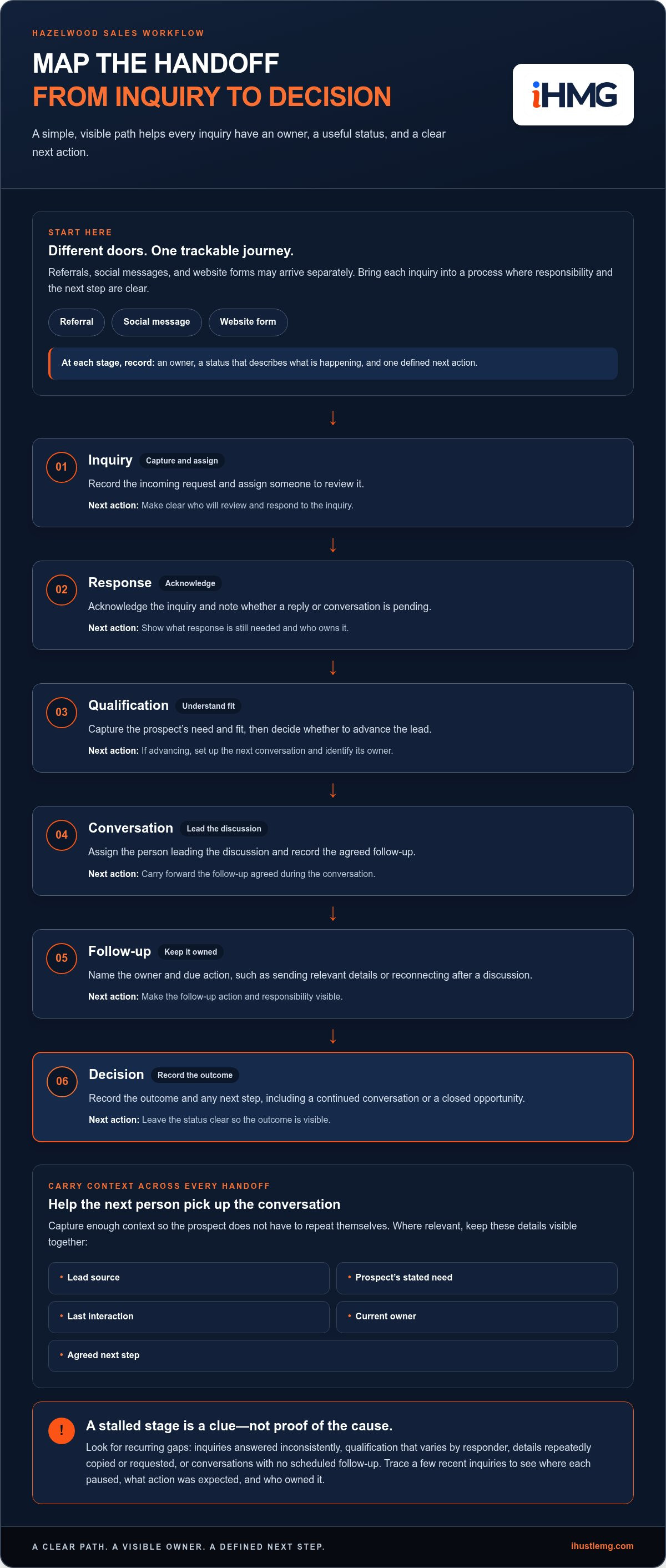
Start with a simple sequence: inquiry, response, qualification, conversation, follow-up, and decision. For each stage, record an owner, a status that describes what’s happening, and one next action. Keep the stages grounded in how customers actually buy from your business.
Which stages should a simple sales pipeline include?
Use plain labels, then adjust them to fit your service. A social message, referral, and website form can enter through different doors but still move through a shared process. For example, the person monitoring social engagement logs an inquiry as “New,” then assigns an owner to respond. Once the prospect’s need and fit are understood, the status changes to “Qualified,” with a scheduled conversation as the next action.
- Inquiry: Record the incoming request; assign someone to review it.
- Response: Acknowledge the inquiry; note whether a reply or conversation is pending.
- Qualification: Capture the prospect’s need and fit; decide whether to advance the lead.
- Conversation: Assign the person leading the discussion; record the agreed follow-up.
- Follow-up: Name the owner and due action, such as sending relevant details or reconnecting after a discussion.
- Decision: Record the outcome and any next step, including a continued conversation or a closed opportunity.
That example is a framework, not a rule that every prospect must follow the same route. Your labels should reflect your actual buying journey, including reasonable variations in how prospects move from first contact to decision.
What information should you track at each handoff?
Capture enough context for the next person to continue without making the prospect repeat themselves. Where relevant, track the lead source, stated need, last interaction, current owner, and agreed next step. A CRM or organized tracking system can make these details, along with each lead’s status, visible in one place.
For more system-level ideas, explore this AI sales pipeline automation blueprint. If you’re ready to connect social engagement with a clearer follow-up path, learn how Social Lead Web supports lead capture and follow-up.
Find the real bottleneck before adding sales tools
Buying software can make a process more visible, but it can’t decide who owns an inquiry or what should happen next. If those basics are unclear, new tools may simply move the confusion into another system. Diagnose the workflow first, then choose tools that support a defined process.
Use this symptom check to decide where to investigate. These are clues, not proof; confirm the cause by tracing what actually happened to recent inquiries.
- Few inquiries: A possible issue is limited visibility or an unclear path for prospects to reach you. First check inquiry counts by source and whether contact options are easy to find.
- Slow response: Ownership may be unclear, or inquiries may be spread across channels. First check who receives each inquiry and how it gets assigned.
- Weak qualification: The team may lack shared criteria or be missing key context. First review how needs and fit are recorded before a conversation.
- Dropped follow-up: Next actions may not be assigned or tracked. First check whether each open opportunity has an owner and a documented follow-up step.
How can you tell where prospects are dropping out?
Review a representative set of recent inquiries from different sources. Trace each one from arrival through its latest outcome: note delays, missing context, unanswered questions, and next steps that were discussed but never recorded. Look for a repeated break in the journey, not just one unusual case.
Track the same indicators before and after you change the process. For example, compare whether inquiries have an assigned owner, whether the next action is recorded, and where prospects pause. Consistent tracking helps distinguish a real change from a temporary fluctuation.
When does automation help, and when can it add friction?
Automation fits tasks that repeat and follow clear rules, such as routing an inquiry to an owner or prompting a planned follow-up. It can add friction when it sends irrelevant messages, asks prospects to repeat information, or tries to handle a situation that needs personal judgment, nuanced advice, or a direct conversation.
Automate a defined handoff, not an undefined sales process. Once you’ve identified the gap, the AI business diagnostic tool guide offers related context for assessing where automation may fit. If you’re deciding how to fix my sales process Hazelwood, start with the evidence from your own lead journey, then select tools that address the specific bottleneck. An AI System Diagnostic for sales workflows can help evaluate existing digital infrastructure and identify automation opportunities.
Fix your sales process with a focused Hazelwood action plan
Don’t overhaul every tool and workflow at once. Choose the recurring bottleneck with the clearest evidence, make one practical change, and check whether the handoff becomes more consistent. A focused repair is easier to follow and easier to evaluate.
What should you change first in your sales workflow?
Start where recent inquiries repeatedly stall and where you can act on the cause. If website inquiries lack an assigned owner, for example, define who takes responsibility and what they do next. Write the rule plainly: “Every new website inquiry is assigned to an owner, who records the next action.” Keep it visible wherever the team tracks leads.
Then pilot the change with one lead source or service line. Don’t roll it across the whole business until you know the new handoff works in practice. A weekly review can show whether each active inquiry has an owner, whether the agreed step was completed, and whether the rule needs adjusting.
How should you measure whether the repair is working?
Choose a few process measures before the pilot begins. Track time to first response, whether inquiries move through the required stages, and whether agreed follow-up is recorded and completed. These indicators show whether the workflow is being used. They don’t, by themselves, prove that a process change caused a revenue or conversion change.
Compare like-for-like periods and account for differences in inquiry volume and lead source. If the pilot includes a different mix of referrals and website inquiries, for instance, the comparison may not reflect the process change alone. Keep notes on exceptions, such as missing contact details or a prospect who asks to reconnect later.
Use the review to make a clear decision: keep the change, refine it, or investigate another bottleneck. If ownership is now consistent but follow-up is still being missed, the next repair may be the tracking or reminder step, not a broader technology overhaul.
If you’re looking to fix my sales process Hazelwood, use this sequence: choose one evidence-backed bottleneck, define the handoff, assign an owner, document the next action, and run a focused pilot. Once the workflow is clear, consider whether a connected system can support it. Explore iHustle’s system-focused approach to see how a diagnostic or lead-flow system may fit your business.
How iHustle helps Hazelwood businesses build a more connected sales system
Once you’ve pinpointed where prospects stall, the next move isn’t automatically to add every available tool. Match the support to the gap. A business with unclear workflows needs a clearer view of its current setup; one losing social inquiries between engagement and follow-up may need a more connected lead path.
Which iHustle solution fits a sales-process bottleneck?
AI System Diagnostic evaluates your existing digital infrastructure and identifies automation opportunities. It’s a relevant starting point when you need to understand how your website, lead capture, customer records, and follow-up processes fit together before deciding what to change.
Social Lead Web connects social media engagement with qualified conversations and automated follow-up. It may fit when people are responding to your social presence but the transition from that interest to an organized sales conversation is inconsistent.
If the central issue is how your business is positioned or perceived, Authority Accelerator may complement the sales process by strengthening professional market presence. It isn’t a substitute for clear ownership and follow-up; credibility and a dependable journey work together.
What is a sensible next step for a Hazelwood business?
Bring a simple map of one recent lead journey: where the inquiry came from, what happened next, who handled it, and where progress slowed or stopped. Add the bottleneck you identified and the change you’re considering. That gives the discussion a practical starting point, rather than turning it into a search for tools without a defined job.
For broader context on how connected lead-generation systems fit together, read the modern lead generation system guide. Use it to think through how visibility, lead capture, and follow-up can support one another, then compare those ideas with your actual workflow.
If you’re looking up “fix my sales process Hazelwood,” focus on fit: identify the gap, clarify the handoff, and explore whether diagnosis or a connected follow-up system addresses it. Start a conversation with iHustle Media Group to discuss the sales-system challenge you’ve mapped and the support that aligns with it. Request a conversation with iHustle Media Group.
Build a sales process that keeps every lead moving
A stronger sales process starts with clarity, not another tool or a bigger lead list. Trace the customer journey, identify where prospects stall, and make ownership and next steps visible at each handoff.
Then test one focused change and review whether responses, stage progression, and follow-up become more consistent. That evidence can help you decide what to improve next and whether automation fits the workflow.
If you’re ready to fix my sales process Hazelwood, iHustle Media Group can help you explore a practical path forward. The AI System Diagnostic evaluates existing digital infrastructure for automation opportunities, while Social Lead Web connects social engagement with qualified conversations and automated follow-up.
Request a conversation with iHustle Media Group and bring the bottleneck you’ve identified. A clearer process is within reach, and the next improvement can start with one well-defined handoff.
Frequently Asked Questions
iHustle Media Group serves businesses in Hazelwood and the wider St. Louis area, including St. Charles, St. Peters, Florissant, Ferguson, and Chesterfield.
How do I know if my sales process is the reason leads are not converting?
Look for repeated breakdowns after prospects show interest, such as inquiries without an owner, inconsistent qualification, or follow-up that isn’t recorded. Review recent leads from different sources and trace what happened from first contact to the latest outcome. If the same stage repeatedly lacks a clear next action, the process may be contributing to stalled opportunities. That’s a clue to investigate, not proof that every lost lead had the same cause.
What should a simple sales process include for a small business?
A simple process should show how an inquiry moves through response, qualification, conversation, follow-up, and a decision. For each stage, define who owns it, what status to record, and the next action. A small Hazelwood service business might assign incoming website inquiries to one owner, track whether the prospect is qualified, and record the agreed follow-up. Keep the stages aligned with how customers actually decide to work with you.
Can automation fix a sales process with inconsistent follow-up?
Automation can support consistent follow-up when the task, owner, and trigger are clearly defined. For example, a system might route a new inquiry or prompt an assigned person to complete a planned next step. It won’t resolve unclear responsibility or replace a conversation requiring judgment. Define the handoff first, then assess whether automation can support it. Social Lead Web connects social engagement with qualified conversations and automated follow-up.
How do I find where leads are dropping out of my sales pipeline?
Trace a representative set of recent inquiries through each stage, noting the source, last interaction, owner, and next action. Look for repeated pauses, missing context, unanswered questions, or follow-ups that weren’t documented. Compare the same indicators over consistent periods as you make changes. This helps distinguish a recurring process gap from an isolated delay and gives you a clearer basis for deciding which handoff to repair first.
Do I need a CRM to improve my sales process?
No. You can start with an organized tracking method that shows each inquiry’s owner, status, and next action. A CRM can help make those details visible and easier to manage as lead volume or team coordination needs grow, but it won’t define your workflow for you. First decide what information needs tracking and how leads should move between stages. Then choose a system that supports those steps instead of adding complexity.
How can a Hazelwood business improve lead follow-up without hiring a large sales team?
Make follow-up repeatable: assign each inquiry an owner, record the last interaction, and set a specific next action. A shared tracking system can help a small team see which prospects need attention without relying on memory or scattered messages. For businesses in Hazelwood and nearby communities, Social Lead Web connects social engagement with qualified conversations and automated follow-up, helping organize the transition from online interest to sales discussion.
What does an AI business diagnostic review in a sales process?
An AI System Diagnostic evaluates a business’s existing digital infrastructure to identify automation opportunities and provide insights for improving lead flow and operational efficiency. In a sales-process review, that can help clarify how digital touchpoints and follow-up systems relate to the workflow. It’s a diagnostic step, not a promise of a specific conversion or revenue result. The findings can help inform which process gaps are suitable for automation and which need clearer ownership.