

Google AI Search and Local Visibility | iHustle Media Group
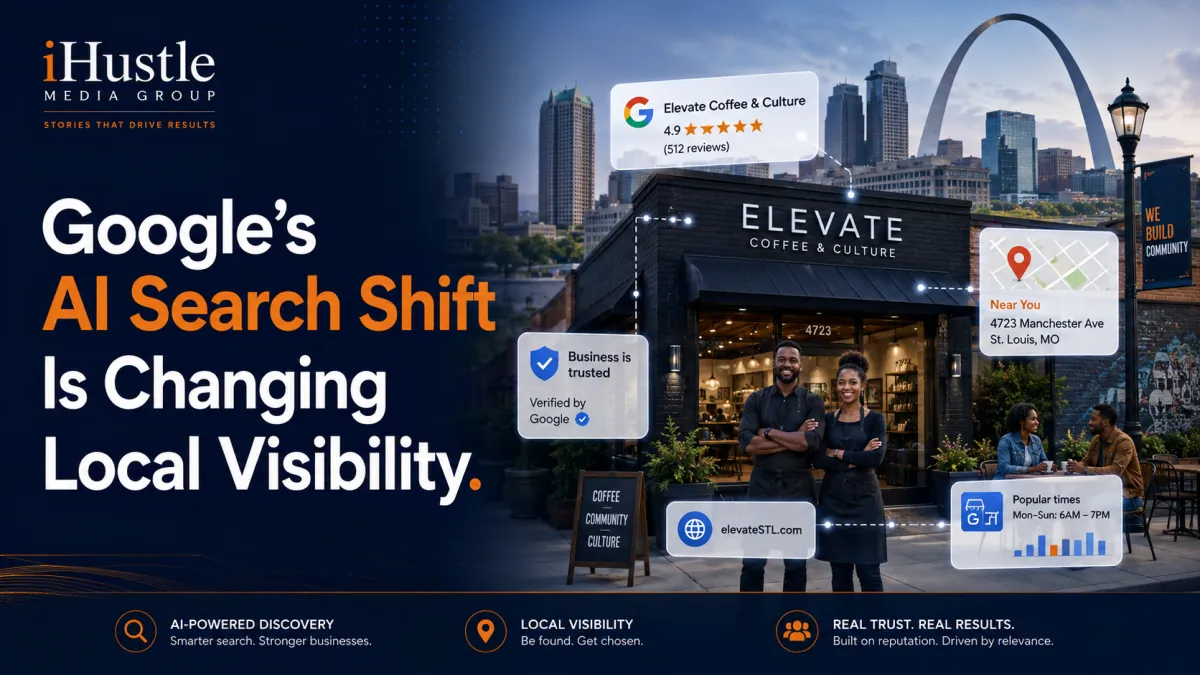
Google’s AI Search Shift Is Changing Local Visibility
For years, local business owners were taught to think about Google in a fairly simple way.
Rank higher.
Use the right keywords.
Build citations.
Get backlinks.
Optimize your website.
Fill out your Google Business Profile.
That advice is not wrong. It is just incomplete now.
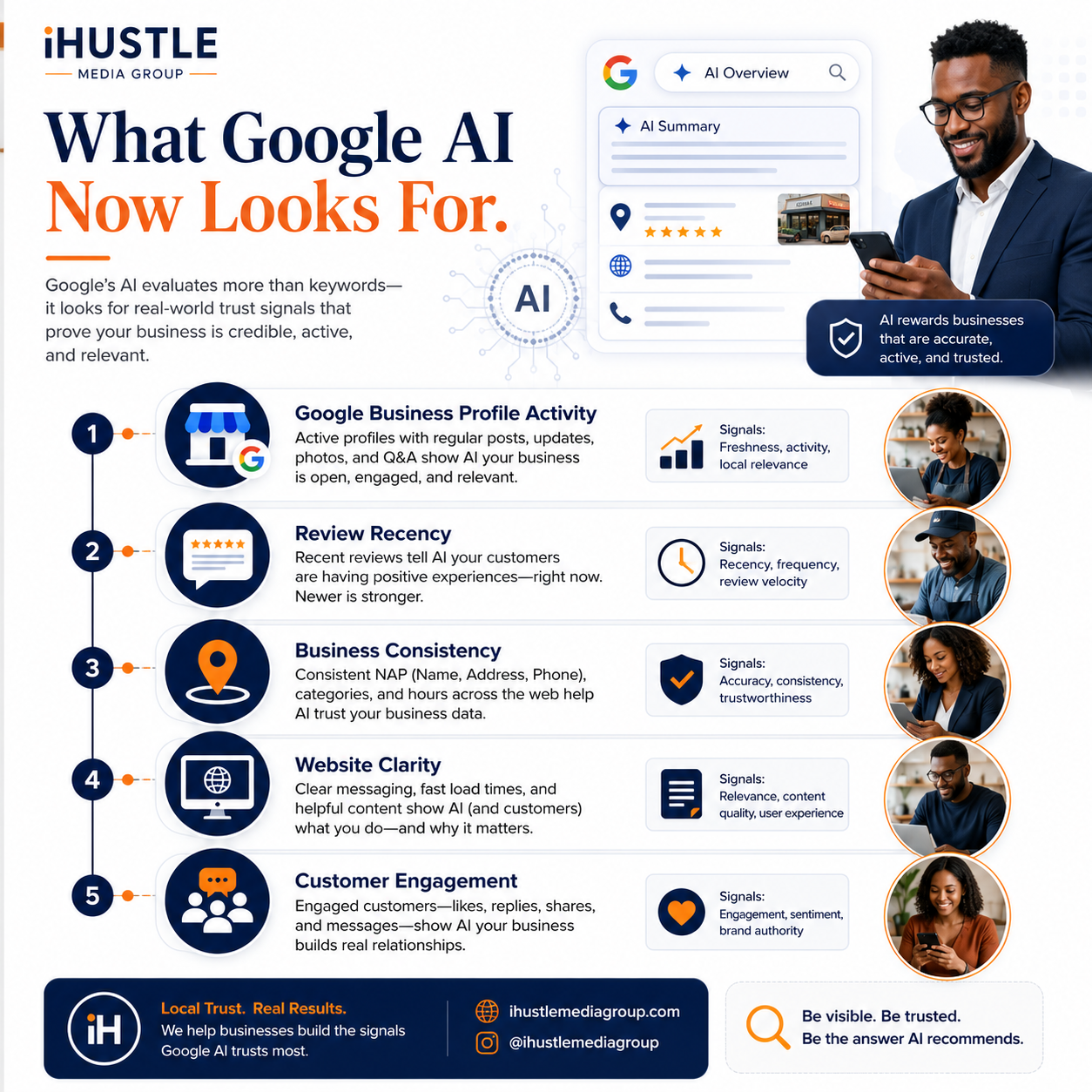
Google’s search experience is changing, and local businesses need to understand what that means in practical terms. Search is becoming more AI-driven. That means Google is doing more than indexing your business information and listing it in results. It is increasingly interpreting what your business is, how trustworthy it appears, and whether it should be recommended.
That is a different game.
The question is no longer just, “Can people find your business?”
The better question is, “Does Google trust your business enough to surface it, summarize it, and recommend it?”
That shift matters because many local businesses still operate like the old rules are enough. They set up a Google Business Profile once, update it every now and then, ask for reviews occasionally, and assume their website is doing its job because it exists. Meanwhile, search behavior is changing, buyer expectations are rising, and Google’s systems are getting better at evaluating the full picture.
That full picture is what I want you to focus on.
Your Business Is Being Interpreted, Not Just Indexed
In the old model, visibility was often treated like a technical SEO issue. If you had the right keywords and enough location signals, you had a shot at showing up.
In the new model, Google’s AI-powered systems are looking harder at trust, clarity, freshness, and consistency.
That means your online presence is no longer a collection of disconnected assets.
Your Google Business Profile, your reviews, your website, your photos, your service information, your customer engagement, and your broader digital footprint all work together to tell a story about your business.
If that story looks incomplete, inactive, inconsistent, or outdated, your visibility can suffer even if your actual service is excellent.
This is why some businesses quietly lose momentum online without realizing what changed. They are still doing good work. They are still serving customers well. But their digital signals are weak, stale, or disconnected, and that makes them harder for AI-driven search systems to trust.
Google Business Profile Is Becoming More Important, Not Less
A lot of businesses still treat their Google Business Profile like a directory listing.
That mindset is too small.
Your profile is often the first trust checkpoint in the local buyer journey. Before someone visits your website, they may look at your reviews. Before they call, they may scan your photos. Before they choose you, they may compare your activity level, your response patterns, your categories, your hours, and the overall quality of your profile.
That means your Google Business Profile is not just a place where your business “shows up.” It is part of your conversion system.
If your profile is inactive, if your photos are old, if your reviews are stale, if your responses are missing, or if your business details are inconsistent, you are giving both customers and Google weaker signals than you think.
This is one of the biggest local visibility mistakes I see right now.
Businesses assume that because they claimed their listing, they handled the issue.
They did not.
An active, trustworthy, complete profile has become part of the modern local growth system.
Reviews Are No Longer Just Social Proof
Reviews have always mattered, but they carry more weight now because they help shape trust at scale.
Fresh reviews tell Google and potential customers that your business is still active and still delivering results. Thoughtful owner responses show engagement. Consistent ratings help reduce buyer hesitation. A steady flow of proof is one of the easiest ways to strengthen local authority.
On the other hand, stale reviews can create doubt.
If your last review was months ago, if you have very few recent mentions, or if negative feedback sits unanswered, that weakens your trust position. It may not kill your visibility overnight, but it contributes to a pattern. And patterns are exactly what AI systems are getting better at evaluating.
That is why review generation cannot stay a random task.
It needs to be operational.
You need a system that asks at the right time, follows up consistently, and encourages more recent proof to enter the ecosystem.
Your Website Still Matters, but Not in Isolation
Some businesses over-focus on their website design while under-focusing on how that website connects to the rest of their visibility system.
A beautiful site is not enough if it is disconnected from your Google profile, your calls to action, your service clarity, and your follow-up process.
Your website should reinforce what Google already sees elsewhere:
clear services
clear service areas
consistent business information
trust-building content
easy next steps
proof of results
If your website feels vague, outdated, or inconsistent with your Google Business Profile, that creates friction.
The goal is not just to have a website.
The goal is to have a website that strengthens trust and supports the journey from search to inquiry.
Local Visibility Now Favors Connected Systems
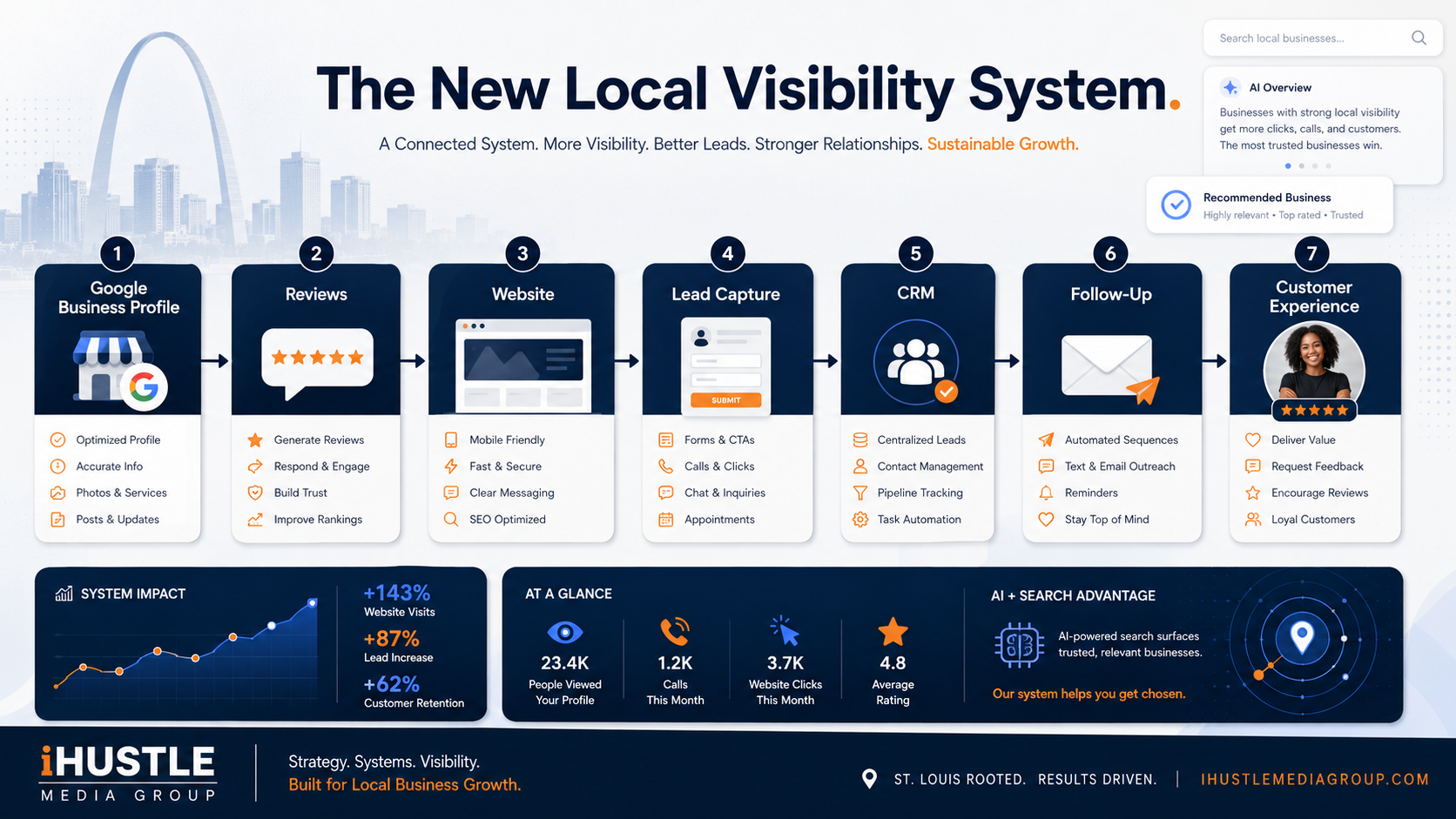
This is the real takeaway.
Local visibility is no longer just a marketing tactic. It is the visible output of a connected business system.
When visibility, trust, lead capture, CRM, automation, follow-up, and customer experience are disconnected, growth becomes fragile.
You may still get some traffic.
You may still get some calls.
You may still get some leads.
But the results will be inconsistent because the system underneath the visibility is weak.
The businesses that win in this next era of local search will be the ones that connect the dots.
They will keep their Google Business Profile active.
They will generate and respond to reviews consistently.
They will keep their website aligned and clear.
They will make it easy for customers to take the next step.
They will support visibility with a stronger customer experience.
That is what creates durable visibility.
Not random activity.
Not once-in-a-while updates.
Not hoping the algorithm works in your favor.
A system.
Actionable Checklist: Strengthen Your Local Visibility in the AI Era
Use this as a practical audit for your business this week.
Google Business Profile
Confirm your business name, address, phone number, hours, and categories are accurate
Add fresh photos that reflect your current business
Review your services and descriptions for clarity
Make sure your profile is complete, not just claimed
Reviews and Trust Signals
Check how recent your last 5 reviews are
Respond to recent reviews, both positive and negative
Build a simple review request process after completed jobs or successful client outcomes
Identify whether review generation is systemized or random
Website Alignment
Make sure your website matches your Google Business Profile details
Clarify your services, service area, and next steps
Remove vague messaging that makes buyers guess
Add visible trust signals like testimonials, case examples, and clear contact paths
Customer Journey
Test what happens when someone calls, fills out a form, or clicks from Google
Look for slow follow-up, broken steps, or confusing handoffs
Make sure inquiries are being captured, routed, and followed up properly
Check whether your visibility system actually leads to action
Ongoing Activity
Commit to weekly profile attention, not random updates
Track review freshness and profile activity monthly
Treat local visibility as an operating priority, not a side task
Ask one question regularly: “Does our digital presence make us easy to trust?”
The businesses that stay visible will be the ones that stay active, trustworthy, and clear.
That is the new standard.