


How to Automate Social Media Lead Generation in 2026
Automation should move a promising social interaction toward a conversation, not pretend to have one for you. That’s the difference between a system that builds trust and one that makes your outreach feel robotic. If you’re trying to automate social media lead generation, the goal isn’t to automate every reply. It’s to make sure relevant engagement gets noticed and followed up while it still matters.
It’s frustrating when comments, questions, and messages don’t consistently turn into qualified conversations. Manual follow-up can slip, but automating too much can make genuine prospects feel like they’re talking to a machine. A better approach is to automate the handoff and keep human judgment where it counts.
This guide shows you how to build a practical workflow from social interaction to timely, relevant follow-up, with clear points for human involvement. You’ll learn what to automate, how to distinguish buying signals from likes and shares, and which measures can show where leads stall. Whether your business serves St. Louis, St. Charles, St. Peters, Florissant, Hazelwood, Ferguson, or Chesterfield, the aim is a repeatable system that saves time without sacrificing trust.
Key Takeaways
- Separate casual engagement from buying intent so your team can prioritize signals that merit a real follow-up.
- Map each step from social signal to conversation, with a clear owner, next action, and visible lead status.
- Compare manual follow-up, platform tools, and connected systems by how well they fit your workflow and preserve human oversight.
- To automate social media lead generation, start with one channel and one high-intent signal, then define ownership, escalation, and opt-out handling.
- Once the handoff is clear, assess whether Social Lead Web fits your approach to turning social visibility into qualified conversations.
Automate social media lead generation by fixing the engagement-to-lead handoff
Social media lead generation automation is a coordinated process for capturing relevant interactions, responding appropriately, and routing potential prospects to a clear next step. It isn’t a machine that turns every like into a sales opportunity.
A reaction creates visibility. A question about whether your service fits a particular need, how to get started, or what happens next may signal buying intent. The distinction matters: lead generation is about identifying potential customers, not treating every sign of attention as a qualified lead.
Handoffs break when social messages sit in disconnected inboxes, replies are delayed, or no one knows who owns the next step. An inquiry can be overlooked because it arrived on the wrong account or someone assumed another person would handle it. To automate social media lead generation effectively, decide what counts as a meaningful signal and where it should go.
Which social interactions can signal a potential lead?
Look beyond low-intent reactions such as likes or general praise. A comment asking whether your service supports a specific use case, a direct message describing a challenge, or an inquiry about next steps gives you more context to assess.
Context still matters. A question may reflect curiosity, not an invitation to pitch. Use the interaction to guide a relevant response, and don’t treat every commenter or message sender as having agreed to sales outreach.
What should automation handle, and what should stay human?
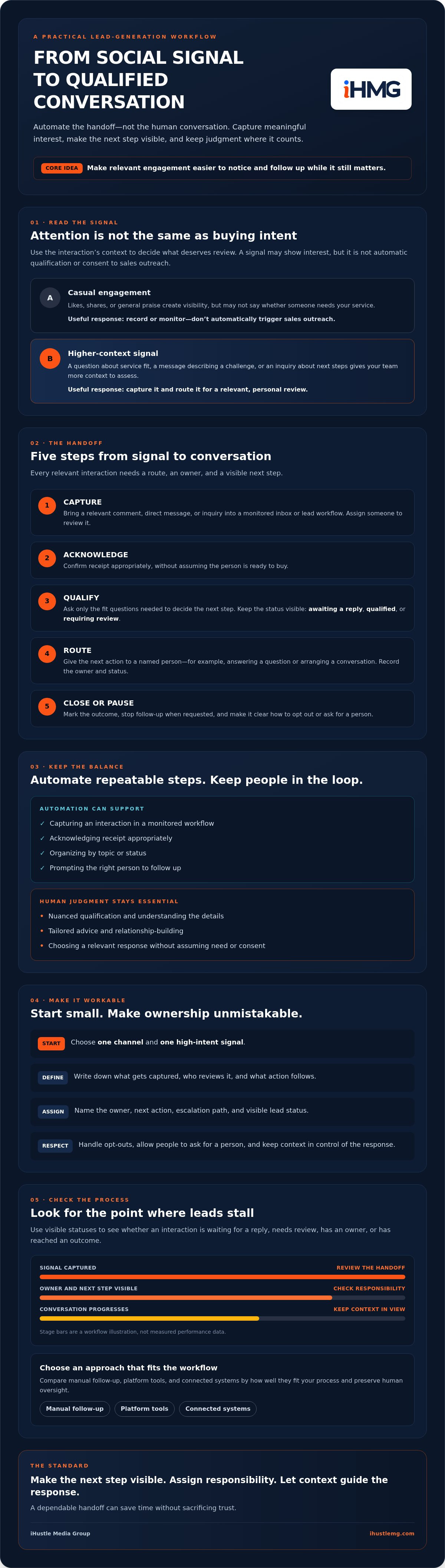
Automation can capture an interaction, acknowledge receipt, organize it by topic or status, and prompt the right person to follow up. These repeatable steps reduce the chance that a meaningful signal disappears in a busy inbox.
Keep nuanced qualification, tailored advice, and relationship-building available to a person. A system can flag that someone asked about fit; a human can understand the details and respond with judgment. Automation should support a relevant next step, not make assumptions about someone’s needs or consent.
Before setting up tools, write down the handoff in plain language: what signal gets captured, who reviews it, and what action follows. For example, route a service-fit question for personal review, while recording a general reaction without triggering outreach. This distinction keeps the process useful instead of noisy.
The standard is simple: make the next step visible, assign responsibility, and let the interaction’s context determine the response. That’s how a social presence can become a dependable path to qualified conversations without confusing activity with opportunity.
How an automated social lead generation workflow moves from signal to conversation
A reliable workflow gives every relevant interaction a route, an owner, and a visible next step. Without that structure, even a timely notification can end in a forgotten message or duplicate replies. As Forbes explains in its overview of effective social media marketing, lead generation is one goal of social media activity. The workflow connects that goal to an actual conversation.
Map the process from the moment someone signals interest to the point where a person takes over. Keep each stage simple enough to understand at a glance:
- Capture: A relevant comment, direct message, or inquiry enters a monitored inbox or lead workflow. Assign someone to review it.
- Acknowledge: Send an appropriate confirmation that recognizes the inquiry without assuming the person is ready to buy.
- Qualify: Ask only the fit questions needed to determine the right next step, and mark the interaction as awaiting a reply, qualified, or requiring review.
- Route: Assign the next action to a named person, such as answering a question or arranging a conversation. Record the owner and status.
- Close or pause: Mark the outcome, stop follow-up when requested, and provide a clear way to opt out or ask for a person.
Fast, relevant follow-up depends on a defined workflow. It clarifies the next action, assigns responsibility, and gives every prospect a way to redirect or stop the conversation.
What happens after someone engages with your social content?
Once a relevant signal reaches the monitored workflow, acknowledge it in a way that matches what the person actually said. For example: “Thanks for asking about how this works. What are you hoping to solve?” That invites context without treating a question as a commitment to buy.
Then offer one clear next step. Depending on the inquiry, that could be answering a question, inviting the person to request a conversation, or asking for a direct response from a team member. Make the option to speak with a person easy to find.
How should a lead be qualified and routed?
Choose a small set of questions tied to your service and sales process, such as what the person needs help with and whether they’re exploring a solution now. Don’t turn an initial exchange into an interrogation. Send complex questions, requests for specific advice, and clear buying interest to a person rather than relying on a rigid automated script.
Track a practical status such as “new,” “awaiting reply,” “needs human follow-up,” or “closed.” Each status should point to an owner and next action, so follow-up doesn’t depend on memory. If you’re reviewing your own handoff, map your social lead workflow before adding more automation.
Choose a social media lead automation approach that fits your team
The right setup isn’t the most elaborate one. It’s the approach your team can use consistently to capture interest, assign the next step, and involve a person when judgment matters. Before you automate social media lead generation, compare options against your actual workflow, not a list of features you may not need.
| Approach | Best fit | What to assess |
|---|---|---|
| Manual follow-up | A manageable flow that a clear owner can review and respond to reliably. | Are inquiries being missed? Is ownership clear? Can the team see what needs follow-up? |
| Basic platform tools | A simple process centered on the tools already available in the social platform. | Confirm which capture, notification, organization, and response functions are currently supported. Don’t assume every platform offers the same capabilities. |
| Connected lead-conversion system | A workflow that needs a more structured handoff from social interaction to business conversation. | Verify platform compatibility, integrations, data handling, lead-status visibility, and how a person can review or take over a conversation. |
When is manual follow-up enough, and when does it break down?
Manual handling can work when the team knows where inquiries arrive, who owns them, and how follow-up is tracked. The deciding factor isn’t a universal lead-volume threshold. It’s whether your current routine holds up under your team’s actual workload.
Review the process if messages are missed, prospects receive duplicate replies, or no one can tell who owes the next response. Those are signs of a workflow problem, not automatic proof that you need a complex system. First, identify where the handoff fails.
How can you assess an automation system before adopting it?
Start with the steps your process actually requires. Can the system support the handoff you’ve mapped, make lead status visible, and let the right person review a conversation? Treat each as something to verify, not an assumed feature.
Then confirm supported platforms and integrations, what information is captured and stored, and which settings your team can control. Test how the system handles an unclear inquiry, a request to speak with a person, and an opt-out. If those paths aren’t clear, the tool may add another layer of confusion instead of fixing the handoff.
Choose for fit. A small team with a dependable manual routine may need only clearer ownership; a more involved sales process may call for structured capture and routing. iHustle Media Group’s AI System Diagnostic evaluates a business’s current digital infrastructure to identify automation opportunities and provide actionable insights for lead flow and operational efficiency. The goal is not maximum automation. It’s a process your team can oversee, measure, and adjust as the work changes.
Set up social media lead automation with a measurable, respectful process
Don’t automate every channel at once. Start with one channel, one high-intent signal, and one follow-up path you can review from start to finish. For example, choose a direct inquiry about service fit, decide who reviews it, and define the next action before enabling an automated response.
What should a simple first workflow include?
Write down the trigger, the acknowledgement, the owner, and the point where a person takes over. Keep the message short and relevant: “Thanks for reaching out. What would you like help with?” Avoid pressure, exaggerated promises, or language that implies the person has agreed to a sales conversation.
Set escalation conditions in advance. A complex question, request for tailored advice, or direct request to speak with someone should reach a team member. Define how to stop follow-up when someone opts out, too. For broader system context, explore this social media lead automation guide.
Which measures reveal whether the handoff is working?
Track movement through the workflow, not just visible engagement. Useful measures include inquiries captured, inquiries assigned, qualified conversations, response status, and leads stalled without a next action. Review them regularly to see where the process loses momentum, then adjust the handoff or ownership rather than simply adding more automation.
For downstream context, see the AI sales pipeline automation blueprint. It can help connect social-originated conversations to later pipeline stages.
Keep the first version practical. Record what counts as a qualified conversation, who owns each status, how long an inquiry can remain without a next action, and what happens if the contact asks to pause. These definitions give your team a shared standard and make results easier to interpret.
A useful review asks: Did the inquiry reach the right owner? Was the next step clear? Did a person step in when context called for judgment? If you still can’t identify where prospects stall, review your lead workflow with iHustle Media Group to explore where the handoff needs more structure.
Turn social engagement into qualified conversations with the right next step
The decision starts with the handoff, not the tool. Clarify how a relevant interaction becomes a conversation, who takes responsibility, and where a human needs to step in. Then choose an approach that supports that workflow instead of adding automation for its own sake.
If you want to automate social media lead generation, use a practical standard: make it easier to move from social visibility to a relevant next step while keeping human judgment in the process. A related social engagement-to-revenue blueprint offers another perspective on structuring that path.
When might Social Lead Web fit your business?
Social Lead Web is iHustle Media Group’s flagship system for bridging social media engagement and business leads through qualified conversations and automated follow-up. It may be worth exploring if your team wants a more structured way to move from visibility to conversations without relying on paid ad management.
Fit depends on your actual workflow. Before choosing any system, confirm which social platforms and integrations are supported, how the handoff would work for your team, and where people can review or take over conversations. Don’t assume a tool supports a channel or process until those details are confirmed.
What should you clarify before taking the next step?
Bring a clear picture of the current process. Note the channels where engagement arrives, the sources of inquiries, who owns follow-up, and where prospects most often stall. Then identify what you want to monitor, such as captured inquiries, qualified conversations, and whether each lead has a clear next action.
- Channels and sources: Where do relevant interactions begin?
- Ownership: Who reviews each inquiry and moves it forward?
- Drop-off points: Where does follow-up slow down or become unclear?
- Measures: What statuses would help your team see progress and gaps?
These answers make a conversation about fit more useful. They also help you assess whether a system supports your needs without assuming it suits every business or promises a particular lead volume or conversion rate.
If the handoff still feels unclear, explore Social Lead Web as a possible next step. Start with the workflow you want to improve, then determine whether the system fits your channels and the way your team handles conversations.
Build a social-to-lead handoff your team can trust
To automate social media lead generation effectively, start with the handoff, not the tool. Define which interactions show meaningful intent, assign an owner and next action, and track where conversations move forward or stall.
Choose automation that fits your team’s workflow and leaves room for human judgment. Consistent capture and follow-up can support the process, but nuanced questions, qualification, and relationship-building still benefit from a person who understands the context.
Social Lead Web is iHustle Media Group’s flagship offering, designed to bridge social engagement and qualified business conversations. If you’re assessing how to structure that transition, explore Social Lead Web and see how it can structure your social-to-lead handoff.
You don’t need to automate everything to make progress. Build a clear, respectful process, review what happens at each stage, and refine the handoff as you learn. A better system makes it easier for the right social interactions to become real conversations.
Frequently Asked Questions
Can you automate social media lead generation without paid ads?
Yes, you can automate social media lead generation without paid ads by creating a clear process for capturing relevant engagement and following up. Organic comments, direct messages, and service inquiries can enter a lead workflow, where they’re reviewed, assigned, and moved toward a suitable next step. iHustle Media Group positions Social Lead Web as a system that bridges social engagement and qualified business conversations without paid ad management.
How do you turn social media comments and messages into qualified leads?
Start by distinguishing questions that show potential intent from casual reactions. A comment asking whether your service addresses a specific need or a message requesting next steps may warrant follow-up. A like alone usually isn’t enough context. Acknowledge the person’s actual question, ask a relevant fit question if needed, and route complex inquiries to a team member. Track the owner and next action so interest doesn’t disappear in an inbox.
Is social media lead automation too impersonal for service businesses?
It can feel impersonal if every interaction receives the same scripted pitch. Use automation for consistent capture, organization, and a relevant acknowledgement, then make it easy for someone to speak with a person. Keep tailored advice, nuanced qualification, and relationship-building human-led. For a service business, the goal isn’t to automate the relationship. It’s to prevent useful inquiries from being overlooked while preserving a response that reflects the person’s context.
What should you automate in social media lead generation?
Automate repeatable steps that support the handoff: capturing relevant inquiries, acknowledging receipt, organizing lead details, assigning ownership, and prompting an appropriate next action. Keep judgment-heavy tasks, such as interpreting an unusual request or recommending a service, available to a person. Before launch, define what triggers follow-up, who reviews the conversation, and how someone can request human help or stop further messages.
How do you measure whether social media lead automation is working?
Measure whether relevant inquiries are captured, assigned, and given a clear next action. Then review how many become qualified conversations and where follow-up stalls, such as waiting for review or a prospect’s reply. Engagement counts can show attention, but they don’t reveal whether the handoff is working. Use the stages in your workflow to identify bottlenecks and decide what to adjust.
Can small businesses automate social media follow-up?
Yes. A small business can begin with a simple workflow for one channel and one meaningful inquiry type. Make sure someone owns review and follow-up, and use automation only for steps the team can monitor. Businesses serving St. Louis, St. Charles, St. Peters, Florissant, Hazelwood, Ferguson, or Chesterfield can apply the same principle: build around the way their team handles inquiries, not an assumed volume threshold.
How do you avoid spam when automating social media lead generation?
Keep messages relevant to the interaction, avoid sending repeated generic pitches, and don’t treat a public reaction as permission for unsolicited sales outreach. Give people a clear way to ask for a human response or opt out, and stop follow-up when requested. Check the current rules for each platform and confirm that any tools you choose are compatible with its requirements. Review automated messages regularly to keep them accurate and respectful.