


How to Scale Lead Flow with AI Without Losing the Human Touch
What if the fastest way to scale lead flow with AI isn’t to automate every interaction, but to improve the handoffs between them? More automation won’t fix a process where social engagement stalls before a sales conversation, follow-up depends on someone finding time, or lead activity is scattered across channels.
As inquiries grow, faster and more consistent follow-up matters. But speed without context can make a promising lead feel like a number. AI is most useful when it handles repeatable steps and surfaces relevant information, while people stay involved where judgment, trust, and a real conversation matter.
This article shows how to connect lead capture, qualification, follow-up, and measurement in a system that can grow with your business. You’ll learn to spot bottlenecks between the first signal and a sales conversation, use automation without losing human oversight, and improve the flow you already have instead of adding disconnected tools. The goal is a clearer path from online attention to qualified conversations.
Key Takeaways
- Map the journey from first signal to sales conversation to reveal where leads lose momentum.
- Use AI to capture context, route inquiries, and support consistent follow-up while keeping people involved where judgment matters.
- To scale lead flow with ai, start with one high-friction handoff instead of automating multiple stages at once.
- Compare manual, rules-based, and AI-supported tasks to decide what to automate and what needs a human touch.
- Explore how Social Lead Web connects social engagement with qualified conversations and follow-up, while AI System Diagnostic helps identify automation opportunities.
Why scaling lead flow with AI starts with fixing the handoffs
More attention can look like growth, but views, comments, and inquiries won’t become a consistent pipeline unless each signal has a clear next step. Lead flow is the connected journey from someone first noticing your business to becoming a qualified sales conversation. If you want to scale lead flow with ai, examine how people move through that journey before adding another tool.
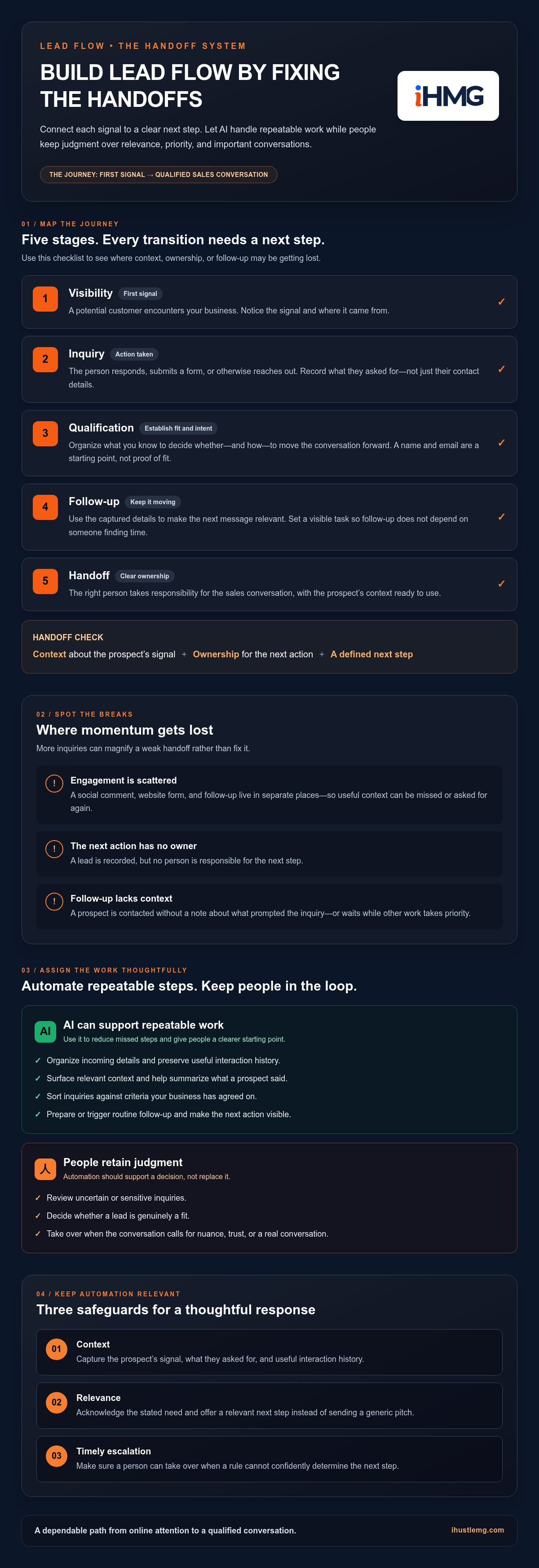
Think of the journey as five stages: visibility, when a potential customer encounters your business; inquiry, when they take action; qualification, when you establish fit and intent; follow-up, which keeps the conversation moving; and handoff, when the right person takes responsibility for the sales conversation. Each transition needs context, ownership, and a defined next action.
AI-supported lead flow connects signals and repeatable actions across those stages, while people retain judgment over relevance, priority, and important conversations. AI can support marketing work such as lead generation, personalization, and automation, as outlined in Artificial Intelligence in Marketing. Its value depends on how well the system fits your actual process.
Where leads stall between engagement and a sales conversation
Consider a consulting firm that shares useful advice on social media. A prospective client comments, later fills out an inquiry form, and describes a specific challenge. If the comment, form, and follow-up sit in separate places, the consultant may miss that context, ask the person to repeat themselves, or leave the inquiry waiting while other work takes priority.
These aren’t failures of visibility. They’re breaks between stages. A lead may be recorded without an owner, marked as qualified without a follow-up task, or contacted without a note about what prompted the inquiry. Repeated manual work makes these gaps more likely: details get entered inconsistently, and responses depend on who sees a notification and when. More inquiries can magnify a weak handoff rather than fix it.
What AI can improve and what still needs human judgment
AI can assist with repeatable tasks: organizing incoming details, surfacing relevant context, sorting inquiries against agreed criteria, and preparing or triggering routine follow-up. This support is useful when it reduces missed steps and gives a person a clearer starting point. Without context, however, automation can send a generic message that ignores what the prospect actually asked.
Keep human decision points clear. A person should be able to review uncertain or sensitive inquiries, decide whether a lead is genuinely a fit, and take over when the conversation calls for nuance. Useful automation depends on three things: context about the prospect’s signal, relevance to their stated need, and timely escalation when a rule can’t confidently determine the next step. The aim isn’t to make every exchange automatic. It’s to make the path to a thoughtful response more dependable.
How AI connects lead capture, qualification, and follow-up
A connected lead flow turns an initial signal into a recorded next step, not just another notification. A prospect might respond to a social post, submit a website inquiry, or reply to an email. Each entry point should feed a process that preserves what they said, identifies who owns the next action, and makes follow-up visible.
Lead capture records that someone has engaged; lead qualification organizes what you know so you can decide whether and how to move the conversation forward. The distinction matters. A name and email address are a starting point, not proof that someone fits your service or is ready to speak with sales.
Capture useful context when a prospect first engages
At capture, retain details that make the next interaction more relevant: where the prospect came from, what they asked for, and useful interaction history. Social media can be one entry point alongside website forms, email, referrals, or other channels. The principle behind Social Media Lead Automation: Scaling Beyond the Manual DM Grind in 2026 is useful here: turn social engagement into an organized next step instead of leaving a promising exchange buried in a message inbox.
For example, a consultant’s inquiry record might note that the prospect arrived through a social post and wants help with a specific business challenge. Routing can direct the inquiry to the appropriate person or queue, while a task records the next action. AI can help organize or summarize these details, but the business should define what gets captured and who responds.
Use qualification and follow-up to move leads forward
Qualification works best when it reflects your actual service and sales process. Define human-led criteria such as the need expressed, the type of support requested, and whether there’s enough information to begin a useful conversation. AI can help sort incoming signals against those criteria, but a score or label should support a decision, not replace it. IBM’s AI for Lead Generation Explained by IBM offers further context on how AI can support lead-generation work.
Once an inquiry is routed, follow-up should use the details already captured. If a prospect asked about a particular challenge, acknowledge it and offer a relevant next step rather than sending a generic pitch. Set rules for what happens when information is missing, a lead falls outside your criteria, or a person hasn’t responded. That prevents automation from treating every inquiry as identical.
- Capture: Record the source, stated need, and relevant interaction details.
- Route: Assign an owner or destination based on clear business rules.
- Qualify: Organize signals against criteria your team has defined.
- Follow up: Create a timely, context-aware next action and record its status.
This is the practical foundation to scale lead flow with ai without making the experience feel scripted. For a closer look at how connected follow-up fits into a broader process, AI Sales Pipeline Automation: The 2026 Blueprint for Scalable Growth explores the pipeline perspective. iHustle Media Group’s Social Lead Web approach connects social visibility with qualified conversations and follow-up.
AI lead flow vs. manual follow-up: where automation helps and where it fails
Automation isn’t the opposite of personal service. Poorly designed automation is. The question isn’t whether to automate lead follow-up, but which tasks benefit from consistency and which need a person’s judgment. This comparison can help you decide where to start.
- Manual: A person reviews each inquiry, decides what it means, and chooses the next step. This suits nuanced conversations, but repetitive sorting and reminders can be delayed or handled inconsistently.
- Rules-based: A defined trigger prompts a predictable action, such as assigning an inquiry by service type or creating a follow-up task. It’s dependable when the input and process are clear, but rigid rules can miss context.
- AI-supported: AI can organize inquiry details, surface relevant context, help sort leads against criteria, or prepare a follow-up prompt. A person should review uncertain signals and own consequential decisions.
These approaches can work together. Rules provide structure, AI can help interpret or organize information, and people handle decisions where context matters. Choose the mix based on your sales process, not just a tool’s capabilities.
Which lead-flow tasks are suitable for AI assistance?
Start with work that repeats and has a clear purpose: organizing inquiry details, suggesting an initial route, flagging a missing field, or prompting consistent follow-up. These tasks are easier to support when the business has defined what information matters and what action should follow.
Clear inputs matter. If inquiry records are incomplete or your team hasn’t agreed on what makes a lead relevant, AI may sort inconsistently or create polished but unhelpful messages. It can assist with a process; it can’t independently guarantee qualified leads or closed sales.
When a person should take over the conversation
Some signals call for a human response: a prospect describing a nuanced need, raising a sensitive concern, asking for personal guidance, or presenting circumstances that don’t fit your usual criteria. A generic sequence can feel impersonal, especially if it repeats questions the prospect has already answered or pushes a pitch that doesn’t match their request.
Set escalation rules before automating. For example, route uncertain inquiries to a person, pause routine follow-up when someone requests direct contact, and make the assigned owner visible. These rules give a prospect a clear path out of automated exchanges. Human review isn’t a breakdown in the system; it’s one of the ways to keep the system responsive as volume grows.
To scale lead flow with ai, automate repeatable steps while preserving context and a clear human handoff. That balance keeps routine work moving without treating every prospect as if they asked the same question.
How to implement AI lead flow without adding another disconnected tool
Another platform won’t solve a handoff nobody has mapped. Before adding AI, examine how inquiries already move through your business, including the forms, inboxes, and records your team uses. A service business in St. Louis, St. Charles, or nearby communities might receive requests through its website and social channels, then manage responses in separate places. The goal is to connect the process, not simply add another destination for lead data.
Start with a lead-flow map and one measurable bottleneck
Trace each inquiry from arrival to next action: where it came from, who responds, what happens next, and where the details are recorded. Look for observable friction, such as a delay between inquiry and first response or a lead with no clear owner. The diagnostic approach in AI Business Diagnostic Tool: Plugging the Profit Leaks in Your Lead Architecture reflects a useful starting point: find the process gap before selecting an automation.
Then roll out the workflow in sequence:
- Map the current flow. Follow a few real inquiries across channels and document each handoff, including where information gets copied or lost.
- Choose one bottleneck. Use missed assignments, inconsistent records, or observed delays to identify a specific friction point. Don’t assume an industry average reveals your problem.
- Define the rules. Decide what information is needed, who owns the next action, and which situations require human review.
- Pilot a narrow workflow. Apply the change to one channel or handoff first. Keep the existing process visible so the team can spot errors and intervene.
- Review and refine. Check what happened, adjust the rules, and extend the workflow only when the pilot is useful and reliable.
Pilot, review, and improve the workflow
Keep the first test focused. For instance, a home-services business could pilot routing website inquiries to the right owner with a follow-up task attached, rather than automating every channel at once. Review actual interactions for accurate details, relevant messages, and appropriate escalation. If the workflow sends a mismatched response or leaves an inquiry without an owner, fix that handoff before expanding.
Lead-flow measurement should track whether handoffs happen, not just how many leads arrive. Review a few practical signals:
- Response consistency: Are inquiries receiving the expected next step?
- Handoff completion: Is an owner assigned, and is the action recorded?
- Qualified conversations: Are inquiries progressing to useful sales discussions?
- Stage progression: Where do leads pause or exit the process?
These measures help you see whether automation is reducing friction or simply moving work elsewhere. An AI System Diagnostic evaluates existing digital infrastructure and identifies automation opportunities. That gives you a grounded starting point to scale lead flow with ai, one measurable handoff at a time.
How iHustle Media Group helps turn AI into a lead-flow system
AI creates value when it strengthens the path from attention to a real business conversation. That takes more than switching on an automated message. It means connecting social visibility, the prospect’s expressed interest, relevant follow-up, and a clear next step, while keeping people involved where judgment matters.
iHustle Media Group focuses on improving that system rather than adding technology for its own sake. Social Lead Web bridges social media engagement with qualified business conversations and automated follow-up. It supports a path from visibility to opportunity without relying on paid ad management.
Turn social visibility into a clearer path to qualified conversations
A comment or message can signal interest, but it still needs a useful next step. Social Lead Web helps create a clearer transition from engagement to follow-up, so social activity has a route toward a business conversation instead of remaining isolated in a feed or inbox. The focus is systemic: connect the signal to an appropriate response and make the next step easier to manage.
This focus also connects with the thinking behind Social Engagement to Revenue: 2026 Systemic Blueprint: engagement matters most when there’s a practical path from interaction to opportunity. The objective isn’t to treat every interaction as a sales-ready lead. It’s to make relevant interest easier to recognize and follow up on.
Find the next improvement in your existing lead system
Before deciding where AI belongs, understand what’s already happening across your digital infrastructure. An AI System Diagnostic evaluates existing systems and identifies automation opportunities, helping clarify where a process could benefit from support and where a person should remain involved. That assessment helps focus on a useful improvement rather than layering on another disconnected tool.
The next step might be improving how social inquiries are handled, organizing existing lead information, or identifying a follow-up task that’s repeatedly missed. The right opportunity depends on the business’s actual process. A diagnostic perspective keeps the focus on that process, not on adopting AI simply because it’s available.
Authority also plays a role in lead flow. Authority Accelerator uses AI-enhanced frameworks to strengthen a professional’s market presence, making it a related option when the priority is building a stronger position with prospective clients. It complements lead-flow improvements, but serves a distinct purpose from connecting social engagement to conversations.
If you’re ready to scale lead flow with ai, begin with the gap that matters most: the point where interest stops moving forward. Explore Social Lead Web or an AI System Diagnostic to identify a practical next step for your business, and keep human judgment at the center of the system.
Build the next step into your growth system
Scaling doesn’t require automating everything at once. Start by choosing one point where a better handoff could make the customer journey clearer, then build from what you learn. That’s how you scale lead flow with ai while keeping the experience grounded in real needs and human judgment.
Social Lead Web bridges social engagement and qualified business opportunities. If you’re unsure where automation could fit, an AI System Diagnostic evaluates your existing digital infrastructure for potential opportunities. The right next move addresses a real friction point in your business, not simply the newest technology.
Explore how Social Lead Web can connect engagement to qualified conversations, and take a practical step toward a lead system that can grow with your business. Start focused, learn from the process, and keep moving forward.
Frequently Asked Questions
How can AI help scale lead flow for a service business?
AI can help a service business scale lead flow by reducing routine handling of incoming inquiries, such as organizing contact details, creating follow-up tasks, and keeping lead records current. For example, a plumbing company could use an AI-supported process to flag a request for a specific service and prepare it for review. The owner still sets service-fit criteria and decides which opportunities merit a sales conversation.
Can AI generate and qualify leads without making follow-up feel impersonal?
Yes, when follow-up reflects what the prospect actually shared instead of relying on a generic pitch. A message that acknowledges someone’s stated challenge or requested service feels more relevant than one that simply repeats a sales script. Set boundaries for automated messaging, too: if a prospect raises a concern or asks for tailored advice, route the exchange to a person rather than continuing a sequence that doesn’t fit.
What should a business automate first in its lead-generation process?
Start with a repetitive task that’s easy to define and currently consumes attention, such as creating a reminder after a new inquiry or sorting requests into established categories. Don’t automate a step just because a tool makes it possible. First confirm that the task follows a consistent process and that someone can review exceptions. A focused first use makes it easier to see whether automation helps before expanding its role.
How do you measure whether AI is improving lead flow?
Compare the workflow before and after the change using the same measures: whether inquiries receive an assigned next action, whether records contain the information your team needs, and whether leads progress to substantive conversations. Also review examples that were delayed, misclassified, or escalated. Higher activity alone doesn’t show that the process is better; look for fewer dropped handoffs and clearer visibility into what happens next.
Is AI lead automation useful if a business already uses a CRM?
It can be, but a CRM doesn’t automatically mean every lead stage is connected or consistently used. Look for practical gaps, such as repeated manual entry, missing ownership, or follow-up tasks that aren’t recorded. iHustle Media Group’s AI System Diagnostic evaluates existing digital infrastructure to identify automation opportunities. This helps a business assess its current setup before deciding whether a workflow needs adjustment or additional AI support.
What happens if an AI system cannot answer a prospect’s question?
The workflow should treat uncertainty as a reason to involve a person, not to guess. It can record the question, flag that a response is needed, and direct the conversation to the appropriate human owner. For instance, if a prospect asks whether a service fits an unusual situation, the system should avoid inventing an answer or repeating canned messages. Clear escalation rules protect trust and help the prospect get a relevant response.
Can AI turn social media engagement into qualified business conversations?
Yes, an AI-supported process can make social engagement easier to organize and follow up on, while qualification still depends on your business’s criteria and human judgment. Social Lead Web bridges social visibility with qualified business opportunities and follow-up. It’s relevant for businesses serving St. Louis, St. Charles, St. Peters, Florissant, Hazelwood, Ferguson, and Chesterfield that want a clearer route from social interactions to business conversations.