


Lead Generation Audit for Business: Find and Fix Conversion Gaps
More leads won’t fix a process that loses prospects after they reach out. A lead generation audit for business traces what happens from first contact to sales conversation, so you can see where interest stalls, follow-up slips, or ownership gets fuzzy.
If marketing activity feels disconnected from qualified opportunities, the problem may be a lack of visibility into what happens after an inquiry arrives. Another channel or a larger pile of inquiries won’t necessarily fix that. First, understand how prospects move through your system and where each handoff builds momentum or breaks it.
This guide shows you how to map that path, review conversion points, and prioritize practical fixes based on where prospects are getting stuck. You’ll examine lead definitions, response and follow-up steps, sales-marketing handoffs, and the quality of the data behind your decisions. You’ll also see when an AI-supported diagnostic may help organize what’s already in place and identify automation opportunities. The goal is a clearer picture of your lead flow, not a more complicated process.
Key Takeaways
- A lead generation audit for business examines the full path from lead source to sales outcome, not just individual campaigns or software.
- Map each stage in order, then clarify who owns the handoff as a prospect moves from inquiry to follow-up and qualification.
- Compare conversion points using consistent lead definitions and time periods to spot where momentum drops.
- Rank potential fixes by evidence, business impact, effort, and dependencies before changing tools or processes.
- A spreadsheet may be enough for a straightforward review. Fragmented systems may call for a deeper look at infrastructure and automation opportunities.
What a Lead Generation Audit for Business Reveals About Your Pipeline
A lead count can look healthy while qualified opportunities quietly disappear. A lead generation audit for business is a structured review of where inquiries originate, how prospects make contact, who responds, how fit is assessed, and what outcome gets recorded. It diagnoses the whole path, not just a campaign or software setup.
The distinction matters. A campaign review may show which channel attracted attention, but an audit follows the prospect beyond that first interaction. For a foundation on how leads fit into the marketing funnel, see Lead generation.
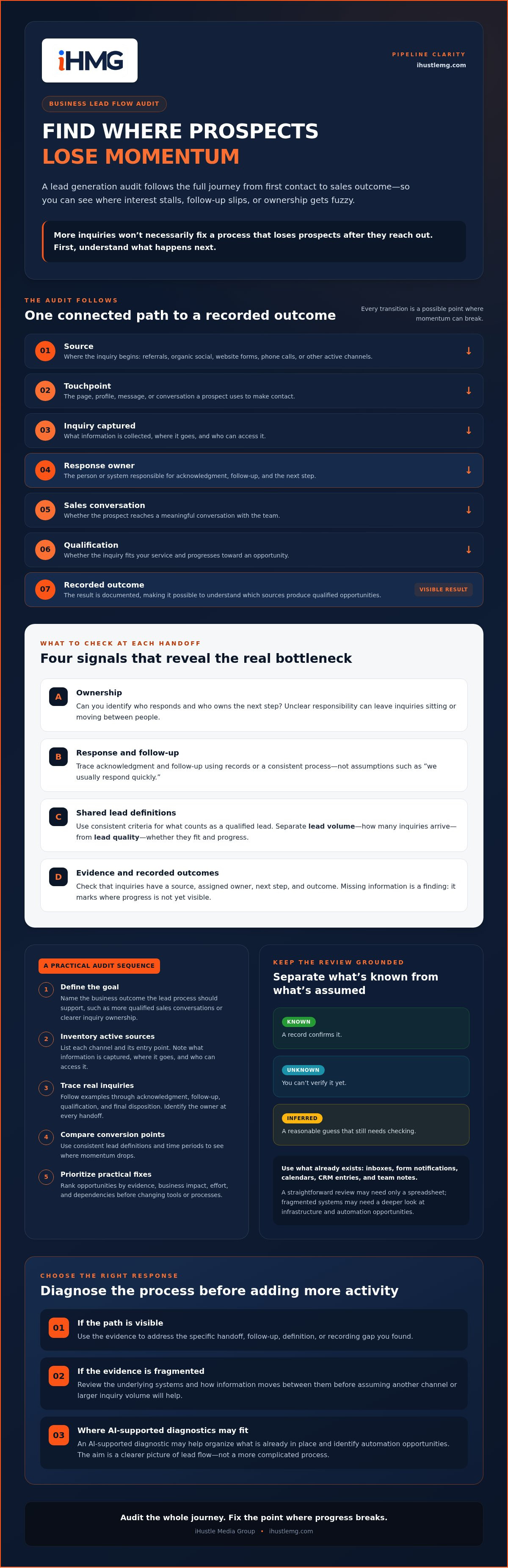
Funnel map: source → touchpoint → inquiry captured → response owner → sales conversation → qualification → recorded outcome
Every transition is a possible loss of momentum. Someone may discover a service through organic social, send a direct message, and never receive a clear next step. A web form may capture an inquiry, but leave ownership uncertain. Or a sales conversation may happen without its result being recorded, making it difficult to tell which sources produce qualified opportunities.
What should a business lead-generation audit cover?
Review the full route across the channels you actually use, such as referrals, organic social, website forms, or other sources. For each one, check the landing page or profile, what information is captured, who is responsible for responding, and what happens next. Then distinguish lead volume, how many inquiries arrive, from lead quality, whether those inquiries fit your service and progress toward a sales conversation. Activity alone doesn’t show progress.
Which businesses benefit from auditing lead flow?
Service businesses benefit when inquiries arrive through multiple channels, reach different team members, or depend on informal follow-up. This can include local operators serving St. Louis, St. Charles, St. Peters, Florissant, Hazelwood, Ferguson, and Chesterfield, where referrals, social engagement, and website inquiries may all feed the same sales process. You don’t need a large data team to begin. Existing inboxes, forms, CRM records, and team notes can show where the journey is unclear.
Start with what you can verify. Check whether each inquiry has a source, an assigned owner, a next step, and an outcome. Missing information is a finding too: it shows where you can’t yet see whether prospects are moving forward. Use the audit to expose weak handoffs before adding more activity or tools.
Audit Lead Gen: Map Every Step from Source to Sales
A useful audit follows evidence, not assumptions. Start with the goal: decide what progress means for your business, such as more qualified sales conversations or clearer ownership of incoming inquiries. Then map how a prospect moves from first contact to a recorded result. This turns a lead generation audit for business into a practical review rather than a guessing exercise.
How do you map lead sources and capture points?
List the channels currently bringing inquiries, such as website forms, social profiles, referrals, and phone calls. For each one, note what information a prospect provides, where it goes, and who can access it. A lead generation system should connect these entry points to clear next steps. The audit helps reveal whether yours do.
Keep a simple evidence trail. Mark each note as known if a record confirms it, unknown if you can’t verify it, or inferred if it’s a reasonable guess that still needs checking. Don’t treat “we usually respond quickly” as a finding unless records or a consistent process support it.
How do you trace response and qualification?
Choose a recent inquiry and follow it through acknowledgment, follow-up, qualification, and final disposition. At every handoff, identify the person or system responsible. If a social message is passed between team members without a clear owner, record the gap. If the team doesn’t share criteria for a qualified lead, note that too. Guidance on automated lead qualification can help clarify which signals and decisions the process should capture.
Use existing records first: inboxes, form notifications, calendars, CRM entries, and team notes. A small business can build a useful map without a large data team or new software.
- 1. Define the goal: Write down the business outcome you want the lead process to support.
- 2. Inventory sources: List active channels and the touchpoint where each inquiry begins.
- 3. Trace journeys: Follow sample inquiries from arrival through the next meaningful step.
- 4. Inspect handoffs: Record each owner, system, and point where responsibility becomes unclear.
- 5. Review outcomes: Check whether the inquiry became a sales conversation, was disqualified, or has no recorded result.
This sequence works for a local service business in St. Louis, St. Charles, St. Peters, Florissant, Hazelwood, Ferguson, or Chesterfield, as well as a company serving clients elsewhere. If records are scattered across tools, an AI System Diagnostic may help examine existing digital infrastructure and identify automation opportunities. Map what’s in place first, then decide whether a deeper diagnosis is warranted.
Which Lead Generation Metrics and Handoffs Reveal the Real Bottleneck?
Start by defining what each number represents. Leading indicators show activity early in the process, such as inquiries received or time until a first response. Later outcomes show whether that activity progressed, such as a completed sales conversation or a qualified opportunity. Both matter, but they answer different questions.
In a lead generation audit for business, review the source, inquiry count, response time, contactability, qualification result, and recorded disposition where those details are available. Before comparing channels, use the same definition of a lead and the same time period. If one source counts every social message and another counts only form submissions, the comparison won’t tell you which channel contributes more qualified conversations.
Which lead-generation metrics should you review first?
Build a baseline from your own records instead of importing generic conversion targets. For a defined period, note how many inquiries arrived, how many could be contacted, how many met your qualification criteria, and what happened next. Keep the time window and stage definitions consistent. If the records don’t support a metric, mark it as unavailable rather than estimating.
How can you tell whether the issue is lead quality or follow-up?
Check inquiry details alongside qualification outcomes before labeling a source as low quality. Then inspect timestamps, assigned owners, and documented next steps for inquiries that stalled. A qualified prospect with no recorded follow-up points to a different area to investigate than an inquiry that didn’t match your stated criteria.
Use the pattern as a clue, not a verdict. If one channel has fewer recorded conversations, that alone doesn’t prove the leads are weaker or the follow-up is slower. Correlation can point to where to look, but it doesn’t establish why a gap exists. Verify the journey and handoffs behind the numbers.
| Observable symptom | Evidence to inspect | Possible process area |
|---|---|---|
| Inquiries arrive, but few have a recorded response | Submission timestamps, inbox records, assigned owner | Response ownership or intake tracking |
| Prospects are contacted, but rarely reach a conversation | Contact attempts, contact details, documented next steps | Contactability or follow-up process |
| Conversations happen, but qualification is inconsistent | Inquiry details, qualification notes, team criteria | Shared qualification definitions |
| Outcomes are missing across channels | CRM entries, notes, source labels, disposition fields | Recordkeeping and data quality |
Missing or inconsistent records are a data-quality finding, not proof of poor performance. Resolve that visibility gap before deciding which channel or handoff needs a larger change.
How to Turn Lead Audit Findings into a Prioritized Improvement Plan
An audit only creates value when findings lead to decisions. Rank each issue by four factors: how strong the evidence is, the likely business impact, the effort to address it, and any dependencies, such as staff agreement, better data, or a tool change.
How should a business rank audit findings?
Give more weight to repeated, documented breakdowns than to one-off stories or assumptions. Then ask whether a proposed fix addresses the cause or only the visible symptom. If inquiries sit unassigned, clarifying ownership may be more direct than adding software. Record why each item earned its priority so you can revisit the decision as evidence changes.
Separate straightforward process corrections from changes that need coordination. A clearer next-step instruction may be quick to test. Connecting systems, aligning qualification criteria across sales and marketing, or improving incomplete records may take more planning. Don’t treat every finding as an urgent project.
How do you test whether a fix is working?
Choose one clearly scoped process change where practical, and record when it begins. Compare the relevant measure before and after using the same lead definitions and a suitable observation period for your sales process. For example, if you clarify who owns incoming inquiries, review whether ownership and follow-up are recorded more consistently. A change in the numbers is useful evidence, but it doesn’t automatically prove what caused it.
If your finding points to a gap between a qualified inquiry and the next pipeline step, an AI sales pipeline automation guide may help you think through the handoff. Keep the test grounded in your own process and records.
Use this compact action plan for each priority in your lead generation audit for business:
- Finding: What specific breakdown did the evidence show?
- Evidence and baseline: What records support the finding, and what does the current process look like?
- Priority reason: How strong is the evidence, what impact may the issue have, and what effort or dependencies are involved?
- Owner and next action: Who will make the change, and what is the first practical step?
- Review date and measure: When will you check progress, and which consistently defined measure will you review?
This creates a reviewable plan without assuming that any single fix guarantees more sales. If fragmented systems make it difficult to assess lead flow or identify automation opportunities, explore the AI System Diagnostic to evaluate existing digital infrastructure.
AI Lead Gen Audit: When It Helps and Next Steps
A spreadsheet is often enough to audit lead flow when the information is easy to follow. If you can identify where inquiries came from, who owned each response, what happened next, and how the outcome was recorded, you can review the process and test basic corrections without adding another system.
When is a self-led audit enough?
A self-led review works best when source, ownership, and follow-up records are visible and consistent. Start by correcting simple gaps, such as missing source labels or unclear responsibility, before adding automation. If you encounter questions about technical access, privacy, or how systems connect, get qualified guidance rather than guessing. A tool can’t compensate for a process the team hasn’t defined.
Consider a deeper diagnosis when prospect information is split across platforms, handoffs are hard to trace, or staff can’t agree on what happens after an inquiry arrives. These signs suggest the challenge may involve the infrastructure behind the process, not just an isolated step.
What can an AI System Diagnostic add?
iHustle Media Group’s AI System Diagnostic evaluates existing digital infrastructure and identifies automation opportunities. It may help organize findings about lead flow and operational efficiency when the current setup is difficult to assess as a whole. Treat it as a way to examine what’s already in place, not as a promise of a particular result or a substitute for clear lead definitions.
Bring the evidence from your lead generation audit for business: where inquiries enter, which handoffs are unclear, what records are missing, and which priorities you’ve identified. That keeps any discussion anchored to your actual system and the questions your audit raised.
If your records are clear and the process is manageable, continue with the self-led review. If fragmented infrastructure is blocking a confident assessment, request an AI System Diagnostic conversation to discuss whether a deeper evaluation fits your needs.
Turn Your Audit Into a Clearer Path Forward
A useful lead generation audit for business gives you more than a list of weak spots. It helps you distinguish what the records confirm from what still needs investigation, then focus effort on the handoffs that matter most.
Keep the next move grounded in your findings. Clarify ownership or tracking where the process is unclear, and consider more support when fragmented systems make the lead journey difficult to assess. iHustle Media Group’s AI System Diagnostic evaluates current digital infrastructure and identifies automation opportunities. If the audit uncovers a gap between social engagement and qualified conversations, Social Lead Web is designed to move that engagement toward conversations and automated follow-up.
To discuss your existing setup and the opportunities your audit surfaced, request an AI System Diagnostic conversation. You’ve already taken the first step by examining how prospects move through your process. Build on that clarity with one practical, evidence-led improvement at a time.
Frequently Asked Questions
What is a lead generation audit for a business?
A lead generation audit for a business is a structured review of how prospects move from discovering a service to becoming a qualified opportunity. It examines sources, inquiry capture, response ownership, follow-up, qualification, and recorded outcomes. The aim is to find unclear or weak points in the process, not simply judge a campaign or choose new software. Findings should distinguish confirmed evidence from missing information and assumptions that need checking.
How do I conduct a lead generation audit?
Start by defining the business outcome you want the process to support, then list the channels where inquiries arrive. Follow sample inquiries through capture, acknowledgment, follow-up, qualification, and final outcome. At each handoff, note who is responsible and what records confirm the step happened. Use existing forms, inboxes, calendars, and CRM entries. Finish by prioritizing evidence-backed issues and assigning an owner and next action to each fix.
Which metrics should I include in a lead generation audit?
Include measures your records can support: lead source, inquiry count, response time, contactability, qualification result, and recorded disposition. These show both early activity and later progress toward a sales conversation. Define what counts as an inquiry or qualified lead before comparing channels, and use the same time period for each. Don’t adopt a generic conversion target as your pass-or-fail standard. Establish a baseline from your own consistent records.
How often should a business audit its lead generation?
Choose a cadence that fits how often your channels, team responsibilities, or follow-up process change. A regular quarterly review can provide a practical checkpoint, with an additional audit after a major process or system change. For service businesses in St. Louis, St. Charles, St. Peters, Florissant, Hazelwood, Ferguson, or Chesterfield, include local inquiry sources such as referrals, social profiles, phone calls, and website forms where relevant.
Can a lead generation audit identify why leads are not converting?
An audit can narrow down where prospects stall by tracing inquiries through response, follow-up, qualification, and recorded outcomes. For example, records may show that inquiries lack an assigned owner or that qualification notes are inconsistent. Those observations point to areas to investigate, but they don’t automatically prove the cause. Check the underlying records and process before deciding whether the issue is lead fit, contactability, follow-up, or incomplete tracking.
Do I need special software to audit my lead generation?
No. A spreadsheet and existing records may be enough if you can see where inquiries came from, who handled them, and what happened next. Start with form notifications, inboxes, calendars, CRM records, or team notes. If ownership or outcomes are missing, treat that as a visibility gap to address before adding automation. Seek qualified guidance if the review raises technical access, privacy, or integration questions that you can’t confidently resolve.
When should I use an AI system diagnostic for lead generation?
Consider one when lead information is spread across systems or it’s difficult to assess handoffs and automation opportunities from your own records. iHustle Media Group’s AI System Diagnostic evaluates current digital infrastructure and identifies automation opportunities. Bring documented questions from your audit, such as where lead records become difficult to follow. A diagnostic can support a closer examination of the setup, but it shouldn’t be treated as a guaranteed fix or outcome.