


St. Charles Marketing Funnel Expert: A 2026 Buyer’s Guide
More marketing won’t fix a customer journey that loses leads after the click. The right St. Charles marketing funnel expert looks beyond adding channels and focuses on the handoffs that turn visibility into timely follow-up and qualified conversations.
That distinction matters when social posts, search visibility, or referrals earn attention but few prospects reach a real conversation. If leads stall between first interest and follow-up, the bottleneck may be your message, process, or technology. More activity can make the gap larger instead of closing it.
This guide shows you how to spot where prospects leave the journey, compare experts using practical funnel and follow-up criteria, and choose a growth system that connects visibility to qualified conversations. You’ll see how credibility, lead capture, CRM, and automation fit together, and how Social Lead Web can help move social engagement toward real business conversations. The goal is to assess the full path, not just another campaign or tool.
Key Takeaways
- Trace the path from first awareness to a sales conversation to see where prospects lose momentum.
- Compare a St. Charles marketing funnel expert on diagnosis, journey mapping, follow-up, measurement, and implementation clarity.
- Map your current lead sources and handoffs before deciding which part of the customer journey to improve first.
- Distinguish a connected funnel strategy from a collection of disconnected channel services.
- Explore how Social Lead Web supports social-to-conversation follow-up and how AI System Diagnostic can identify automation opportunities in your existing infrastructure.
Why St. Charles Businesses Need a Marketing Funnel Expert Beyond More Marketing Activity
Being visible is not the same as being chosen. A business can publish regularly, appear in search results, and earn social engagement, yet still struggle to turn interest into qualified conversations. Often, the missing piece isn’t another channel. It’s a clear path from discovery to inquiry, response, qualification, and a useful next action.
Picture a St. Charles home-service business whose local post prompts a homeowner to ask about a project. The prospect visits the website and submits an inquiry, but the message lands in an inbox no one owns. More posts might bring additional attention, but they won’t repair that handoff. The process is letting an existing opportunity cool.
A marketing funnel describes how a potential customer moves from awareness toward action, an idea with roots in the AIDA model. For a business today, that path needs to work across real touchpoints, not just exist as a diagram. The practical question is where a person loses clarity or momentum.
When marketing attention fails to become a sales conversation
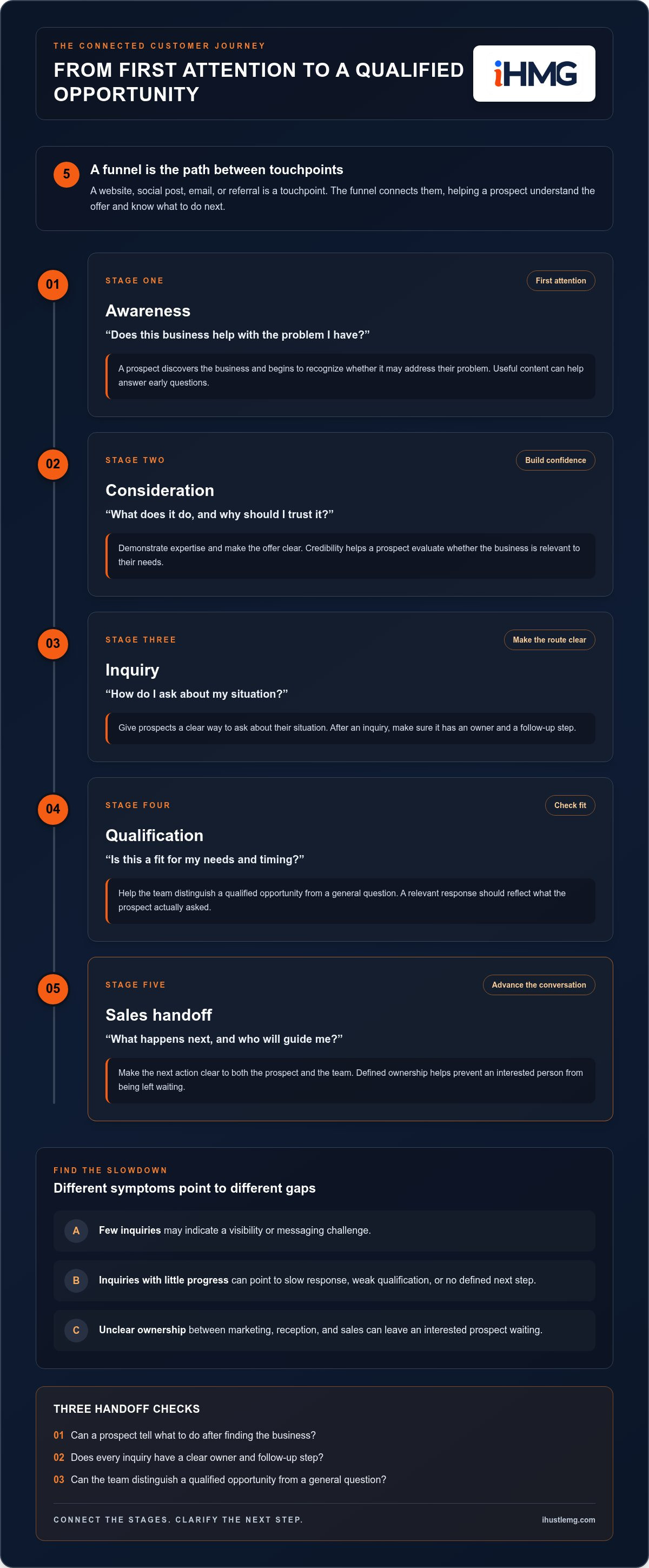
Different slowdowns point to different problems. Few inquiries may indicate a visibility or messaging challenge. A steady stream of inquiries with little progress can point to slow response, weak qualification, or no defined next step. If marketing, reception, and sales each assume someone else is following up, an interested prospect can be left waiting while the gap goes unnoticed.
What a marketing funnel expert should actually improve
The work should start with the customer journey your business already has: where prospects discover you, what you ask them to do, who receives each inquiry, and how the conversation advances. Then review messaging, lead capture, follow-up, and qualification as connected stages rather than isolated tasks or separate channel reports.
A funnel expert improves the handoffs between stages, not the number of channels a business uses.
That means identifying what happens after a click or inquiry, clarifying who owns the response, and making the next action clear to both the prospect and the team. A useful initial review asks:
- Can a prospect tell what to do after finding the business?
- Does every inquiry have a clear owner and follow-up step?
- Can the team distinguish a qualified opportunity from a general question?
A St. Charles marketing funnel expert should diagnose these connections and clarify where the journey needs attention. The goal is a more coherent system, not a promise of guaranteed leads or sales. Once the bottleneck is visible, the business can decide whether to refine its message, process, or technology before adding more activity.
What a Marketing Funnel Connects From First Attention to Qualified Opportunity
A marketing funnel is the connected path a potential customer follows from first noticing a business to beginning a sales conversation. It isn’t a checklist of channels. A website, social post, email, and referral source are touchpoints. The funnel is the logic that helps a prospect move between them, understand the offer, and know what to do next.
That distinction matters. Social media lead automation can capture engagement and support follow-up, but it’s one mechanism within a broader journey. A complete funnel also considers how people discover the business, build confidence, evaluate an offer, and become qualified opportunities. For a wider look at how engagement connects to business outcomes, explore this Social Engagement to Revenue framework.
The funnel stages a service business needs to connect
For a service business, the journey often moves through five stages. Each needs a clear transition, with details suited to the offer, buying cycle, and business model.
- Awareness: “Does this business help with the problem I have?”
- Consideration: “What does it do, and why should I trust it?”
- Inquiry: “How do I ask about my situation?”
- Qualification: “Is this a fit for my needs and timing?”
- Sales handoff: “What happens next, and who will guide me?”
A local professional might earn attention through a useful post, build confidence by demonstrating expertise, and invite the prospect to request a conversation. The funnel works when each step makes the next one easier to understand, not when every visitor is pushed toward the same action.
How trust and follow-up move prospects forward
Buyers arrive with different levels of knowledge and readiness. Helpful content can answer early questions and demonstrate authority before a direct sales conversation. A clear offer then connects that credibility to a relevant next step, so prospects can act without guessing what the business provides or what to expect.
Follow-up should reflect what the person actually expressed. Someone who asked about a specific service needs a response related to that inquiry, not a generic message that ignores their question. Clear ownership and a relevant next action keep the conversation moving while respecting the prospect’s decision process.
A funnel is a sequence of connected buyer decisions, with each step giving a prospect a clear reason and route to continue. A St. Charles marketing funnel expert should make those decisions and handoffs visible, then help align the business’s messaging and process around them. For businesses connecting social engagement with follow-up, the Social Lead Web system provides a practical way to move toward qualified conversations.
How to Evaluate a St. Charles Marketing Funnel Expert Before You Choose
A polished channel plan can still leave prospects stranded. To choose a St. Charles marketing funnel expert, look past the number of services offered and assess how the approach connects diagnosis, prospect movement, follow-up, measurement, and implementation. The key question is simple: does the plan fix handoffs, or just add activity?
A structured diagnosis should show how leads currently move, where progress stalls, and what information is missing. An AI business diagnostic provides a way to examine existing lead systems and identify potential automation opportunities. The assessment should inform the plan, not justify adding technology without a defined purpose.
Questions that reveal whether the expert understands your funnel
Ask for a clear explanation of how the prospect journey will be mapped. A useful discussion follows the path from first contact to a meaningful sales conversation, identifies where prospects pause or disappear, and explains how proposed changes address those gaps.
- How will you document the steps prospects take today and identify where they drop off?
- What counts as a qualified conversation for this business, rather than simply an inquiry?
- Who owns each handoff, and what specific next action should follow?
Look for answers tied to your offer and sales process. “More leads” isn’t a useful definition of success if the team can’t tell which inquiries fit, who should respond, or how to move a suitable prospect forward.
Compare systems, measurement, and implementation fit
Use a comparison like this to assess different approaches. A strong proposal explains how each piece works together and what the business will need to operate afterward.
| Area | What a connected approach should clarify |
|---|---|
| Diagnosis | Current lead sources, process gaps, and the evidence behind the recommended priority. |
| Journey mapping | The stages prospects move through, including points of friction and the next action at each stage. |
| Follow-up | How inquiries are routed, who owns the response, and how communication reflects expressed interest. |
| Measurement | How movement from inquiry to meaningful conversation is tracked, not just clicks or activity. |
| Tools and implementation | Which tools support the plan, what will be configured, and how each component connects to the journey. |
| Ongoing responsibilities | What the business team manages, what the expert supports, and how the process can be reviewed. |
Automation should support timely, relevant follow-up, not make judgments about fit that require a person’s understanding. Implementation should also match the team’s capacity. A sophisticated system that no one can maintain isn’t practical.
Before choosing, ask the expert to walk through one prospect scenario from first inquiry to sales handoff. If the explanation connects the steps, ownership, and measurement, you’re evaluating a funnel strategy rather than a menu of disconnected channels. iHustle Media Group’s lead-generation and authority-building systems connect visibility, follow-up, and qualified conversations.
A Practical Funnel Readiness Plan for Your St. Charles Business
You don’t need a perfect CRM or a fresh campaign to prepare for funnel work. Start with the evidence already in your business: where inquiries come from, what happens after they arrive, and which steps lead to a meaningful sales conversation. That gives a St. Charles marketing funnel expert a grounded view of the customer journey instead of a set of assumptions.
Map the current customer journey before changing tools
Sketch the route a prospect takes, from first discovery to the next meaningful business conversation. Include the channels, people, and systems involved, then mark where ownership changes or progress stalls. A business serving customers in St. Charles, St. Louis, St. Peters, Florissant, Hazelwood, Ferguson, or Chesterfield may find that local search, social media, and referrals create different inquiry routes.
- Inventory lead sources. List how prospects find you, such as referrals, search, social media, or recommendations from existing customers. Note which sources bring inquiries, not just attention.
- Map each inquiry route. Record what a prospect does next, where the inquiry goes, who sees it, and how the response is handled.
- Mark handoffs and stalls. Identify who owns each transition, from the initial response to qualification and the next action. Note any point where responsibility becomes unclear.
- Gather existing evidence. Review available inquiry records, follow-up notes, and outcomes. Separate what the records show from explanations the team suspects but hasn’t verified.
Prioritize one bottleneck and define useful signals
Once the journey is visible, avoid trying to fix every stage at once. Choose the point with the clearest evidence of friction, then agree on what the team will track and when it will review progress. The goal is a practical learning loop, not a borrowed benchmark or arbitrary target.
- Choose the bottleneck. It might be inquiries without a clear owner, conversations that aren’t qualified consistently, or prospects who don’t receive a defined next step.
- Track signals tied to that stage. Depending on the issue, record inquiry source, response status, qualification, and the agreed next action. Keep the measures relevant to the problem under review.
- Set a review rhythm. Choose a recurring time for the team to inspect the records, identify patterns, and adjust the process. The right routine depends on how your business handles inquiries.
This readiness process turns scattered observations into a prioritized bottleneck before you introduce new activity or tools. For broader context on building a connected lead system, explore The Modern Lead Generation System. To evaluate your existing digital infrastructure and identify automation opportunities, explore an AI System Diagnostic.
How iHustle Media Group Connects Funnel Strategy to Your Next Step
A useful next step depends on the bottleneck, not a one-size-fits-all package. iHustle Media Group provides AI-driven lead-generation and authority-building systems to help businesses focus on the gap they’ve identified instead of adding activity without a clear purpose.
For a St. Charles business, that might mean improving the path from social engagement to an inquiry, examining how existing digital infrastructure handles leads, or strengthening the credibility prospects need before they’re ready to talk. The right starting point depends on what’s happening in your current funnel.
Match the iHustle system to the bottleneck you identified
Each system supports a distinct need. Consider where prospects are getting stuck and which part of the journey needs attention:
- Social Lead Web: Connects social media visibility with qualified conversations and automated follow-up. It’s designed for businesses that want a clearer route from social engagement to a sales conversation.
- AI System Diagnostic: Evaluates existing digital infrastructure and identifies automation opportunities. It can help clarify how current lead flow works before improvements are prioritized.
- Authority Accelerator: Supports professional positioning and market presence, reinforcing the credibility stage of the prospect journey.
These systems address different points in the path. Social engagement may need a stronger connection to follow-up, while a business with unclear internal processes may first need to assess its setup. If prospects need clearer signals of expertise before taking action, professional positioning may be the more relevant focus.
Make the first conversation focused and practical
Bring three things into the discussion: your core offer, the route a prospect currently takes from discovery to inquiry, and the friction points you’ve observed. For example, you might know that social content earns responses but be unsure how those responses become qualified conversations. Specific context makes it easier to identify a useful priority.
A conversation with a St. Charles marketing funnel expert should clarify the challenge and explore an approach that fits your current journey. The focus should be on understanding what needs attention and what a practical next step could involve, not on promising a particular lead, revenue, or conversion result.
Start with the evidence you have, even if it’s incomplete. A few examples of inquiry paths, follow-up patterns, or unanswered questions can make the discussion more concrete. Then focus on the stage that matters most, whether that means connecting social visibility to follow-up, examining automation opportunities, or sharpening your professional positioning.
If you’re ready to discuss your current funnel challenge and identify a practical priority, Request Cortez to discuss your funnel.
Make Your Next Funnel Move with Purpose
Your next step doesn’t have to be a full marketing overhaul. Start with the customer-journey question you most need to answer: where should social interest lead, what could your existing systems handle more effectively, or how can your expertise come through more clearly? A focused priority gives your business a direction and a way to judge whether the next change is useful.
That priority can shape a conversation with a St. Charles marketing funnel expert. Social Lead Web connects social visibility to qualified conversations and automated follow-up. AI System Diagnostic evaluates existing digital infrastructure for automation opportunities, while Authority Accelerator supports professional market positioning. Each offers a different starting point, depending on the challenge you want to address.
Bring your current offer and the friction you’ve noticed. You don’t need every answer before taking action. Start with a clear question and examine the path prospects take. Request Cortez to discuss your funnel and identify a practical next move. A more connected customer journey starts with one deliberate improvement.
Frequently Asked Questions
Can a marketing funnel expert help if my business already gets referrals?
Yes. Referrals can create strong introductions, but what happens after that introduction still affects whether interest becomes an opportunity. A St. Charles marketing funnel expert can help map how a referred prospect reaches your team, what information they receive, and whether someone follows up with a useful next step. Note whether referral partners introduce prospects by email, phone, or a shared form, then look for gaps in that handoff.
Is a marketing funnel different from a sales funnel?
The terms overlap, and their meaning can vary between businesses. Marketing often describes how people first learn about an offer and decide to inquire. Sales often focuses on evaluating fit, discussing options, and reaching a decision. A regional service company might call a website inquiry a marketing conversion, while its team sees qualification as the start of sales. Aligning on those terms prevents reporting confusion.
How much does a marketing funnel expert cost?
There isn’t one useful fee for every project because the scope can range from reviewing an existing customer journey to assessing automation opportunities or shaping a broader strategy. Compare proposals by the work they cover, the deliverables, who handles implementation, and how progress will be assessed. A clear scope makes it easier to judge whether the work addresses your business’s actual priority.
How long does it take to improve a marketing funnel?
Timing depends on what needs to change and how the business can implement it. Clarifying one inquiry handoff may involve fewer moving parts than coordinating changes across several teams, tools, or offers. Before work begins, document the current process and agree on the first change to review. That gives the team a reference point for learning without relying on a universal timeline or assumed result.
Can a marketing funnel work without paid ads?
Yes. A funnel is the path prospects follow, not a requirement to buy advertising. A business can build that path around referrals, organic search, useful content, social visibility, and a clear way to express interest. For example, a professional serving customers across St. Charles and nearby communities could connect an educational article to a relevant inquiry option, then track whether those conversations fit the service.
Do I need a large audience before building a marketing funnel?
No. A smaller audience can still include people with a genuine need and interest in your offer. Start by making the offer easy to understand and giving interested prospects a straightforward next step. Pay attention to the questions people ask and where they hesitate. Those real interactions can reveal what information or reassurance would make the journey clearer.
What should I prepare before speaking with a marketing funnel expert?
Prepare a short description of your offer, the customer types you want to reach, and a few examples of recent inquiries with identifying details removed. Note what happened after each inquiry and any questions your team has about fit or follow-through. If you serve St. Louis, St. Charles, St. Peters, Florissant, Hazelwood, Ferguson, or Chesterfield, include how the customer journey differs across those communities.