


Stop Manual Social Media Outreach and Build a Better Lead System
Manual social outreach can make a busy pipeline look productive while leaving real opportunities stuck in the inbox. If you’re ready to stop manual social media outreach, the answer isn’t to send more messages or automate every interaction. It’s to build a clearer path from engagement to conversation.
The frustration is familiar: follow-ups eat into your day, likes and comments don’t reliably become qualified business conversations, and generic automation can make your brand feel impersonal. Without a clear way to track what moves prospects forward, it’s hard to know which activity deserves your time.
A stronger lead system handles repeatable steps while keeping your judgment and personal voice where they matter. In this article, you’ll learn why manual prospecting stalls, how to connect social engagement with timely follow-up, and how to make conversations more purposeful without turning outreach into spam. We’ll also look at how Social Lead Web bridges social visibility and qualified business opportunities, and how to identify gaps in your existing lead flow.
Key Takeaways
- Learn why busywork like sending more messages doesn’t necessarily create qualified opportunities.
- Spot the handoffs where scattered inboxes, memory-based follow-up, and unclear ownership can slow lead momentum.
- Compare manual outreach with a connected lead system across prospecting, context, follow-up, qualification, and measurement.
- Use a practical transition plan to stop manual social media outreach while keeping human judgment and a personal voice in the process.
- See how Social Lead Web is designed to move social engagement toward qualified conversations.
Why stop manual social media outreach when it keeps you busy?
Manual social media outreach means personally finding prospects, starting conversations, tracking replies, and repeating follow-ups. It can feel productive because the activity is visible: you can count messages sent, profiles reviewed, and comments answered. But those counts show effort, not whether a potential customer is moving toward a useful business conversation.
That distinction matters. A message may start a genuine exchange, but without a clear next step, relevant context, or a way to track progress, it can remain just an exchange. Social media marketing supports broader business goals, as the Social Media Marketing Overview explains, but prospecting still needs a deliberate path from engagement to conversation.
A social lead system is a repeatable process for moving relevant social engagement toward a qualified business conversation, with follow-up organized rather than left to memory. Its purpose isn’t to automate human connection away. It’s to make the steps around that connection more consistent.
When outreach becomes a second job
The cycle is easy to recognize: find someone who might be a fit, review their profile, write a personal message, check for a reply, then remember when and how to follow up. Repeat that across platforms and prospects, and outreach becomes another queue competing with client work.
Hypothetical example: A consultant spots a promising prospect after a comment on a relevant post, sends a thoughtful message, then gets pulled into a client deadline. The prospect replies while the consultant is away from social media. Later, the message is buried under other notifications, and the follow-up happens only if it’s remembered. Nothing about this means the consultant didn’t care. The process simply depended on uninterrupted attention.
Interruptions are normal in a service business. A workable lead process accounts for them instead of assuming the owner will remember every conversation at exactly the right moment.
What manual effort can and cannot tell you
Activity measures answer questions such as how many prospects you contacted or how many follow-ups you sent. By themselves, they don’t show whether someone has expressed a need, asked a relevant question, agreed to a next step, or otherwise become a qualified opportunity. Those are signs of movement, not just motion.
Track both kinds of information. Keep outreach activity visible, but also record meaningful signals: what prompted the exchange, what the prospect is interested in, and what next step makes sense. This gives you a clearer view of which conversations deserve attention without treating every like or reply as a sales opportunity.
Personal outreach still has an important role. A timely, context-aware message can be the right response to a thoughtful comment or a direct question. The goal isn’t to stop being personal; it’s to stop relying on memory and repeated manual effort for every step. To stop manual social media outreach as the default, move routine tasks into a repeatable process and reserve your attention for judgment, context, and real conversation.
How manual social media outreach leaks attention and lead momentum
A social interaction rarely becomes a business conversation in one leap. Someone comments on a post, asks a question, or responds to a message. Then someone must recognize the signal, retain its context, decide whether it’s relevant, and choose a sensible next step. If each handoff depends on switching platforms or remembering what happened, momentum can fade between stages.
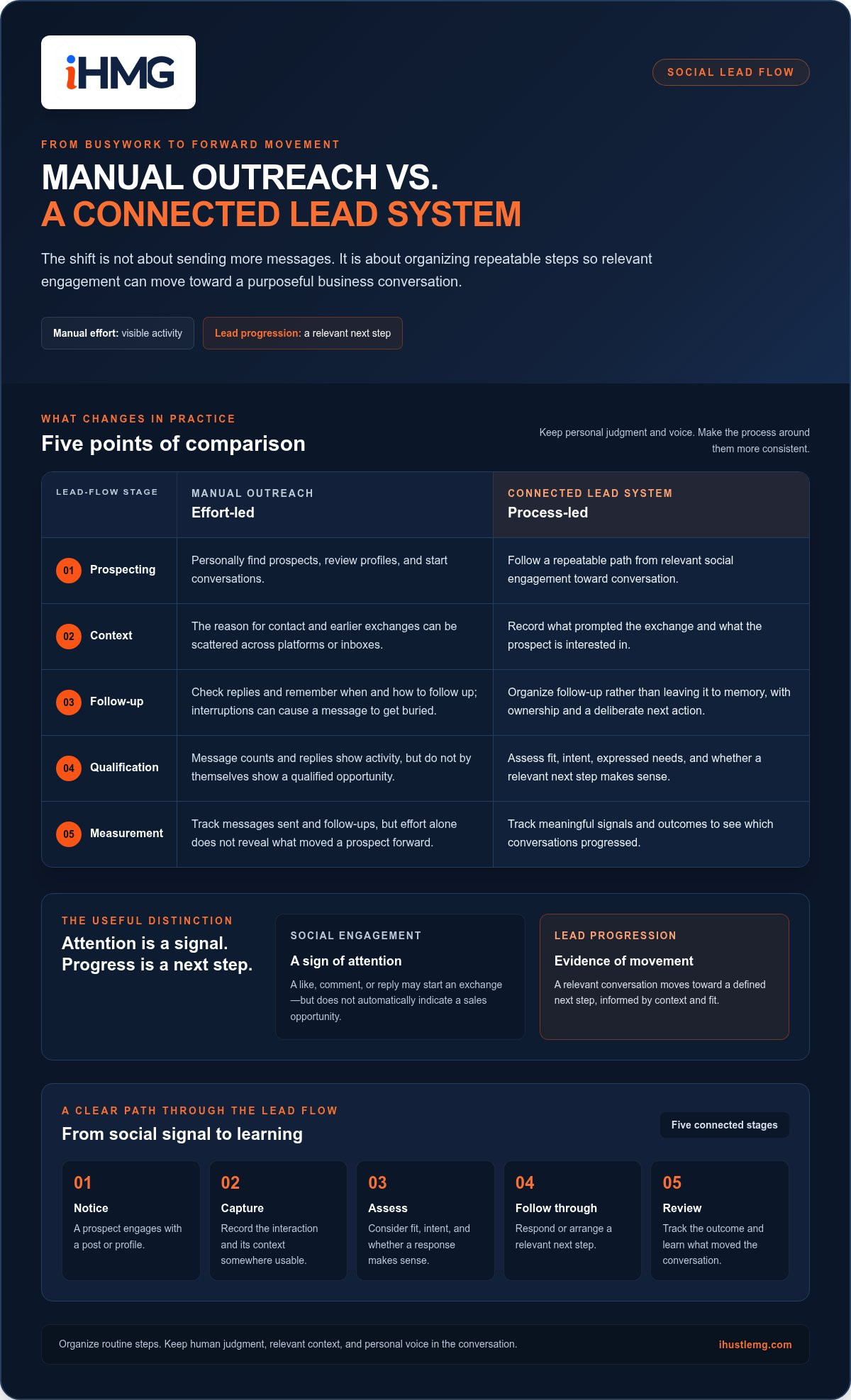
Social engagement is a signal of attention; lead progression is evidence that a relevant conversation is moving toward a defined next step.
Map the journey to see where friction enters:
- Notice: A prospect engages with a post or profile.
- Capture: The interaction and its context are recorded somewhere usable.
- Assess: Someone considers fit, intent, and whether a response makes sense.
- Follow through: The right person responds or arranges a relevant next step.
- Review: The outcome is tracked so the team can learn what moved the conversation forward.
Every transition is a potential stall point. A comment sits in one platform’s notifications, while a later direct message appears in another inbox. A team member replies without seeing the earlier exchange. Or two people assume the other owns the next follow-up. These aren’t necessarily failures of effort. They’re signs that the process has gaps.
Where promising conversations lose momentum
Context makes outreach feel like a continuation, not an interruption. Imagine a prospect asking about a specific challenge in a comment, then receiving a generic follow-up that ignores the question. Even if the reply arrives later, the disconnect can make the exchange feel disjointed. A simple record of what prompted contact, what was discussed, and who owns the next step helps preserve continuity without relying on memory alone.
Delays also matter because the next message may no longer fit the moment. A timely question can be useful; the same question sent later without acknowledging the original interaction may seem disconnected. The practical fix isn’t to pursue every signal. It’s to make sure meaningful interactions have context, ownership, and a deliberate next action.
Why more outreach is not the same as better outreach
Volume-first habits make message counts easy to see and relevance harder to judge. Sending more messages won’t clarify who fits, what they need, or whether a follow-up is appropriate. Repetitive outreach without a clear reason can feel impersonal, even if each message is sent manually. Better outreach begins with a real point of connection and a next step that makes sense for that person.
For a practical look at structuring this transition, explore the social media lead automation guide. It complements a useful operating rule: automate repeatable handoffs, not the judgment that makes a conversation relevant. If you’re ready to map where engagement is getting lost, explore a connected lead system designed to move social activity toward qualified conversations.
Manual outreach vs. a lead system: what changes in practice?
Manual outreach and a lead system can both support personal conversations. The difference is where consistency lives. In a manual process, the steps depend on the person handling each prospect. In a system, agreed steps and tools help carry context forward, clarify responsibility, and show what happens next. Neither approach guarantees a sale. A system makes the process easier to see and manage.
| Area | Manual outreach | Lead system |
|---|---|---|
| Prospect discovery | Individuals search feeds, profiles, and comments as time allows. | People use shared criteria to identify relevant signals and record prospects consistently. |
| Context | Details may stay in a platform inbox, personal notes, or memory. | Useful interaction history is organized so the next person can understand the conversation. |
| Follow-up | Each person decides when to return and may need to remember each next step. | Ownership and follow-up steps are defined, with automation supporting repeatable tasks where appropriate. |
| Qualification | Fit and intent can be judged differently from one conversation to another. | Shared signals guide review, while people decide whether a prospect is genuinely relevant. |
| Measurement | Message counts are visible, but progress may be difficult to trace. | Teams can review movement between stages and see where conversations pause. |
What a lead system changes, and what it does not
A defined process makes the path from initial interest to a considered next step more visible. It can clarify what to capture, who follows up, and how to record the outcome. Automation can support repeatable follow-up, but it shouldn’t be treated as permission to automate every interaction. A nuanced question, a sensitive concern, or a judgment about fit still calls for a person.
The system doesn’t create interest or make every prospect suitable. It helps prevent useful context from being lost and gives the team a consistent way to decide what deserves attention. For the wider role of a connected sales process, see this overview of a modern lead generation system.
How to evaluate the trade-off for your business
Compare the approaches against your actual workflow. Manual outreach offers direct control and can be highly personal, but repeatability and visibility often depend on individual habits. A connected process takes deliberate setup and review; in return, it can make ownership clearer and preserve continuity. Personalization remains a human responsibility, not a box a workflow can tick automatically.
Consider a local service business in St. Louis as an illustration, not a client case study. If an owner is handling appointments, service delivery, and social conversations, the main constraint may not be finding more people to message. It may be keeping relevant inquiries organized and ensuring there’s a clear next step. A smaller team may value continuity and clarity more than higher outreach volume.
If you want to stop manual social media outreach as the default, assess where handoffs break down before adding tools. Build a process that supports the conversations your business can serve well.
How to stop manual social media outreach without losing the human touch
The shift isn’t from personal conversations to automated messages. It’s from remembering every task yourself to designing a process that carries the right context forward. To stop manual social media outreach as the default, first identify which actions repeat, where prospects stall, and where human judgment is essential.
Map the current outreach journey before changing it
Start with a simple map, not a new tool. List where prospects engage, what follow-up tasks recur, who owns each step, and what useful next action should happen. Mark any point where context disappears or a prospect is left without a clear path forward. For a broader view of how engagement can connect to business outcomes, see this social engagement to revenue blueprint.
Then work through this transition plan in order:
- Inventory: Note repeated tasks, such as checking notifications, copying prospect details, sending routine acknowledgments, and remembering follow-up dates. Include where each task happens and how often it interrupts other work.
- Map: Trace the journey from the first social interaction to a meaningful business conversation. Record the context needed, the person responsible, and the intended next step at each handoff.
- Prioritize: Choose recurring friction to address first, such as duplicated data entry or follow-ups that depend on memory. Don’t automate an interaction just because it happens often; consider whether it needs a personal response.
- Systematize: Define what gets recorded, how ownership is assigned, and which routine steps a system can support. Keep the process simple enough for the team to use consistently.
- Review: Check whether context is preserved, prospects have a clear next step, and conversations are progressing appropriately. Adjust the workflow when it creates friction or fails to reflect how people actually engage.
Keep automation relevant, measured, and human
Set a clear handoff rule. A system may support a routine acknowledgment or help organize a planned follow-up, while a person takes over when someone raises a specific concern, asks a context-sensitive question, or needs qualification. Relationship-building belongs with people. The system’s job is to help the right person respond with the relevant history, not to imitate personal judgment.
Measure conversation quality and meaningful next steps alongside operational activity. For example, review whether an exchange established a need, clarified fit, or led to an agreed follow-up. Don’t use message volume as the only sign of progress. Before configuring automated outreach, check the current policies of the platforms involved and any applicable requirements. Rules can vary, and a process should respect them.
For teams that want to improve existing lead flow, an AI System Diagnostic evaluates a business’s current digital infrastructure to identify automation opportunities. Explore an AI System Diagnostic to assess where a more connected process could support your team.
Replace the manual DM grind with a connected lead system
A connected lead system becomes worth considering when social activity is spread across inboxes, follow-ups depend on memory, or no one can easily tell what should happen after a prospect engages. The signal isn’t simply that outreach takes effort. It’s that useful interactions keep requiring the same manual handoffs, while the route from interest to a qualified conversation remains unclear.
Replacing that routine doesn’t mean switching on automation and stepping away. It means creating a clearer bridge between social visibility, engagement, follow-up, and human conversation. The objective is a more coherent process, not a promise of a particular number of leads, conversions, or revenue.
How Social Lead Web fits the engagement-to-conversation gap
Social Lead Web is iHustle Media Group’s system for streamlining the transition from social media visibility and engagement toward qualified conversations, with automated follow-up supporting that path. It addresses the gap between someone noticing or engaging with a business and the next steps being organized to support a meaningful exchange.
That distinction matters. Automation can help carry a repeatable process forward, but it doesn’t decide whether a prospect is a good fit or what a thoughtful response should say. People still bring the context, judgment, and relationship-building that make a conversation feel relevant. The system supports those conversations; it doesn’t replace them or guarantee that every interaction becomes an opportunity.
When a broader systems review may help
Sometimes the friction extends beyond social outreach. If follow-up touches several parts of your digital infrastructure, an AI System Diagnostic can identify automation opportunities within the systems already in place. The focus is on understanding where a process could be improved, rather than adding automation for its own sake.
Another challenge may be credibility rather than follow-up. If prospects engage but don’t understand your expertise or positioning, Authority Accelerator supports professional market positioning. The right path depends on the bottleneck: a disconnected journey from engagement to conversation calls for a lead-system focus; unclear authority may call for attention to positioning.
To stop manual social media outreach from carrying the entire burden, start by identifying the specific breakdown: visibility that goes nowhere, engagement without an organized next step, or follow-up that loses context. Then choose a system aligned with that gap and keep people involved wherever relevance and judgment matter.
Ready to explore a more connected path from social engagement to qualified conversations? Explore iHustle Media Group’s growth systems and take the next step toward a lead process built around both structure and human connection.
Make your next move a deliberate one
Before changing your outreach, decide what a better process should make possible. Choose one point of friction to address, then define what a useful next step looks like for both your team and the prospect. That gives you a clear standard for judging whether a system supports the work, rather than simply adding another layer of activity.
You don’t have to choose between personal connection and a more organized process. The goal is to stop manual social media outreach from consuming attention that belongs in thoughtful, qualified conversations. Social Lead Web is iHustle Media Group’s flagship system for bridging social engagement and qualified conversations, while AI System Diagnostic evaluates existing digital infrastructure for automation opportunities.
Start with the challenge that matters most to your business, whether it’s carrying engagement forward or identifying where your current systems can work together more effectively. Explore Social Lead Web and move beyond the manual DM grind. A clearer process can create more room for the human conversations your business is built on.
Frequently Asked Questions
Is it a good idea to stop all manual social media outreach?
No, not necessarily. The goal is to stop manual social media outreach from being the only way you manage prospects, not to eliminate thoughtful personal contact. If someone asks whether your service fits a particular situation, a tailored response is more useful than a generic automated message. Start by noting which actions you repeat and which require your judgment, then decide where a process can make routine steps easier to track.
Can social media outreach be automated without sounding spammy?
Yes, if automation supports relevant follow-up instead of blasting the same message to everyone. For example, a system might help organize people who asked for a resource, while a team member writes a response that reflects the request. Give each message a clear reason and useful next step, and review how it sounds in context. Before enabling automated outreach, check the current rules for the platform you’re using.
How do I know whether manual outreach is wasting time?
Look for effort that repeatedly produces administration rather than insight: searching old message threads, copying the same details into separate notes, or trying to remember who needs a reply. Then examine whether those tasks lead to relevant conversations or agreed next steps. A busy inbox isn’t proof of progress. If a manual action adds useful context or helps assess fit, it may still be worth keeping.
What should a small business automate first in its social lead process?
Start with one predictable administrative task, such as recording where an inquiry came from or assigning an incoming question to the right person. For a service business serving St. Louis, St. Charles, St. Peters, Florissant, Hazelwood, Ferguson, or Chesterfield, this can help keep inquiries organized across a broad local audience. Keep unusual requests visible for personal review, then assess whether the change improves clarity before expanding it.
Do I need paid ads to generate leads from social media?
No, paid advertising isn’t the only possible way to start social media conversations. Organic posts and interactions can help people discover a business, though visibility and interest depend on the audience, offer, and follow-through. Keep attention generation separate from lead handling: content may prompt an inquiry, while a clear process helps your team respond appropriately. Neither organic activity nor an organized process guarantees a particular business result.
Which metrics matter more than likes when reviewing social outreach?
Track signs that connect to business intent, such as relevant replies, requests for details, qualified conversations, and agreed next steps. A like can show that someone noticed a post, but it doesn’t reveal whether they need your service or are ready to talk. Review these signals alongside the source and context of each interaction. That makes it easier to learn which conversations deserve attention without relying on generic benchmarks.