


Authority Marketing in Florissant: Align Your Expertise With Growth
Expertise alone doesn’t build authority; a clear, consistent message does. An authority marketing framework in Florissant aligns what you know, where you share it, and the services you provide around the transformation you help people achieve. It gives businesses, nonprofits, and churches a coherent way to show why their knowledge matters and when to seek their help.
People need a reason to trust an organization before they act. Scattered posts and credentials without context can make that harder, even when the expertise is real. The shift is from simply being visible to making your value clear wherever your audience encounters you.
This article explains what authority marketing means and how it works for expert-led organizations. You’ll learn how to connect audience needs to your expertise, align your website and platforms with your services, and communicate the outcomes your organization can support. The result is a more deliberate strategy for building credibility and advancing your goals.
Key Takeaways
- Build authority around the change your audience wants, not a catalogue of everything you know.
- Align your website, social content, speaking topics, and services around one clear message.
- Show how your expertise addresses a specific challenge so people can understand its value and relevance.
- Measure progress through meaningful signals, such as qualified inquiries, engagement, conversions, and the role credibility plays in decisions.
- Explore how Social Lead Web can help connect social media engagement with qualified business opportunities.
Authority marketing framework for thought leaders and expert organizations
An authority marketing framework aligns an organization’s expertise, public message, and proof of value. In Florissant, it can help leaders turn credibility into a strategic advantage that creates opportunities and encourages action. The framework works best when its message reflects the organization’s genuine strengths and audience needs.
Core Authority-Building Elements
Authority combines useful content, recognizable branding, thought leadership, and social proof. Each element gives an audience a reason to trust an organization’s expertise. For example, a nonprofit can publish practical guidance, use consistent language across its website, and share client stories. Together, these signals make its purpose easier to understand and its work easier to evaluate. Every article, profile, and testimonial should reinforce the same central value.
Authority Marketing Compared with Other Approaches
SEO helps people discover relevant content; advertising buys exposure for a message. Authority marketing builds on both by showing why an organization’s perspective deserves consideration. For a Florissant business, a useful article can answer a local audience’s question while demonstrating expertise beyond a single promotion. What local marketing rules or requirements apply to Florissant businesses? Authority marketing itself is a strategy, while applicable obligations depend on the organization, its industry, and what it promotes. Keep claims factual and proof transparent.
Thought Leadership That Shapes Evaluation Criteria
Thought leadership does more than explain a service; it helps people decide what quality looks like. A consulting firm, for instance, can publish a guide that clarifies the questions buyers should ask before choosing an approach. That guide gives prospects a stronger basis for comparison and positions its author as a knowledgeable voice. Teach a decision process rather than simply claiming one organization is best.
Structural Signals, Personal Branding, and Credibility
Category leadership appears through repeated, connected signals: a clear point of view, useful resources, visible credentials, and relevant media features. Leaders can reinforce those signals through personal branding, linking their expertise to the organization’s mission rather than creating competing identities. The Milgram experiments illustrate how perceived credibility can affect willingness to follow guidance. Reputation also influences decisions: a 2026 consumer research report found that 63% of shoppers say a brand’s reputation influences what they buy.
Risks and Drawbacks of Authority Marketing
What are the risks or drawbacks of authority marketing? It takes sustained effort, and inconsistent publishing can weaken the message instead of strengthening it. Overstated expertise or unsupported claims can also damage credibility. A practical safeguard is to connect each claim to real experience, evidence, or a clearly identified perspective. Authority should clarify what an organization can help with, not imply that it suits every need or guarantees a particular outcome. For organizations applying an authority marketing framework in Florissant, clear evidence keeps the strategy grounded in the value they genuinely deliver.
Aligning websites, books, speaking topics, social media, and services
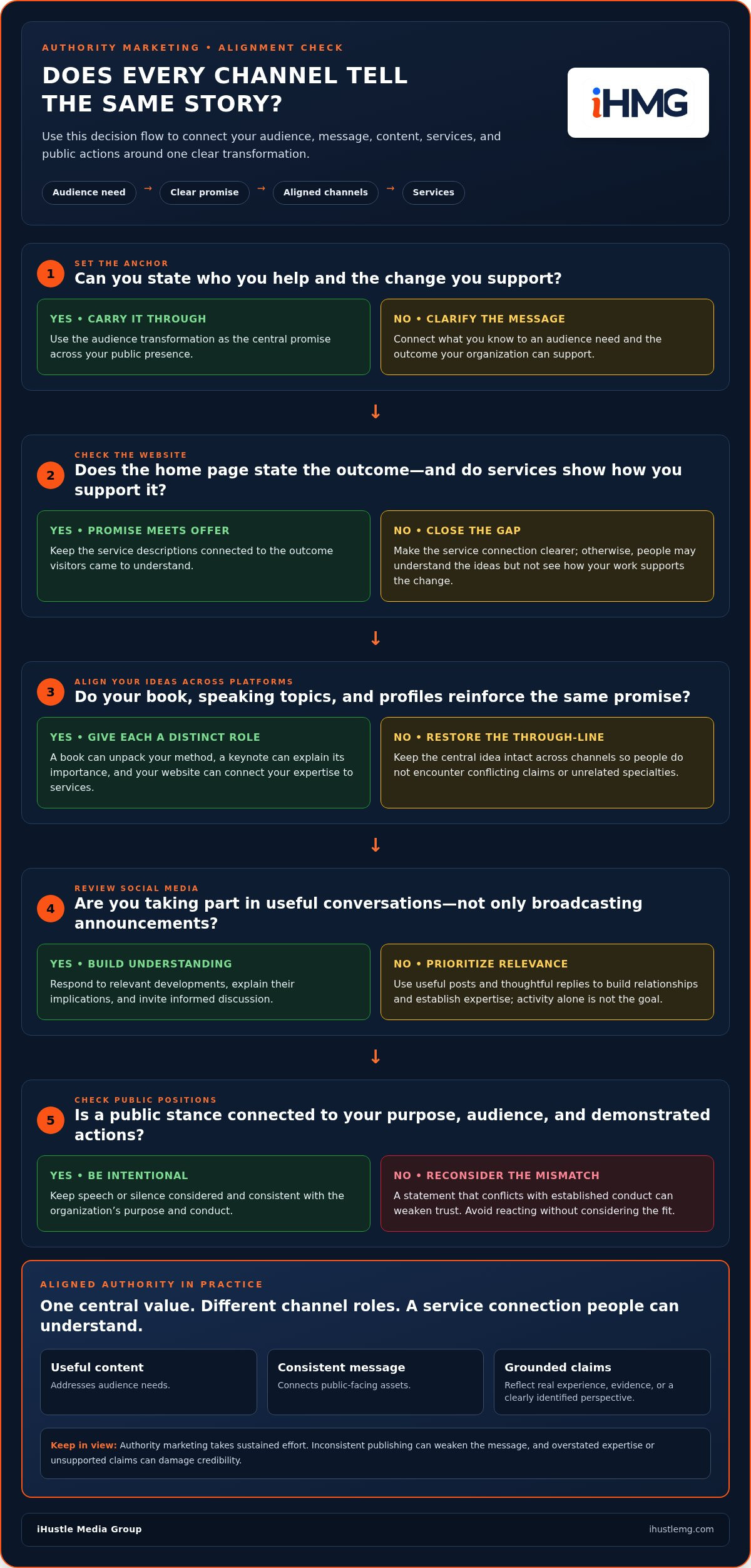
Every public-facing asset should tell the same story about who you help and why. A Florissant organization can strengthen that message by connecting its website, published ideas, talks, social posts, and services to one audience transformation.
Start with the website’s central promise. A leadership consultant, for example, might help managers lead difficult transitions with greater clarity. The home page should state that outcome, while service descriptions explain how the consultant supports it. A book description, speaking bio, and LinkedIn profile can reinforce the same promise rather than introduce unrelated specialties.
Consistency doesn’t mean copying identical text everywhere. It means giving each platform a distinct role while keeping the central idea intact. A book can unpack the consultant’s method, a keynote can explain its importance, and a website can show how that expertise connects to services. This structure helps audiences move from awareness to understanding without encountering conflicting claims.
Social media gives leaders a place to take part in real conversations, not just broadcast announcements. A Florissant firm could respond to an industry development, explain its implications, and invite informed discussion. Useful posts and thoughtful replies can establish expertise while building relationships with customers, peers, and community organizations. The goal is meaningful interaction, not activity for its own sake.
Services must complete the message. If an organization publishes about making complex decisions easier, its service pages should explain how its work supports that change. Otherwise, its digital presence creates a gap: the audience understands the ideas but can’t see a clear next step. Aligning the offer with the content makes the organization’s value easier to grasp.
Public positions require the same discipline. Business entities, including brands, firms, and executives, may feel pressure to speak on social and political issues. Before taking a stance, leaders should consider its connection to the organization’s purpose, audience, and demonstrated actions. A statement that conflicts with established conduct can weaken trust; speech or silence should be intentional, not reactive.
Establishing alignment works best as an editorial practice. Compare the audience, promise, evidence, and next step across the website, book materials, speaking topics, social profiles, and service pages. For example, if a keynote focuses on nonprofit leadership, its follow-up content and service descriptions should serve that same audience. Formats may differ, but the organization’s identity should remain consistent.
Social engagement can also reveal where the message needs refinement. Notice which questions prompt thoughtful discussion, which posts lead to useful conversations, and where readers misunderstand the offer. Then adjust the relevant page or content theme. A deliberate social engagement-to-lead pathway can connect audience interaction with a clear business opportunity.
Communicating the results of your expertise
Expertise becomes valuable to an audience when its practical effect is clear. Positioning should show who you help, what challenge they face, and what can change through your work. For example, a Florissant consultant might explain how leadership guidance helps teams make clearer decisions during organizational change. That outcome gives prospective clients a reason to connect their challenge with the consultant’s expertise.
Make the Outcome Easy to Recognize
Describe the audience’s starting point before presenting the desired result. A nonprofit serving families could explain how its guidance helps people find appropriate community resources. This makes its expertise tangible without reducing its value to revenue or another narrow metric. Confidence, clarity, and stronger relationships can also represent meaningful transformations.
Use this positioning across the homepage, service descriptions, and professional profiles. A visitor arriving at a website should quickly understand the audience, the problem, and the outcome. Then provide evidence that supports the promise, such as a client story, review, or case study. Specific examples help readers assess relevance; broad claims leave them guessing.
Technical SEO and Website Experience
Technical SEO helps search engines understand a website’s pages and helps people find useful answers. A Florissant accounting firm, for example, can organize content around the questions its intended clients search for. Clear page titles, descriptive headings, relevant internal navigation, and mobile-friendly layouts connect each answer to the right service. The content still needs substance; technical structure can’t make a vague promise persuasive.
Check the visitor’s path from search result to next action. If a page answers a question about planning, its next step should relate to that topic, not lead into an unrelated service description. Review the page on a phone as well as a computer. Confusing menus, unclear labels, or missing context can interrupt the journey before expertise has a chance to influence a decision.
Collaborate and Develop a Niche
Collaboration can extend credibility when partners bring distinct, relevant knowledge. A Florissant business adviser might interview an accountant or operations specialist for an article about business planning. Each contributor can clarify their role, deepen the discussion, and share the finished resource with an audience interested in the topic. Thoughtful collaboration adds substance; a list of names without meaningful input does not.
Niche expertise sharpens the focus. Instead of addressing every possible business challenge, an organization could serve a defined audience facing a particular operational issue. That focus guides content development, attracts readers with relevant needs, and makes the service connection easier to explain. Expand only when new topics reinforce the organization’s core expertise.
Finally, assess whether people understand the outcome without decoding industry jargon. Ask a colleague unfamiliar with the service to summarize the page’s promise and intended audience. If their explanation misses the point, refine the headline, example, or service description. Clear communication lets expertise influence evaluation, while a strong website experience helps visitors act on what they learn.
Who created the Authority Marketing Framework and how does it work?
Authority marketing emerged alongside digital publishing and personal branding in the early 2000s. The framework is associated with ideas described by Adam Witty and Rusty Shelton in their book Authority Marketing. That connection matters, but it doesn’t mean every organization must follow one rigid, universal formula. The useful principle is strategic: make expertise visible, credible, and relevant to the people who need it.
Think of authority marketing as a connected system rather than a single campaign. An organization identifies the audience it serves, understands that audience’s challenges, and explains how its expertise can help. For example, a Florissant nonprofit supporting families could focus on the practical barriers families face and the support it provides. That clarity guides what the organization publishes and how it describes its work.
The system depends on consistent, useful communication. Articles, white papers, and blog posts can share an organization’s insights, while credentials, titles, and media features add credibility. A local engineering firm, for instance, could explain how it evaluates infrastructure needs, then introduce the professionals responsible for the work. The content demonstrates its thinking; credentials help readers assess its experience.
Teaching is central to the approach. Instead of relying only on promotional claims, an organization helps its audience understand a problem and consider possible ways forward. A church might publish guidance on community support, while a professional adviser might explain how clients can evaluate a difficult decision. Each example gives readers useful context before inviting them to act.
The framework also connects expertise to a desired transformation. That outcome may be practical, such as making a better-informed choice, or personal, such as gaining confidence or peace of mind. An organization should identify what its audience is struggling with, what frustrates them, and what they want to accomplish. Those answers shape its themes, examples, and service descriptions.
Other marketing models can help organize parts of the work without replacing its authority focus. The 4 Ps framework covers product, price, place, and promotion. The RACE framework maps reach, act, convert, and engage across the customer journey. A Florissant organization could use these models to plan distribution or engagement, while authority marketing keeps its expertise and audience value at the center.
In practice, the process creates a reinforcing loop: useful ideas attract attention, consistent communication builds familiarity, and credible proof helps people evaluate the organization. Feedback from audience questions can then guide future content. The Authority Accelerator connects to this strategic need by focusing on authority building, helping organizations bring their expertise and growth goals into closer alignment.
How can Florissant businesses measure authority marketing results and ROI?
Measure authority marketing by tracking whether expertise reaches the right audience and advances meaningful decisions. For a Florissant business, connect visibility signals, such as relevant search visits, to inquiries, qualified opportunities, and completed engagements. A nonprofit may also track resource requests or community participation. Choose outcomes that reflect the organization’s goals, not activity for its own sake.
Start with a baseline for each channel. Record which articles attract relevant visitors, which social posts prompt useful conversations, and which speaking events lead to follow-up. Then use consistent source tracking on inquiry forms and intake conversations. If a prospect says a practical guide helped them choose your firm, record that influence alongside their original discovery source.
Separate leading indicators from business outcomes. Search visibility and audience engagement show whether authority content is gaining traction. Qualified inquiries and conversions show whether that attention supports organizational goals. A Florissant consultant might find that a niche article attracts fewer visitors than a broad overview but generates more conversations with suitable prospects. Context makes the comparison useful.
Connect Metrics to Decisions
Review the path from discovery to action, rather than judging each channel on its own. A reader might find an article through search, return through a social post, and later request a service. Recording those touchpoints helps reveal how content contributes, even when it isn’t the final interaction. Consistent tracking gives leaders a clearer basis for refining topics and distribution.
- Visibility: Track relevant search impressions, visits, and branded searches.
- Engagement: Note meaningful comments, guide downloads, and event follow-ups.
- Pipeline: Record qualified inquiries, referrals, and progression to a proposal.
- Outcomes: Compare completed engagements and attributable revenue with marketing investment.
ROI requires a defined connection between investment and return. For a professional firm, compare the value of engagements linked to authority activities with the resources spent creating and distributing them. For a church or nonprofit, useful outcomes may include stronger participation, more relevant inquiries, or deeper community relationships. State the intended outcome first, then assess the evidence against it.
Use attribution carefully. Prospects may encounter several articles, conversations, and referrals before acting. Ask how they heard about the organization, then compare their answers with recorded web and campaign data. A mismatch can expose tracking gaps or show that a channel helps inform decisions without directly producing the final inquiry.
Build a review process around evidence and action: identify the content associated with qualified interest, examine where prospects disengage, then adjust the next initiative. If you want a structured approach to aligning authority activity with organizational growth, explore the Authority Accelerator.
IHustle Media Group: Social Lead Web
iHustle Media Group’s Social Lead Web helps organizations move from social media engagement toward qualified business opportunities. It fits when posts attract attention but the path from conversation to meaningful inquiry feels disconnected. Social Lead Web connects social interest to a clearer lead-generation and follow-up flow.
For organizations strengthening their market authority, the Authority Accelerator can help align expertise with growth goals. An AI System Diagnostic addresses a different need: evaluating AI systems. Choose the offering that matches the challenge you’re working to solve.
To discuss a next step for your organization, contact iHustle Media Group.
Put Your Expertise to Work
Your next move isn’t to publish more for the sake of activity. Choose one audience, one meaningful challenge, and one clear outcome your organization can help create. Then use that promise to guide future decisions about content, platforms, and services.
A focused authority marketing framework for Florissant organizations can help turn expertise into a coherent growth strategy. Shift from asking, “What should we post?” to asking, “What should the right audience understand, trust, and do next?” That question keeps marketing connected to organizational purpose.
If your strategy needs stronger alignment, iHustle Media Group’s Authority Accelerator connects authority building with growth goals. Social Lead Web focuses on moving social engagement toward qualified business opportunities, while an AI System Diagnostic evaluates digital infrastructure and identifies opportunities to improve lead flow and operations. Choose the next step that fits the challenge in front of you.
Contact iHustle Media Group to discuss how your organization can make its expertise work harder. Start with a clear direction, then build momentum one purposeful move at a time.
Frequently Asked Questions
What Is Authority Marketing?
Authority marketing makes an organization’s expertise recognizable and useful to its intended audience. For a Florissant organization, an authority marketing framework can connect its knowledge to the questions local audiences need answered. It gives people reasons to consider that organization before they’re ready to buy, donate, join, or seek guidance. The aim isn’t simply to gain attention; it’s to become a trusted option when a relevant need arises.
What steps should I take to build authority in my niche?
Start by choosing a specific audience and learning the questions it asks before making a decision. Review customer conversations, support requests, or community discussions to identify recurring concerns. Then develop a distinct point of view and support it with useful, original material. For instance, a business serving commercial property managers could explain how to compare service proposals. Keep the focus narrow enough for the right audience to recognize its needs.
What is the Authority Marketing Framework?
The Authority Marketing Framework is an approach inspired by Adam Witty and Rusty Shelton’s book Authority Marketing. It treats reputation as something an organization can build deliberately through visible expertise and credible communication. Rather than relying on a single campaign, an organization connects its knowledge to audience needs and makes its value easier to recognize. The framework can guide businesses, nonprofits, and churches while adapting to each group’s purpose.
Which Florissant businesses benefit most from authority marketing?
Organizations that depend on expertise, trust, or careful evaluation often have the most to gain. That includes consultants, professional service firms, specialized businesses, nonprofits, and churches serving Florissant and nearby communities such as Hazelwood, Ferguson, St. Louis, St. Charles, St. Peters, Chesterfield, and Florissant. An authority marketing framework can help a business explain a complex service, while a community organization can make its mission and resources easier for local audiences to understand.
What steps are involved in implementing an authority marketing strategy?
Turn the strategy into an operating plan: assign an owner, define the intended audience, select a clear business or organizational objective, and map content to that objective. Record where inquiries originate, for example with a source field in an intake form. Then review performance and audience questions regularly. A Florissant firm can use those findings to decide which topics need more coverage and which messages need sharpening.