


Business System Optimization in Chesterfield to Align Operations
More software won’t fix a misaligned workflow. Business system optimization in Chesterfield means improving processes, resource allocation, and the use of automation and data so systems work efficiently and support better decisions. The goal isn’t added complexity; it’s aligning daily operations, workflows, and strategy.
When work slows or information gets stuck between teams, it’s tempting to look for a new tool. But disconnected systems and inconsistent processes can keep the same bottlenecks in place, even after another tool is added.
This article explains how process standards, clearer workflows, and better-aligned strategy can help your systems support daily work. You’ll learn how to spot lost information or effort, choose useful measures of progress, and treat optimization as an ongoing practice rather than a one-off fix.
Key Takeaways
- Use business data to pinpoint friction and compare proposed changes with current practices before committing resources.
- Standardize repeatable processes so teams can work consistently while still improving how tasks move between them.
- Set shared objectives and performance measures to keep department-level improvements aligned with the organization’s wider strategy.
- Review how information flows across tools and workflows to uncover bottlenecks, then make improvements an ongoing practice.
What is business optimization?
Business optimization improves processes, resource allocation, and systems so daily work supports business goals. For a Chesterfield, Missouri business, a practical starting point is tracing one customer request from its first record to its final outcome.
Data-Driven Decision-Making
Compare current performance with the expected results of a proposed change before committing resources. Track where inquiries stall, how often records need correction, and which handoffs delay a response. These measures help you decide whether a process change supports financial or competitive priorities.
AI, predictive forecasting, and data analysis can help teams anticipate demand and spot workflow issues. Review the underlying data, compare forecasts with actual conditions, then choose an action and measure its effect. An AI System Diagnostic can help identify opportunities to improve lead flow and operational efficiency.
Integrated Systems and Data Silos
Separate sales, service, and operations systems may hold data that differs in context, timing, or detail. A spreadsheet may show one status while a customer platform shows another. Before planning an integration, map where each key record originates, who updates it, and which teams rely on it.
System interfaces can transfer information without making it consistent or current. During migration, define which records to move, clean duplicates, and test sample records in the destination system. Pair integration with verified backups and a documented recovery process, so teams know how to restore essential information after disruption.
To choose between a local consultant, national firm, or software vendor, compare the work each will own: process analysis, organization-wide coordination, or product implementation. Chesterfield business directory listings include 25 business application development consulting firms. Select based on your systems, project scope, and need for direct support.
For small and midsize businesses, optimization can mean documenting repeatable workflows, reducing manual handoffs, connecting essential data, and setting performance measures. Start with one process, assign an owner, and review whether the change improves the intended outcome.
Chesterfield, Missouri directory listings include business application development consulting firms. For a specific project, assess whether a firm’s stated expertise and scope match your workflow, ERP, or CRM needs.
Business process management and standardization
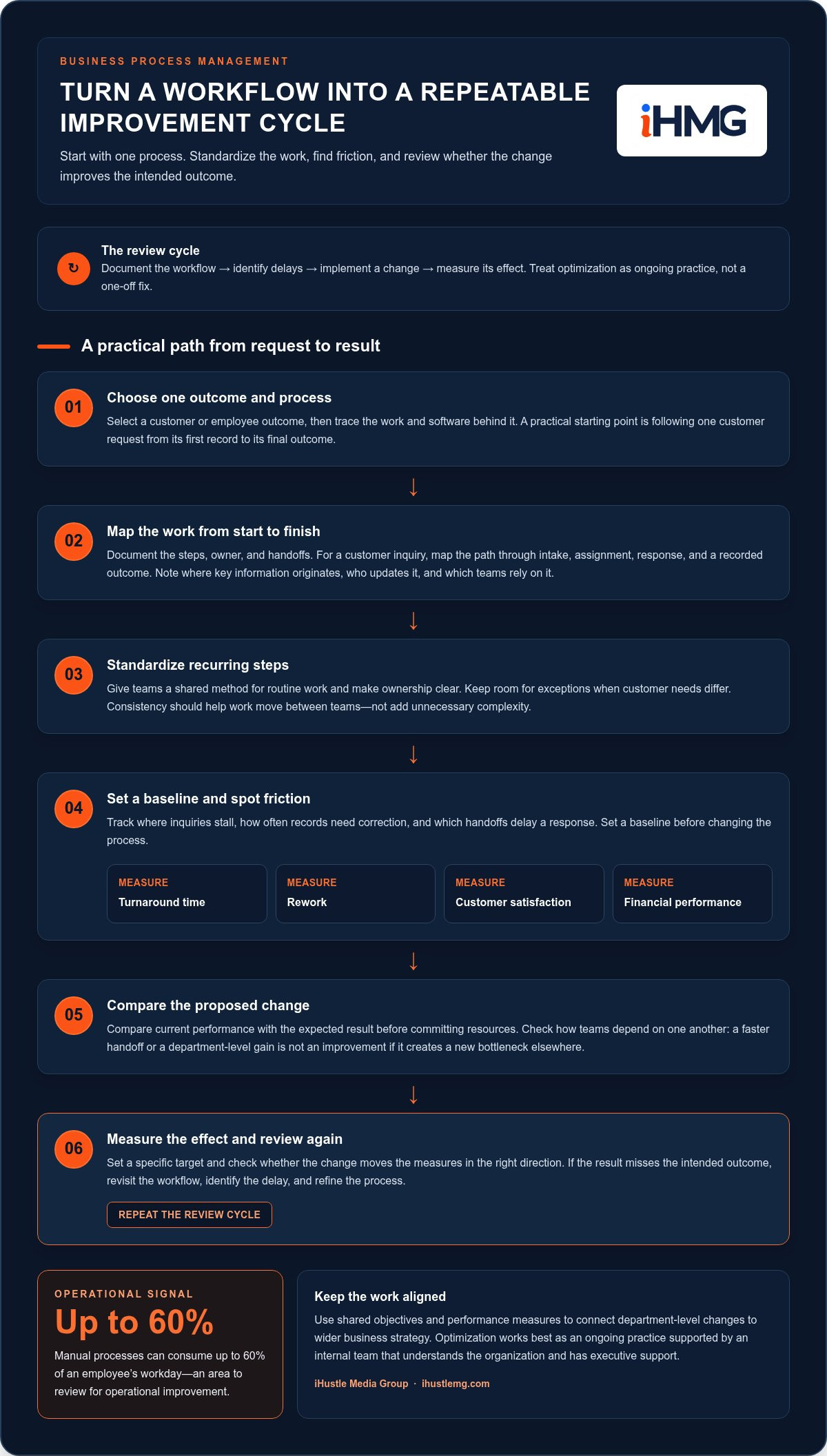
Standardization gives teams a shared method for recurring work. Map a process from request to completion, assign an owner, and document handoffs. For example, route each customer inquiry through intake, assignment, response, and a recorded outcome using a consistent workflow.
Business process management adds a review cycle: document the workflow, identify delays, implement a change, and measure its effect. Set standards for routine steps while allowing exceptions for distinct customer needs. This helps teams make decisions based on evidence rather than habit.
For managed IT support and service desk response, record each issue’s category, priority, owner, and resolution. If the same login issue recurs, review whether access instructions or staff training need improvement. Ticket patterns can reveal whether a problem is isolated or reflects a process gap.
Review generation and response management also require clear ownership. Decide when to invite feedback, who responds, and how recurring concerns reach the relevant team. A defined process helps staff respond consistently and flag service issues that need operational attention.
For citation management, maintain one approved record of your business name, address, and phone number. Compare directory listings with it whenever details change. Consistent NAP information helps customers find accurate business details and makes updates easier to manage.
A virtual CIO or strategic IT leader can connect technology decisions to business priorities. Involve that role during planning, then assess how each proposed change affects workflows, data access, and staff responsibilities. This keeps system decisions tied to operational needs.
For Chesterfield businesses, funding options to investigate include state or local economic-development incentives and workforce-training support. Identify whether the project focuses on technology investment, employee training, or process improvement, then review eligibility and application requirements.
If a process review exposes unclear system responsibilities, a structured systems review can help clarify where to focus next.
Standardizing business processes can help ensure consistency and efficiency across departments, while optimized processes can contribute to improved service delivery and customer experiences. Manual processes can consume up to 60% of an employee’s workday, highlighting an area for operational review.
Business optimization works best when a capable internal team understands the organization and has executive support. Treat it as an ongoing process built into the organization’s culture, not a one-off project.
Business operations, workflows, and strategy
Optimization works when operations, workflows, and strategy support the same business objectives. Choose a customer or employee outcome, then trace the work and software behind it. A faster handoff matters only if it improves the result without creating a new bottleneck elsewhere.
Set a baseline before changing a process. Track measures such as turnaround time, rework, customer satisfaction, and financial performance. Define a specific target and review whether the change moves those measures in the right direction. If a sales team speeds up intake but creates incomplete records, the overall workflow hasn’t improved.
Department-level gains can undermine organization-wide performance. For example, purchasing may reduce order costs while increasing delays for operations. Map dependencies between teams before choosing a solution. If an organization-wide ERP system isn’t immediately feasible, integrated business planning can provide an interim way to align plans and decisions across functions.
Software alone won’t repair an unclear process. Before adding tools or features, identify the work employees need to complete, the information each step requires, and the decisions the system should support. This links technical changes to customer impact or revenue growth.
Make improvement a recurring management practice, not a one-time project. Review performance data, identify a specific source of waste, implement a focused change, and compare the results with your baseline. Real-time data can help teams respond to disruptions or opportunities, while historical data can show whether an optimization model reflects actual operating conditions.
Consider the people affected by each change. Explain what will change, gather employee concerns, and allow time for adoption during rollout. A process that looks efficient on paper can fail if employees lack clear roles or guidance. Measure both workflow performance and effects on service delivery.
Keep strategy in view during each review. Leaders can assess proposed improvements by financial value, customer impact, and operational risk, then prioritize accordingly. This helps prevent local fixes from pulling teams away from shared objectives and makes ongoing optimization part of how the organization works.
Business workflow and system optimization
Business system optimization in Chesterfield should connect each workflow to a practical business outcome. The aim is a smoother end-to-end process, not automation for its own sake.
Workflow Automation and System Alignment
Trace a task from its trigger to completion, noting repeated data entry, approvals, and handoffs. Automate stable steps, such as routing a completed service request to the right team, while keeping exceptions visible. This helps companies deliver consistent work without hiding process failures behind faster software.
When considering workflow automation, ERP, or CRM, compare providers based on their experience with the systems and processes involved. Look for a clear scope covering workflow mapping, system alignment, and implementation. Chesterfield businesses should prioritize solutions that address their actual operational needs, not a generic tool rollout.
Systems Audit and Optimization Steps
Begin an audit by recording business objectives, current applications, process owners, and recurring friction. Follow a representative task across systems and note where employees repeat information, wait for approvals, or switch platforms. These observations help define the project scope and reveal dependencies before changes begin.
Next, rank improvements by business impact and effort. Establish baseline measures, document risks, and test a proposed change with the employees who will use it. Review the outcome, adjust the approach, then expand implementation when the workflow performs as intended.
Measurable ROI and Efficiency Gains
There’s no single ROI figure that fits every company. Compare baseline and post-change measures such as completion time, errors, rework, delays, and software use. Calculate financial impact using documented savings or added revenue, then compare it with project costs.
For example, if automation reduces duplicate CRM entry, measure whether employees can use the time saved for customer follow-up. Also assess whether response quality and lead handling improve. A business system optimization project in Chesterfield should define these measures before launch, then use the results to guide the next improvement.
Continuously refining workflows can eliminate waste and improve productivity. Make refinement an ongoing practice, returning to workflows to identify waste and improve productivity as operational needs evolve over time.
IHustle Media Group: Social Lead Web
iHustle Media Group’s Social Lead Web streamlines the path from social media engagement to qualified business opportunities. It helps businesses create a more structured way to turn audience interest into lead-generation activity, rather than treating engagement as the finish line.
If you need to understand how AI systems can support your operations, the AI System Diagnostic provides a Marketing Blueprint, a strategy call, and credit toward a future system buildout. For businesses looking to strengthen their market presence, the Authority Accelerator offers tools, training, and resources for building authority. Each serves a distinct need, so start with the bottleneck you want to resolve and the outcome you want to improve.
Contact iHustle Media Group to discuss your priorities and choose a practical next step.
Turn Your Next Improvement Into a Clear Move
Make the next step a focused decision, not another round of disconnected changes. Choose one workflow that affects customer experience or growth, name the outcome it should improve, and assign an owner to track progress. That gives business system optimization in Chesterfield a practical starting point: a specific priority your team can act on and evaluate.
Match support to the challenge. Social Lead Web streamlines the path from social engagement to business opportunities. The AI System Diagnostic helps you examine where AI systems fit, while the Authority Accelerator supports authority-building. Each offering serves a distinct purpose, so begin with the outcome your business needs to advance.
Ready to discuss your priorities and next move? Contact iHustle Media Group and take the next step with purpose.
Frequently Asked Questions
What risks should Chesterfield businesses consider before replacing or integrating business software?
Key risks include data loss, service disruption, incompatible formats, and access gaps during a transition. Before changing systems, identify critical records, confirm who owns each data set, and test a sample migration against real business tasks. Keep a recovery copy, limit access to authorized users, and plan the change around essential operations so staff can continue serving customers in Chesterfield.
How do business system optimization firms in Chesterfield compare by services, pricing, and reviews?
Compare firms by whether they handle process analysis, organization-wide coordination, or product implementation, and whether their scope covers workflow mapping, system alignment, and implementation.