


Lead Qualification Service in St. Charles for Inbound and Outbound Leads
A full pipeline can still be full of poor-fit prospects. A lead qualification service in St. Charles uses human-led conversations to assess each prospect’s needs, ability to buy, purchasing authority, and readiness for a sales discussion. The result is a clearer distinction between early interest and a sales-qualified opportunity.
That distinction matters whether a lead comes through a form or outbound outreach. A name in a database is not a buying signal. Qualification adds context so sales teams can decide what to do next.
This guide explains how inbound and outbound qualification works, which criteria help identify fit, and how qualified prospects move toward a sales conversation. You’ll also learn what to consider when choosing a service in St. Charles, and how human-led qualification can support a more focused B2B lead generation process.
Key Takeaways
- Use live conversations to uncover a prospect’s needs, buying role, and readiness, rather than treating every response as a qualified opportunity.
- Choose qualification criteria that fit your sales cycle: BANT, CHAMP, and MEDDIC each help structure discovery in different ways.
- Define what happens after qualification so sales-ready prospects move forward and early-stage leads receive an appropriate next step.
- When comparing services in St. Charles, assess how the process handles inbound and outbound leads, records useful context, and aligns with your team’s goals.
- Understand how workload, outreach methods, and appointment expectations shape pricing models before deciding which arrangement suits your needs.
Human-led qualification of inbound and outbound leads
Lead qualification determines whether a potential customer fits a product or service. A focused conversation can reveal what a form field cannot: what the prospect needs, whether there is a fit, and what next step makes sense. The aim is not to label every reply an opportunity, but to assess fit and readiness.
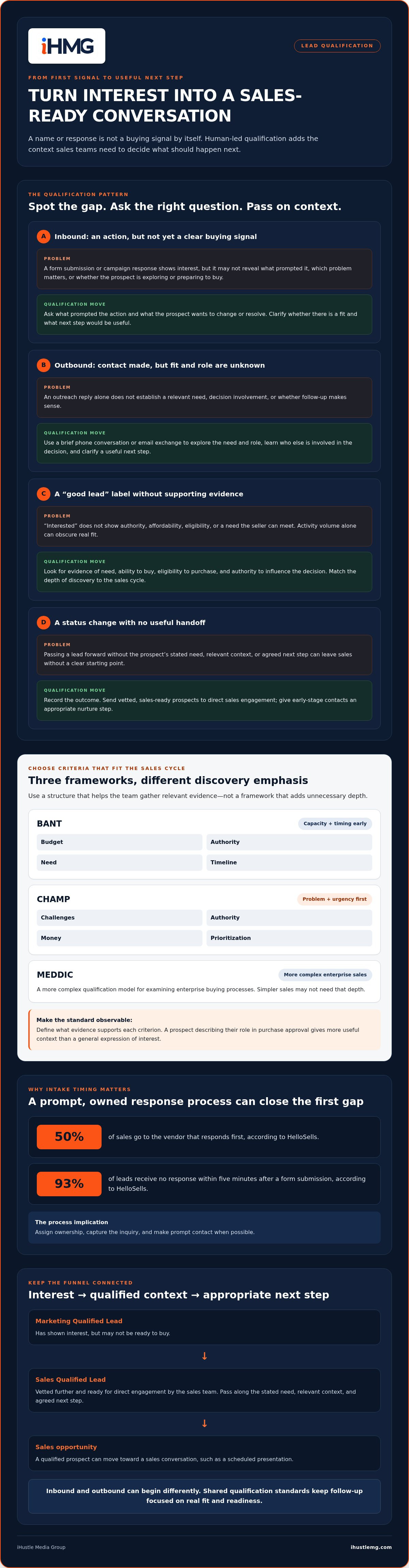
Inbound leads begin with an action, such as submitting a form or responding to a campaign. A conversation can clarify what prompted the action, which problem matters most, and whether the prospect is exploring or preparing to buy. For example, a St. Charles business requesting a software demonstration may need a specific workflow addressed before a sales meeting. Discussing that need helps establish whether there is a fit.
Outbound qualification starts with contact initiated by the business. A brief phone conversation or email exchange can reveal whether the person has a relevant need and role, who else is involved in the decision, and whether follow-up makes sense. Inside sales teams commonly qualify leads remotely through calls, email, and video meetings; field sales teams rely primarily on in-person interactions.
A practical screening sequence keeps both channels consistent:
- Confirm the context: Identify the campaign, account, and reason for the conversation.
- Explore the need: Ask what the prospect wants to change or resolve.
- Assess readiness: Clarify urgency, decision involvement, and the next useful step.
- Record the outcome: Pass a sales-ready lead forward or nurture an early-stage contact.
Timing can shape the first interaction. HelloSells reports that 50% of sales go to the vendor that responds first. It also reports that 93% of leads receive no response within five minutes after a form submission. These figures make a clear intake process valuable: assign ownership, capture the inquiry, and make prompt contact when possible.
Qualification should produce more than a status label. A sales-qualified lead has been vetted further and is ready for direct engagement by the sales team. The representative should pass along the prospect’s stated need, relevant context, and agreed next step. Qualified leads can then become sales opportunities for which presentations are scheduled. That handoff keeps the funnel connected to an actual conversation.
For St. Charles B2B teams, inbound and outbound leads need distinct opening questions but shared qualification standards. A local prospect who requests information and a target account reached through outreach may have different levels of readiness. Human judgment helps separate those signals, focus follow-up, and ensure the next conversation matches the prospect’s situation.
Lead screening uses inbound or outbound communication to learn about potential customers. These exchanges can clarify a prospect’s needs, provide context, and establish whether a useful next step makes sense.
Lead qualification criteria
A useful qualification process turns a vague “good lead” label into criteria the sales team can apply consistently. Start with fit: does the prospect have a need the seller can meet, the ability to afford a purchase, eligibility to buy, and authority to influence the decision? These checks help keep activity volume from becoming the only measure of success.
BANT assesses budget, authority, need, and timeline. It suits conversations where purchasing capacity and timing matter early. CHAMP evaluates challenges, authority, money, and prioritization, putting the prospect’s problem and urgency first. For example, a prospect describing an unresolved operational challenge may merit follow-up before discussing budget.
MEDDIC is a more complex qualification model used in enterprise sales. It can help teams examine complicated buying processes, but simpler sales may not need that depth. Choose a framework that fits your sales cycle, then define what evidence supports each criterion. “Interested” does not show decision-making authority; a prospect explaining their role in approving purchases offers more useful context.
Marketing Qualified Leads have shown interest in a product or service but may not be ready to buy. Sales Qualified Leads have been vetted further and are ready for direct engagement by the sales team. Set a clear handoff threshold so marketing interest does not automatically become a sales opportunity.
Businesses comparing providers should ask how their experience matches the industry, how they define a qualified lead, and how they calculate conversion rates. Compare like with like: use the same lead source, qualification standard, and conversion outcome before judging performance.
Protect customer data with clear rules for access, retention, secure handling, and recording prospect preferences. Use approved outreach scripts and a process for honoring opt-outs. Align procedures with applicable U.S. telemarketing and privacy rules.
Set up the process in a defined sequence: share your target accounts, ideal-customer criteria, exclusions, and handoff rules; align on outreach and recordkeeping; then review reports against agreed measures. Useful reporting shows dispositions and recurring objections, not just contact volume.
A qualification process can falter if representatives misunderstand the offer, apply criteria inconsistently, or pass incomplete notes to sales. Reduce these risks with clear scripts, sample reviews, feedback from the sales team, and regular updates to qualification criteria.
For businesses evaluating a lead qualification service in St. Charles, the right standard is the one that reflects real buying fit, not simply a fuller funnel. A more structured B2B lead-generation approach can help connect qualification criteria with the next step in the prospect journey.
B2B lead qualification benefits
A fuller pipeline isn’t automatically a stronger one. Qualification helps B2B teams distinguish active buying interest from contacts that need more time. That distinction gives each sales lead a defined next step, such as a discovery meeting, relevant follow-up, or no immediate sales outreach. The benefit is focus: engagement reflects the prospect’s situation, not just a campaign response.
Efficiency is measurable in how sales teams use their time. Sales representatives spend 28% of their time actually selling. Qualification can help reserve that time for conversations with prospects whose needs and buying readiness fit the offer. For example, a representative can prioritize an account with a defined business challenge over a contact who only downloaded introductory material.
It also makes pipeline decisions more grounded. About 2.9% of leads across all industries turn into sales. That figure gives teams a reason to examine lead quality, but it doesn’t define the outcome for a particular company. A useful strategy tracks where prospects progress or stall, then uses that record to refine targeting, messages, and handoffs.
- Prioritize follow-up: Route prospects with clear needs and active buying signals toward timely sales conversations.
- Protect selling time: Separate early research from conversations that warrant direct sales attention.
- Improve campaign learning: Record which sources produce suitable prospects, not only which sources produce responses.
- Strengthen forecasting: Use consistent qualification outcomes to show which opportunities have substantive buyer engagement.
Consistent records create a feedback loop between marketing and sales. If a campaign generates replies but few prospects match the agreed profile, revisit the audience or message. If suitable prospects repeatedly pause at the same stage, examine objections and clarify what information is missing. Base each adjustment on observed pipeline behavior.
Good qualification also improves handoffs. A sales-ready prospect should come with a concise account of their stated need, relevant decision context, and agreed next action. That record helps the sales team start with the prospect’s priorities instead of repeating discovery questions.
For a B2B team in St. Charles, these benefits depend on using qualification outcomes consistently. Review accepted leads, rejected leads, and stalled opportunities together. Then refine the criteria or campaign strategy where the record shows a mismatch. A disciplined process focuses resources on meaningful engagement and gives leaders clearer evidence for improving the pipeline.
Lead qualification services by city
A city-specific search should do more than add “St. Charles” to a provider’s page title. The useful question is whether its qualification process fits your target customers, sales motion, and local coverage. A B2B company serving St. Charles prospects may need different opening questions from a business selling across several markets. Judge the operating fit, not the city label alone.
When assessing a qualification process, ask how it defines a qualified lead, what information it captures, and how it hands opportunities to sales. Review a sample report to see how prospect needs, decision authority, and next steps are recorded. Also ask how outreach quality is reviewed and how feedback shapes scripts or criteria.
Does a lead qualification service in St. Charles specialize in local industries such as real estate, healthcare, or home services? To assess the fit, consider whether the process reflects your industry and buyer type. A real estate team, for example, should distinguish an initial inquiry from a prospect ready for a sales conversation.
Local context can shape qualification without becoming a substitute for evidence. A St. Charles service-area business may want to determine whether an inquiry falls within its actual coverage, while a regional B2B firm may prioritize account fit over the prospect’s exact address. Define those rules before outreach begins. Otherwise, a provider may convert responses into opportunities that your business cannot serve.
Use this checklist to assess a provider’s practical fit:
- Industry understanding: Can representatives explain your offer accurately and recognize relevant buyer needs?
- Qualification evidence: Are lead decisions tied to agreed criteria, rather than contact volume alone?
- Handoff detail: Does each opportunity include the prospect’s stated need and agreed next action?
- Performance reporting: Can reports distinguish contact attempts, conversations, qualified leads, and sales outcomes?
- Local relevance: Can the process account for your St. Charles service area, target accounts, or buyer context?
Conversion rates need careful interpretation. Define what counts as a conversion, which lead sources are included, and whether the result measures qualified leads becoming sales opportunities or closed sales. Those are different outcomes. Without a shared definition, comparisons can be misleading because one measure may reflect an earlier funnel stage.
For a business in St. Charles, local targeting works best alongside a repeatable qualification process. Consider whether the system reflects your coverage boundaries, industry language, and buyer criteria. Reporting should help your team understand whether suitable prospects are moving into meaningful sales conversations, not simply track activity.
How do lead qualification services price their work: per lead, per hour, per appointment, or monthly?
The right lead qualification approach depends on the work involved. Consider lead volume, inbound or outbound activity, qualification criteria, outreach channels, reporting needs, and appointment expectations. Define the scope before comparing options, and make sure the measures reflect useful outcomes rather than activity alone.
Per lead ties payment to a defined lead unit. Specify whether “lead” means a contact attempt, a reached prospect, or someone who meets agreed criteria. If payment is based on qualified leads, define qualification clearly and agree on how records are reviewed.
Per hour bills for time spent on tasks such as calling, emailing, researching accounts, and documenting responses. This can suit campaigns with variable workloads or criteria that are still being refined. Agree on which activities count as billable work and what reports will show, such as call outcomes and prospect dispositions.
Per appointment links payment to scheduled meetings. Define whether that means a meeting booked, accepted by the prospect, or completed. Also specify the target attendee, qualification threshold, and how cancellations are handled. Clear rules help appointment totals reflect meaningful sales opportunities.
Monthly pricing groups the work into a recurring arrangement. It can simplify planning when a team needs ongoing lead screening and reporting. Clarify the included workload, channels, campaign scope, review schedule, and how changes are handled if lead volume or criteria shift.
- Compare the unit: Identify whether charges apply to time, contacts, qualified leads, appointments, or ongoing work.
- Set acceptance rules: Define the evidence needed for a lead or appointment to count.
- Map delivery: Align outreach tasks, reporting, and sales handoffs with the chosen model.
- Review outcomes: Compare billing records with lead quality and sales-team feedback.
For a business in St. Charles, start by matching the approach to the campaign’s objective. A short test of outbound messaging requires different tracking from ongoing inbound screening. Choose a structure suited to the task, then review what the records show about qualified prospects and completed handoffs.
IHustle Media Group: Social Lead Web
iHustle Media Group’s Social Lead Web helps businesses move social media engagement toward qualified business opportunities. It fits when prospects respond to your content but the path from interaction to meaningful follow-up needs structure. The system connects engagement with a clearer next step rather than treating every reaction as a sales lead.
For a broader view of your growth systems, an AI System Diagnostic evaluates your digital infrastructure and identifies automation opportunities. The Authority Accelerator supports professionals working to strengthen their market presence and credibility. Each offering addresses a different need, so consider which challenge you want to address.
Visit ihustlemg.com to explore Social Lead Web and take the next step for your business.
Build the Next Step Into Your Growth System
Start by identifying where momentum breaks: attracting attention, recognizing serious interest, or turning engagement into a clear path forward. That bottleneck gives your team a practical way to decide what to improve and what a lead qualification service in St. Charles should support.
iHustle Media Group offers Social Lead Web, AI System Diagnostic, and Authority Accelerator. They address different growth needs: connecting social engagement with business opportunities, evaluating digital systems for automation opportunities, and building market authority. Start with the challenge that matters most to your business and explore the offering that fits.
Contact iHustle Media Group to discuss your next step. Build with intention, and give your growth system a clearer direction.
Frequently Asked Questions
What Is Lead Qualification?
Lead qualification is the process of deciding whether a potential customer fits an offer and merits follow-up. For example, an accounting business might distinguish a company seeking ongoing support from someone looking for a one-time tax answer. That distinction helps route each inquiry appropriately. A qualified lead has a relevant need and a next step that makes sense for both the prospect and the sales team.
Can your agents source leads to cold call on my behalf?
iHustle Media Group’s Social Lead Web connects social media visibility with qualified conversations and automated follow-up. It helps turn existing engagement into business opportunities, rather than providing agent-led cold calling to source prospect lists. If your priority is giving social engagement a clearer path to follow-up, Social Lead Web addresses that part of the lead-generation process.
What lead qualification services are available in St. Charles, Missouri and St. Charles, Illinois?
In St. Charles, Missouri, iHustle Media Group offers Social Lead Web, which helps connect social media engagement with qualified business conversations. St. Charles, Illinois is a separate location across the state line. The local areas identified for iHustle Media Group include St. Charles, St. Peters, St. Louis, Florissant, Hazelwood, Ferguson, and Chesterfield, Missouri-area markets, not Illinois locations.
Which lead qualification companies serve businesses in St. Charles, Missouri?
iHustle Media Group serves the St. Charles, Missouri market with Social Lead Web, a system that streamlines the move from social media engagement to qualified business opportunities. It can suit a business seeking to turn online attention into follow-up conversations. Consider whether that social-engagement focus matches your lead source; it differs from manually calling a supplied prospect list.
Which lead qualification companies serve businesses in St. Charles, Illinois?
This guide covers iHustle Media Group’s local focus in Missouri, including St. Charles, St. Peters, St. Louis, Florissant, Hazelwood, Ferguson, and Chesterfield. It doesn’t identify a company serving St. Charles, Illinois. Keep the city and state together when evaluating local coverage, since the Illinois and Missouri communities share a name but represent distinct markets.
What services do lead qualification providers offer, such as inbound call handling, outbound calling, and appointment setting?
Lead-generation services may handle incoming inquiries, contact prospects through outbound calls, assess fit, or schedule meetings. These tasks are distinct: screening an inquiry does not automatically include appointment setting. iHustle Media Group’s Social Lead Web connects social media engagement with qualified conversations and automated follow-up. Match the approach to your lead source and the handoff your team needs.