

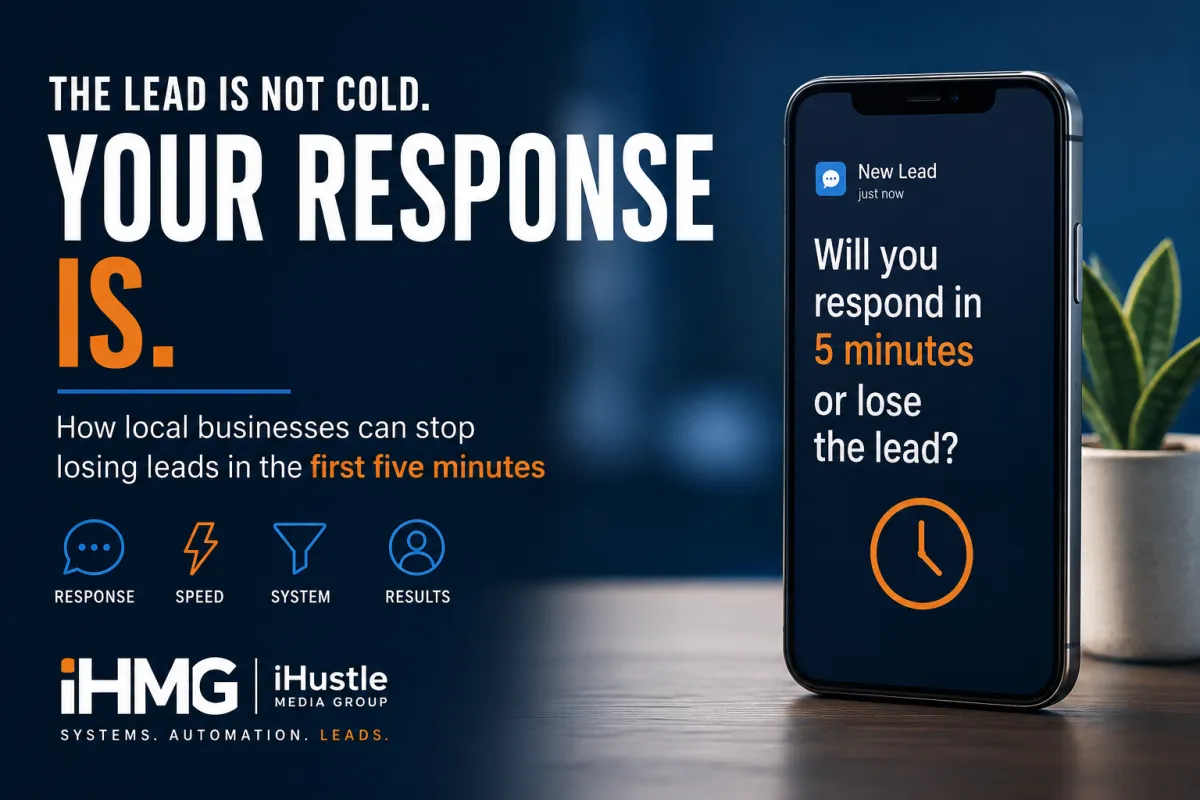
How Local Businesses Can Stop Losing Leads in the First Five Minutes
The Lead Is Not Cold. Your Response Is.
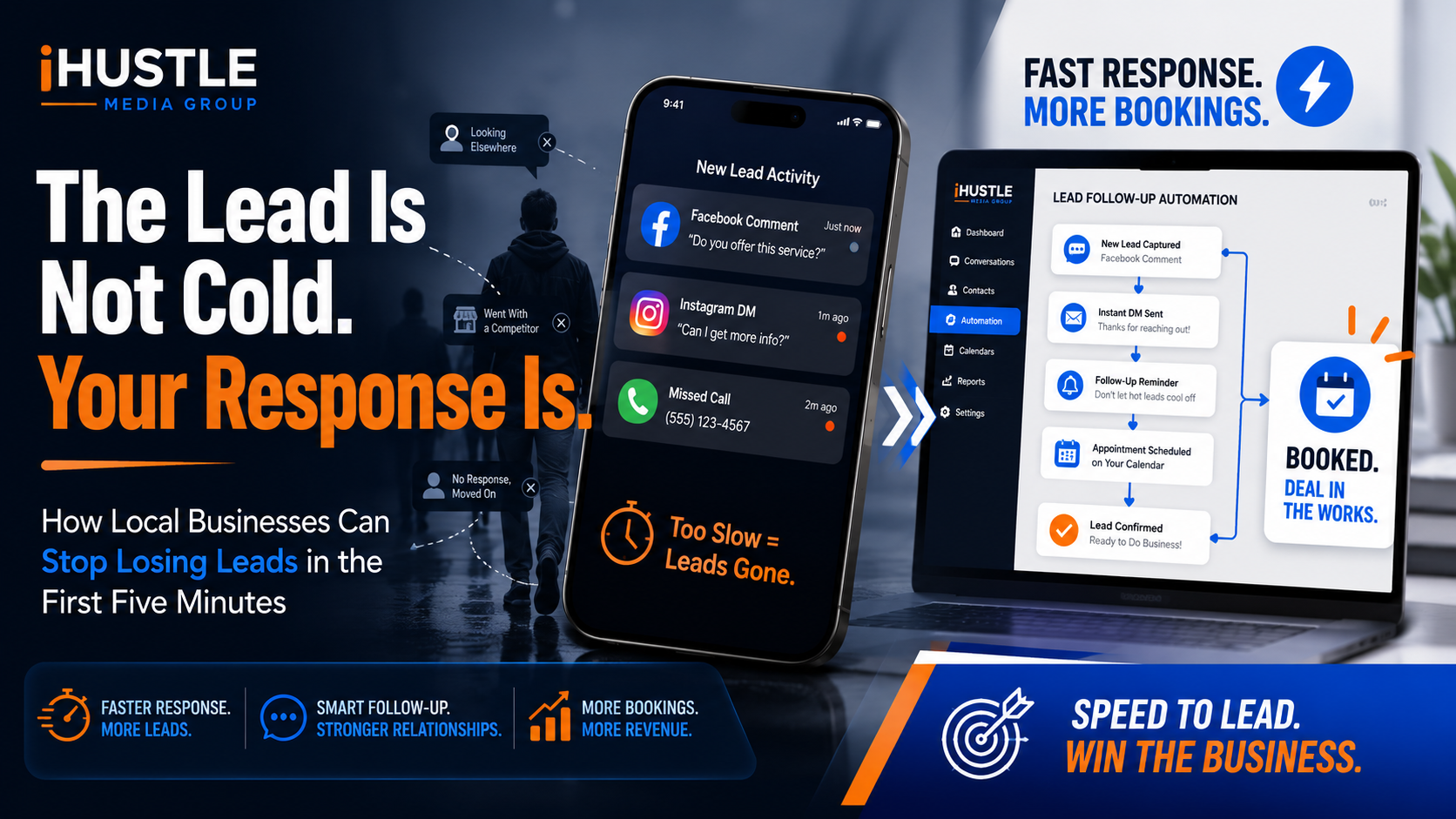
How Local Businesses Can Build a First Five Minutes Follow Up System That Turns Interest Into Leads
Most local businesses do not have a lead problem.
They have a response problem.
That may sting a little, but it is also good news. Because if the issue is not your service, your skill, your reputation, or your market, then the solution is not to burn everything down and start over.
The solution is to build a better system.
Here is the truth most business owners need to hear: when someone shows interest, the clock starts.
They comment on your post.
They send a DM.
They ask for a quote.
They click your booking link.
They visit your Google Business Profile.
They fill out a form.
They call and do not get an answer.
That person may not be ready to buy in that exact second, but they are giving you a signal. They are saying, “I might need help.”
The problem is that most businesses treat that signal casually.
They respond when they get around to it. They check the inbox later. They forget to follow up. They rely on memory. They assume the customer will come back if they are serious.
But customers are busy. They are distracted. They are comparing options. And in many cases, they are reaching out to more than one company at the same time.
That is why speed to lead matters.
HubSpot’s lead pipeline automation guidance shows how modern CRM systems can create leads, move them through stages, and trigger actions automatically when pipeline activity changes. That is important because lead response should not depend only on someone remembering to check a spreadsheet, inbox, voicemail, or social media account.
The lead is not cold.
Your response is.
And today, we are going to fix that.
Why Interested People Disappear
Let us talk about what really happens after someone shows interest.
A homeowner sees a roofer’s before and after post. They think, “I need someone to look at my roof before the next storm.” They comment, “How much for an inspection?”
No response.
A homeowner searches for a plumber, lands on a Google Business Profile, and wants to book an appointment. But there is no booking link, no clear quote request button, and no easy next step.
They move on.
A business owner sees a consultant’s LinkedIn post and downloads their free guide. The guide is good, but there is no follow up email, no calendar link, no next step, and no nurture sequence.
They forget.
A parent sends a DM to a local service provider asking about availability. The business owner sees it two days later and replies, “Sorry, just seeing this.”
Too late.
None of these examples mean the person was a bad lead.
They mean the system was not ready for the moment.
The first five minutes after someone shows interest are not just an operational window. They are a trust window.
Fast response communicates professionalism.
Clear next steps communicate confidence.
Follow up communicates that the customer matters.
Automation communicates that your business is organized, even when you are busy.
The goal is not to chase people. The goal is to protect the interest your marketing already created.
The First Five Minutes System
At iHustle Media Group, we look at this through a simple lens:
Content creates attention.
Lead capture catches the signal.
Automation responds fast.
CRM organizes the opportunity.
Follow up keeps the relationship alive.
The next step moves the right person forward.
That is the foundation of a Social Lead Web.
It is not just posting more. It is not just running ads. It is not just having a website. It is connecting the pieces so that when interest shows up, the system knows what to do.
Here is how to build it.
Step 1: Identify Every Place A Lead Can Raise Their Hand
Before you automate anything, you need to know where leads are coming from.
Most businesses underestimate how many doors they have open.
Start by listing every place someone can show interest.
For a local business, this might include:
Google Business Profile calls
Google Business Profile messages
Website contact form
Quote request form
Facebook comments
Facebook Messenger
Instagram DMs
TikTok comments
Lead ads
Missed calls
Voicemail
Email inbox
Referral messages
Booking links
Text messages
For an expert brand, this might include:
Lead magnet opt ins
Webinar registrations
Podcast guest inquiries
DM keyword responses
LinkedIn comments
Discovery call applications
Newsletter replies
Event registrations
Community messages
Sales page clicks
Consultation forms
Once you list the entry points, ask one question for each:
What happens after someone shows interest here?
If the answer is “I check it when I can,” that is a leak.
If the answer is “It depends,” that is a leak.
If the answer is “I am not sure,” that is a leak.
Your first job is not to make the system fancy. Your first job is to make the system visible.
Step 2: Create One Clear Next Step For Each Lead Source
Every lead source needs a next step.
This does not mean every person should book a call immediately. Some people need education. Some need a quote. Some need pricing guidance. Some need to answer qualifying questions. Some need to talk to a human.
But confusion kills momentum.
If someone comments on a post, what should happen?
Maybe they receive a DM with a link to the Social Lead Web Quiz.
If someone asks for a quote, what should happen?
Maybe they receive a form asking for service type, location, timeline, and project details.
If someone visits your Google Business Profile, what should happen?
Maybe they can click a booking link, call, visit your website, or request service.
Google’s Business Profile booking documentation explains that businesses can set up booking providers so booking options appear directly on the profile. That matters because local customers should not have to hunt for the next step when they are ready to act.
The easier the next step, the less interest you lose.
Meta’s lead ad best practices make the same point from a form perspective. Meta recommends keeping instant forms simple and asking as few questions as needed to align with the goal.
That is a powerful principle.
Do not make interested people work harder than necessary to tell you they are interested.
Step 3: Build The Immediate Response
Once someone raises their hand, they should receive a response right away.
This first response does not have to be complicated. It just needs to do three things:
Acknowledge the action
Confirm the next step
Set expectation
Example for a local quote request:
“Thanks for reaching out. We received your request and will review the details shortly. In the meantime, you can reply with any photos, preferred timeline, or special notes that will help us prepare.”
Example for a missed call:
“Sorry we missed your call. This is iHustle Media Group. What can we help you with today? Reply here and we will point you in the right direction.”
Example for a guide download:
“Your guide is on the way. While you review it, take the quick scorecard to see where your current lead system may be leaking opportunities.”
Example for a social media comment:
“Appreciate the comment. I sent you the resource in your DMs. It will help you see how to turn social media attention into actual leads.”
That first response buys trust.
It tells the person, “You did not disappear into a black hole.”
For service businesses, this alone can separate you from competitors who respond hours or days later.
For expert brands, this creates a professional experience that makes your authority feel organized.
Step 4: Route Every Lead Into A CRM
Your inbox is not a CRM.
Your memory is not a CRM.
A sticky note is not a CRM.
A spreadsheet might be better than nothing, but it is still not the system most growing businesses need.
A CRM gives you one place to track the contact, source, status, follow up, notes, and next action.
This matters because leads do not usually disappear all at once. They disappear through small gaps.
Nobody updated the status.
Nobody followed up.
Nobody knew who owned the lead.
Nobody remembered what the customer asked for.
Nobody checked whether they booked.
Nobody knew the person had already reached out three times.
That is how money leaks quietly.
Salesforce has publicly described how reducing lead assignment complexity with data and automation reduced its own time to lead by 98 percent. While that is an enterprise example, the lesson applies to smaller businesses too: when lead assignment and follow up are scattered, speed suffers.
Your CRM does not have to be complex.
Start with a simple pipeline:
New Lead
Contacted
Qualified
Quote or Consultation Scheduled
Follow Up Needed
Won
Lost or Not Ready
That is enough for most businesses to stop guessing.
Step 5: Create A Follow Up Sequence
The fortune is not just in the follow up.
The fortune is in the follow up that actually happens.
Most businesses follow up once, maybe twice, then stop. Not because they do not care. Because they are busy.
That is exactly where automation helps.
Automation should not replace your relationship. It should protect it.
Create a basic follow up sequence for people who show interest but do not take the next step.
For a local service business, the sequence might look like this:
Immediately: “Thanks for reaching out. We received your request.”
After 1 hour: “Do you have any photos or details you want to send over?”
After 1 day: “Are you still looking for help with this project?”
After 3 days: “Here are three things to know before choosing a provider.”
After 7 days: “Still need help? We can point you in the right direction.”
For an expert brand, the sequence might look like this:
Immediately: deliver resource
After 1 day: explain the common mistake
After 3 days: share a quick win
After 5 days: invite them to the scorecard
After 7 days: invite them to book or join the next step
Notice the tone.
Helpful. Clear. Respectful.
You are not begging people to buy. You are guiding people who already showed interest.
Step 6: Add Human Touch Where It Matters
Automation is not the whole relationship.
It is the safety net.
The best systems combine automation with human judgment.
Use automation to respond, organize, remind, and nurture. Use your team to handle the moments that require real conversation.
Here are good places for a human touch:
High value quote requests
Complicated service questions
Hot leads who respond quickly
People who ask about pricing
Past customers who reengage
Referral leads
Prospects who book calls
Messages with emotional urgency
A homeowner with a flooded basement does not need a seven email nurture sequence first. They need a response.
A business owner asking about a full AI growth system does not need a generic reply. They need a guided conversation.
The system should help you see those moments faster.
Step 7: Measure Your First Five Minutes
You cannot improve what you do not measure.
Once your system is in place, track the basics:
How many new leads came in?
Where did they come from?
How fast was the first response?
How many booked?
How many received follow up?
How many went cold?
How many became customers?
Where did people drop off?
Start simple.
Every Friday, review your pipeline for 20 minutes.
Look for stuck leads.
Look for missed follow ups.
Look for sources that create interest but no conversion.
Look for content that creates comments but no next step.
Look for forms that collect information but do not trigger action.
This weekly review will show you what to fix next.
That is how you move from random marketing to a real operating system.
What This Looks Like In Real Life
Let us say you are a local HVAC company.
You post a short video about preparing your AC before summer heat hits. At the end, you say, “Comment CHECKUP and we will send you our quick AC readiness checklist.”
Someone comments.
Automation sends the checklist.
The DM asks if they want to schedule a seasonal checkup.
If yes, they click a booking link.
If no, they still enter your CRM as a seasonal maintenance lead.
They receive helpful follow up over the next week.
Your team sees the lead source.
You now know which post created the opportunity.
That is a Social Lead Web.
Now let us say you are a consultant.
You post a LinkedIn article about why visibility does not convert without a backend system. You invite people to take your scorecard.
Someone takes it.
They receive their results.
They enter your CRM.
Based on their score, they either receive educational nurture or an invitation to book a diagnostic.
Your content created interest. Your system captured it. Your follow up guided the next step.
That is the game.
Final Thought
The businesses that win are not always the ones posting the most.
They are not always the ones with the biggest budget.
They are not always the ones with the flashiest content.
Many times, the businesses that win are the ones that respond clearly, quickly, and consistently when interest shows up.
That is the shift.
Stop treating leads like random notifications.
Start treating them like signals.
Build the system that protects the signal.
Because the lead is not cold.
Your response is.
And once you fix the response, your content has a much better chance of becoming customers, appointments, consultations, quotes, and revenue.
First Five Minutes Lead Response Checklist
Use this checklist to audit your current lead response system.
Lead Source Audit
[ ] List every place a lead can contact your business.
[ ] Check your Google Business Profile call, message, booking, and website links.
[ ] Review all social media inboxes and comment sections.
[ ] Identify every form, calendar, landing page, and lead magnet.
[ ] Write down what currently happens after each lead action.
Next Step Clarity
[ ] Every post has a clear CTA when appropriate.
[ ] Every lead form confirms what happens next.
[ ] Every booking link is easy to find.
[ ] Every Google Business Profile visitor has a clear action path.
[ ] Every lead magnet points to one next step.
Immediate Response
[ ] New form fills receive an instant confirmation.
[ ] Missed calls receive a text back.
[ ] Social media comments have a DM or reply process.
[ ] New DMs receive a helpful response.
[ ] The first message sets clear expectations.
CRM Setup
[ ] Every new lead enters the CRM.
[ ] Each lead has a source attached.
[ ] Each lead has a status.
[ ] Each lead has an owner or next action.
[ ] The pipeline stages are simple and clear.
Follow Up
[ ] Leads who do not book receive follow up.
[ ] Follow up messages are helpful, not pushy.
[ ] The system sends reminders to your team.
[ ] Old leads can be reactivated.
[ ] Not ready leads are nurtured instead of ignored.
Weekly Review
[ ] Review new leads every week.
[ ] Check average first response time.
[ ] Identify stuck leads.
[ ] Review which content created interest.
[ ] Fix one leak before creating more content.