

How Local Businesses Can Turn Social Media Attention Into Real Leads
Your Social Media Is Not Broken. Your Lead Path Is Missing.
Most business owners do not need another person telling them to post more.
They have heard that already.
Post every day.
Be consistent.
Show up online.
Make reels.
Share your story.
Talk about your offer.
Use better hooks.
Create more content.
All of that can help.
But for many local businesses and expert brands, more content is not the real fix.
The real issue is this:
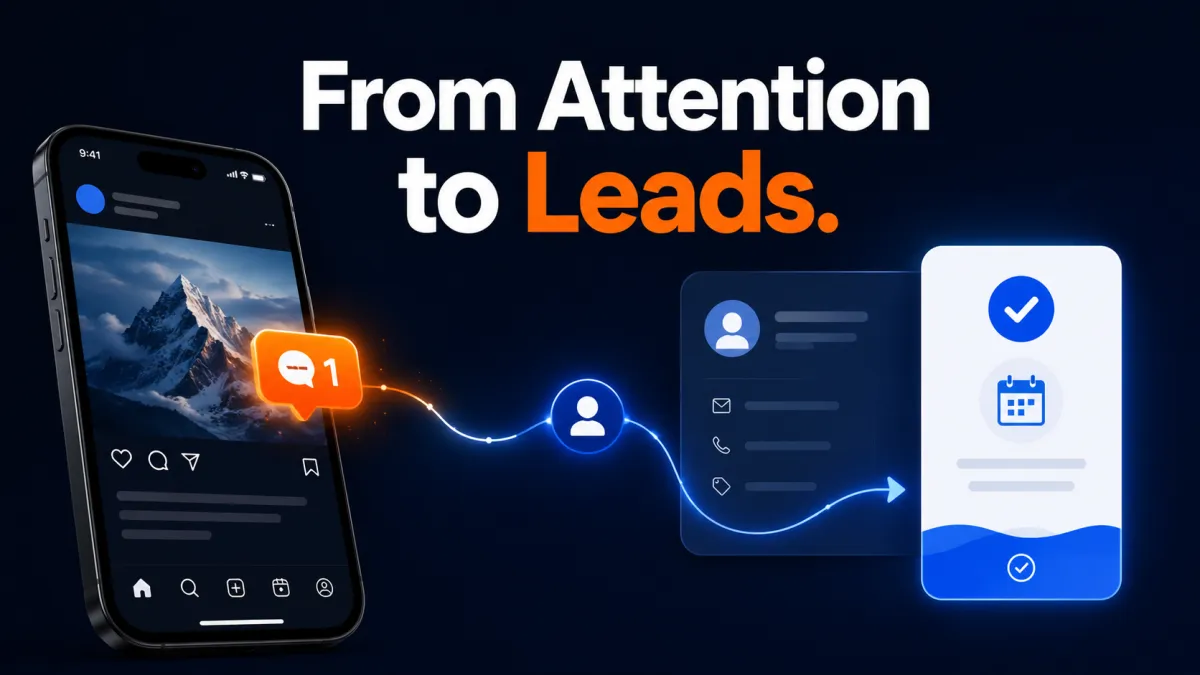
Your social media may be creating attention, but your business does not have a clear path for turning that attention into leads.
That is why a post can get likes but no inquiries.
That is why a video can get views but no booked calls.
That is why people can comment “I need this” and still never become a customer.
That is why local businesses can stay visible online while national brands, franchises, and bigger competitors keep winning the customer.
The problem is not always the content.
Sometimes the problem is what happens after the content works.
At iHustle Media Group, we call this missing piece the lead path.
A lead path is the connected journey between someone seeing your content and becoming a real opportunity inside your business.
It usually looks like this:
Content creates interest.
A call to action gives direction.
A comment or DM starts the conversation.
A form captures the contact.
A CRM organizes the lead.
Automation responds quickly.
Follow up keeps the relationship alive.
The right next step moves the person closer to buying.
That is the difference between social media that creates visibility and social media that creates leads.
Visibility Is Not The Same As Lead Generation
Visibility means people can see you.
Lead generation means interested people know what to do next, and your business has a system to capture and follow up with them.
That distinction matters.
A roofer can post a great before and after photo.
An HVAC company can share a seasonal maintenance tip.
A med spa can post a client transformation.
A consultant can share a strong business lesson.
A speaker can post a clip from a recent event.
A coach can share a client breakthrough.
All of that content can create attention.
But attention by itself is not a lead.
A lead requires a path.
Google Business Profile makes this point clearly in its own product positioning. Google says a Business Profile helps turn people who find a business on Search and Maps into new customers with photos, offers, posts, and more. That tells us something important: visibility should be connected to action.
Meta makes a similar point with lead ads, saying lead generation marketing can help businesses build trust, establish rapport with potential customers, and nurture interest. In other words, social platforms are not only about reach. They are also about moving interested people into a relationship.
That is the shift local businesses need to make.
Stop asking only, “How do we get more people to see us?”
Start asking, “When people do see us, what happens next?”
Why Local Businesses Lose Leads After Getting Attention
Most local businesses already have more content assets than they realize.
Your camera roll is full of marketing.
Completed jobs.
Happy customers.
Before and after photos.
Team members in the field.
Behind the scenes moments.
Customer questions.
Reviews.
Local events.
Community involvement.
Tips from your day to day work.
The issue is not that you have nothing to say.
The issue is that the content is often disconnected from the sales process.
Here is what usually happens.
You post a photo. People like it. Then nothing happens.
You share a helpful tip. Somebody thinks, “That is useful.” Then nothing happens.
You get a comment. You reply manually when you see it. Then nothing happens.
You receive a DM. You answer a question. Then the conversation fades.
You get profile visits. But there is no clear lead magnet, quote request, booking path, or follow up.
The attention is real.
But the business has no system to catch it.
This is how local customers drift to national brands and big competitors. Not always because those companies are better. Often because their path is clearer.
They have obvious calls to action.
They have forms.
They have automated confirmations.
They have retargeting.
They have follow up.
They have reminders.
They have systems.
Local businesses have the relationship advantage.
But national brands often have the system advantage.
The opportunity is to combine both.
That is why the future belongs to local businesses that can keep their human trust while adding modern lead capture, CRM, AI automation, and follow up systems.
[CTA Box: Local business owners, download the free Stop Losing Local Business guide to identify the silent gaps that send ready buyers to national brands.]
The Social Lead Web Concept
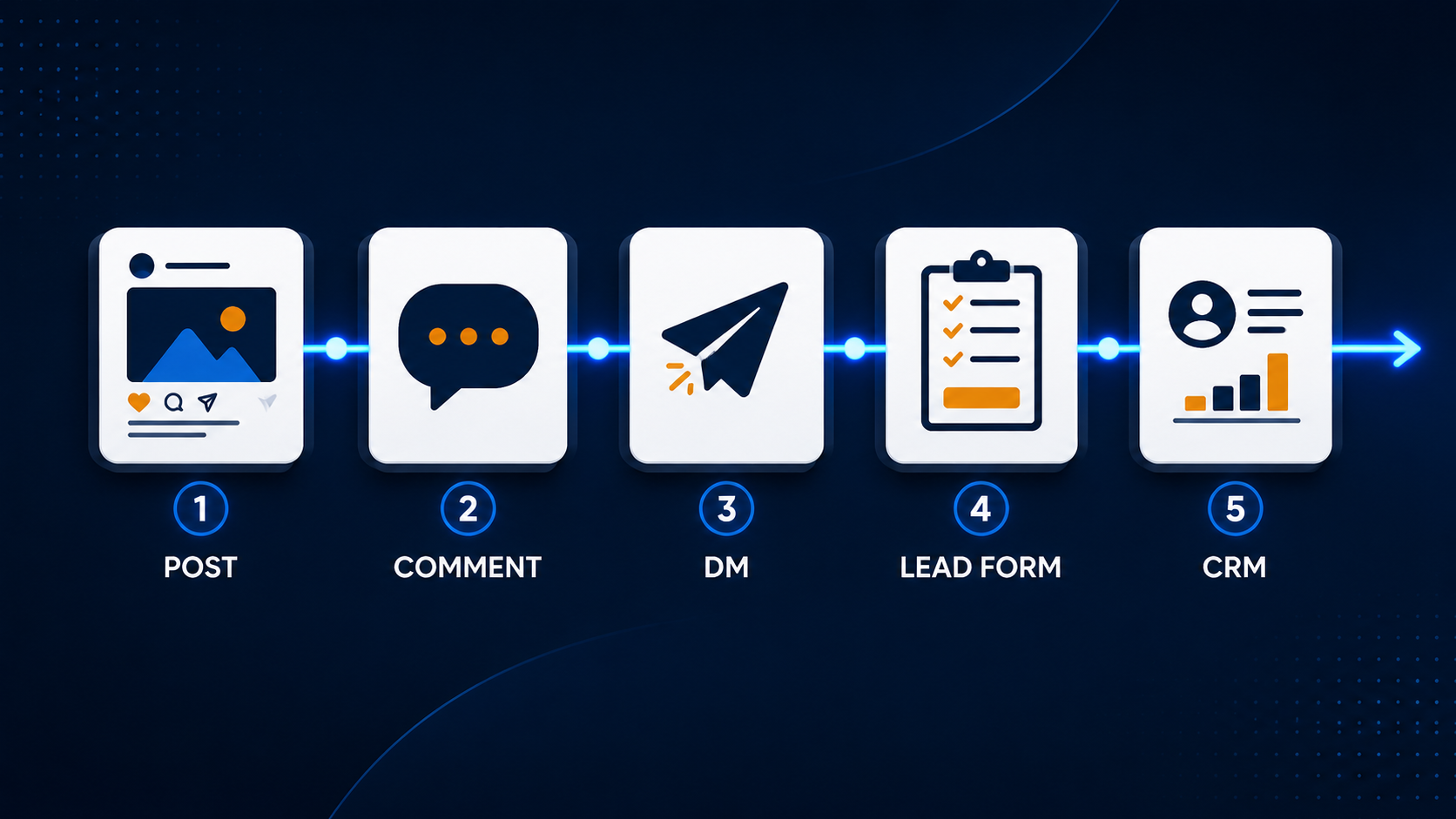
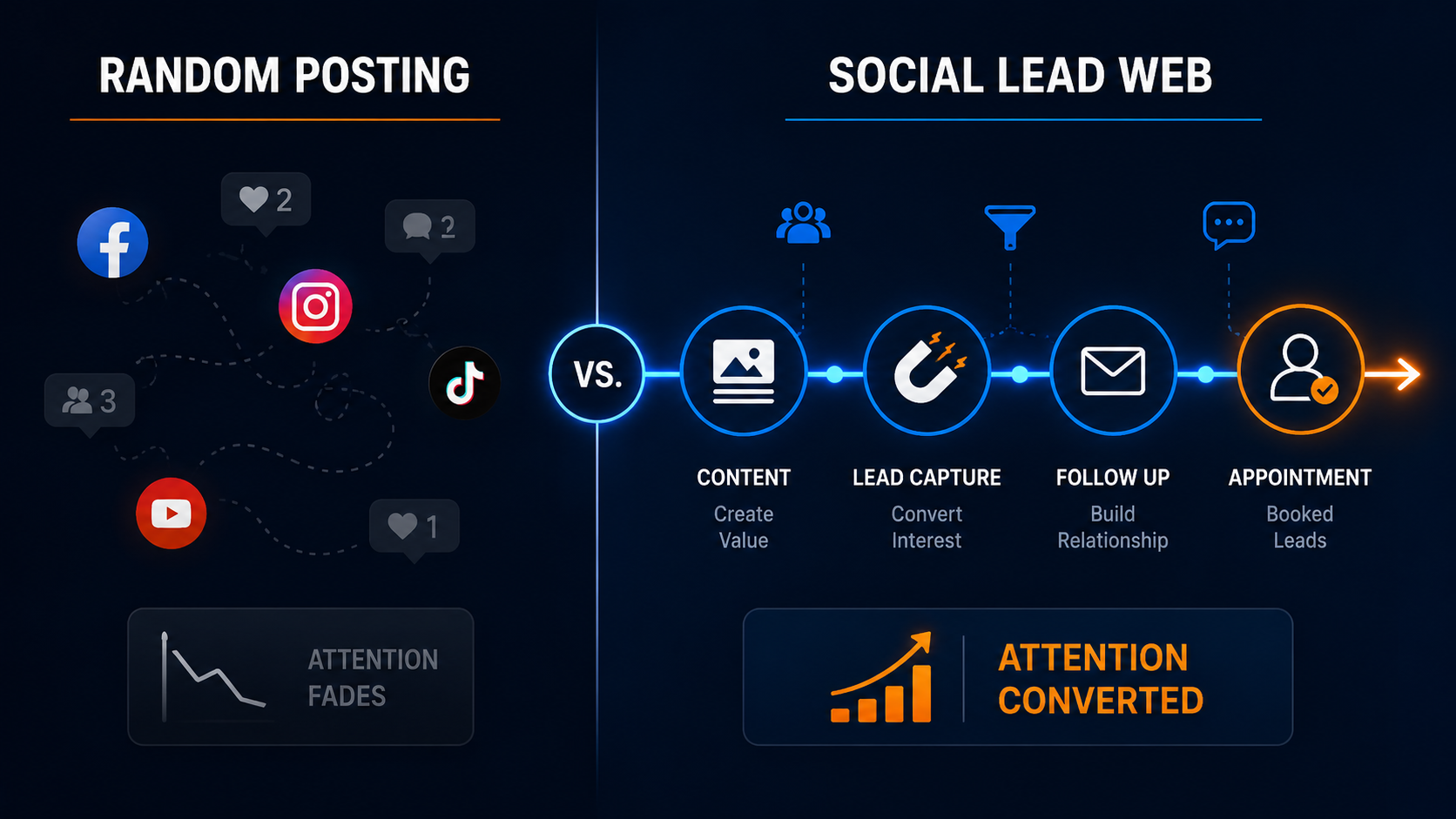
A Social Lead Web is the connected system that turns social media attention into organic leads.
It is not just one funnel.
It is not just one post.
It is not just one automation.
It is the web of touchpoints that helps someone move from interest to action.
Here is the simple version:
Post: The person sees something useful, relevant, or timely.
Engagement: They like, comment, save, share, click, or send a DM.
CTA: The content tells them what to do next.
Conversation: A DM, comment reply, or landing page continues the journey.
Capture: A form, quiz, booking page, or lead magnet collects their information.
CRM: The lead enters a pipeline so they do not disappear.
Automation: The system responds, tags, routes, notifies, and follows up.
Human follow up: The right person steps in at the right time.
Conversion: The lead books, requests a quote, buys, applies, or joins.
That is the path.
Without it, social media becomes a public billboard.
With it, social media becomes part of your growth infrastructure.
This is why iHustle Media Group focuses on Social Lead Web, CRM and follow up systems, and AI automation as connected pieces. One without the others is usually incomplete.
Content creates demand.
Systems capture demand.
Follow up converts demand.
Step 1: Choose One Business Goal For Your Content
Before you build the lead path, decide what the content is supposed to do.
Not every post needs to sell.
But every strategic post should have a purpose.
For local businesses, common goals include:
Get quote requests.
Book consultations.
Generate service calls.
Promote seasonal offers.
Get reviews.
Grow a local email list.
Educate customers before they buy.
Drive traffic to a Google Business Profile.
Build trust in a specific neighborhood or service area.
For expert brands, goals may include:
Get people to take a scorecard.
Book strategy calls.
Download a lead magnet.
Register for a workshop.
Join a newsletter.
Listen to a podcast episode.
Enter a nurture sequence.
Apply for a program.
The mistake is trying to make one post do everything.
Pick one goal.
For example:
“This week, our content will drive people to request a free roof inspection.”
Or:
“This week, our content will drive people to take the Ecosystem Growth Scorecard.”
Or:
“This week, our content will get local business owners to download the Stop Losing Local Business guide.”
A clear goal makes the next step obvious.
Step 2: Match The Right CTA To The Right Content
A call to action is not just a button.
It is direction.
When someone feels interest, curiosity, pain, or urgency, the CTA tells them how to move.
The wrong CTA can kill momentum.
A person watching a quick educational video may not be ready to book a call. But they may be willing to comment a keyword, take a quiz, or download a guide.
A person comparing service providers may not want a newsletter. They may want a quote form or booking link.
A person who just discovered your expert brand may not be ready for a paid program. They may need a scorecard or free resource first.
So match the CTA to the content.
Examples:
For awareness content: “Download the free guide.”
For problem diagnosis content: “Take the scorecard.”
For proof content: “Request a quote.”
For seasonal service content: “Book your checkup.”
For educational expert content: “Get the checklist.”
For social proof content: “See how the system works.”
For direct response content: “Book the diagnostic.”
The CTA should feel like the natural next step, not a hard turn.
Step 3: Create A Simple Lead Capture Point
Once the CTA is clear, the next step needs somewhere to go.
This is where many businesses lose people.
They say “DM us” but never check the inbox.
They say “visit our website” but the website has no specific page.
They say “call now” but miss calls.
They say “book today” but do not provide a booking link.
They say “learn more” but send people to a generic homepage.
Fix that.
Every CTA should connect to a specific lead capture point.
That could be:
A GoHighLevel form.
A survey or quiz.
A booking calendar.
A landing page.
A quote request page.
A lead magnet opt in.
A DM keyword automation.
A missed call text back.
A Google Business Profile booking link.
Google also allows businesses to create posts on their Business Profile to share updates, offers, and events directly with customers on Search and Maps. That matters because your Google presence can support your social lead path, not just your website.
The key is this:
Do not send interested people into confusion.
Send them to one clear next step.
[Insert Image 2: Random Posting vs Social Lead Web]
Step 4: Connect The Lead Capture To Your CRM
Once someone fills out the form, clicks the booking link, comments the keyword, or requests the guide, they should enter your CRM.
This is where the lead becomes trackable.
HubSpot describes its Smart CRM as a single source of truth that connects business data. For small businesses, that concept matters because scattered conversations across email, text, DMs, forms, and missed calls create missed opportunities.
Your CRM should show:
Who the lead is.
Where the lead came from.
What they requested.
What stage they are in.
Who needs to follow up.
What has already been sent.
What needs to happen next.
Start with a simple pipeline.
New Lead
Contacted
Qualified
Booked
Follow Up Needed
Won
Not Ready
That is enough for most local businesses to get control.
You do not need to overcomplicate it.
You just need to stop letting leads live only in inboxes, comment sections, and your memory.
Step 5: Build The First Response
Now that the lead is captured, the system should respond quickly.
A good first response does three things:
Confirms the action.
Sets expectation.
Gives the next step.
Example for a local business quote request:
“Thanks for reaching out. We received your request. Please reply with any photos, timing details, or service notes that will help us prepare. Someone from our team will follow up shortly.”
Example for a comment keyword:
“Thanks for commenting. Here is the guide we mentioned. After you read it, take the scorecard to see where your current lead system may be leaking opportunities.”
Example for a scorecard completion:
“Your scorecard has been received. Based on your answers, your next step is to review your results and identify the biggest gap in your lead path.”
The tone should be helpful, clear, and human.
Not robotic.
Not pushy.
Not confusing.
Automation should make the business feel more responsive, not less personal.
Step 6: Follow Up Without Feeling Salesy
Most businesses do not follow up enough.
They are afraid of annoying people.
But helpful follow up is not annoying when it is relevant.
If someone asked for a quote, follow up with useful information about what affects pricing.
If someone downloaded a guide, follow up with a quick win from the guide.
If someone took a scorecard, follow up with an explanation of their biggest gap.
If someone commented on a post, follow up with the resource they requested.
The secret is to follow up based on the signal they already gave you.
Here is a simple three message follow up sequence.
Message 1: Confirm and deliver
“Here is the resource you requested. Start with page one and look for the section on missed follow up.”
Message 2: Educate
“One of the biggest mistakes we see is posting content without a next step. Here is a quick way to fix that.”
Message 3: Invite
“Want to see where your own system may be leaking? Take the Ecosystem Growth Scorecard.”
For local businesses promoting the free guide, it could look like this:
Message 1: “Here is the Stop Losing Local Business guide.”
Message 2: “One thing to check today: does your Google Business Profile have a clear next step?”
Message 3: “Want help identifying your biggest leak? Take the scorecard.”
That is follow up with value.
Step 7: Review The Path Weekly
You do not improve a system by guessing.
You improve it by reviewing the path.
Every week, look at the following:
Which posts created engagement?
Which CTAs got clicks or comments?
Which lead capture points converted?
Which leads entered the CRM?
Which leads received follow up?
Which leads booked or requested more information?
Where did people drop off?
Pick one leak to fix.
Not ten.
One.
Maybe the CTA is unclear.
Maybe the landing page is too broad.
Maybe the form asks too many questions.
Maybe the follow up is too slow.
Maybe leads are entering the CRM without a source.
Maybe the content is getting attention from the wrong audience.
Fix one leak per week, and your system will get stronger fast.
What This Looks Like For A Local Service Business
Let us say you run a plumbing company.
You create a post titled:
“Three signs your small leak is about to become an expensive repair.”
At the end, the CTA says:
“Comment LEAK and we will send you our quick homeowner leak checklist.”
Someone comments.
They receive an automatic DM.
The DM sends the checklist and asks if they want help checking the issue.
If they say yes, they are sent to a short service request form.
The form enters them into the CRM.
The system sends a confirmation text.
The team gets notified.
A follow up reminder is created.
If they do not book, they receive helpful follow up over the next few days.
That is how one post becomes a lead path.
That is a Social Lead Web.
What This Looks Like For An Expert Brand
Let us say you are a consultant.
You post:
“Your content is not the problem. Your conversion path is.”
The CTA says:
“Take the Ecosystem Growth Scorecard to find the weakest link in your content to client system.”
Someone takes the scorecard.
They receive their results.
They enter your CRM.
If they score low, they get educational nurture.
If they score high and appear qualified, they are invited to book the AI Growth Diagnostic.
If they are not ready, they receive helpful emails that build trust over time.
That is how authority becomes pipeline.
Not by being louder.
By being clearer.
Final Thought
Social media is not broken.
Most businesses just ask it to do too much by itself.
A post cannot capture the lead, organize the contact, follow up, qualify the buyer, and book the appointment unless you build the system behind it.
That is the shift.
Stop posting into the wind.
Build the path behind the post.
When you connect your content, CTA, lead capture, CRM, automation, and follow up, social media becomes more than visibility.
It becomes a lead generation system.
And for local businesses, that is how you stop losing ready buyers to bigger brands with better infrastructure.
For expert brands, that is how you turn attention into conversations, conversations into opportunities, and opportunities into clients.
The post is not the whole strategy.
The path behind the post is where the money is.
[CTA Box: Take the Ecosystem Growth Scorecard to see where your content to lead system is leaking.]
[CTA Box: Local business owners, download the free Stop Losing Local Business guide and learn how to protect your local advantage against national brands.]
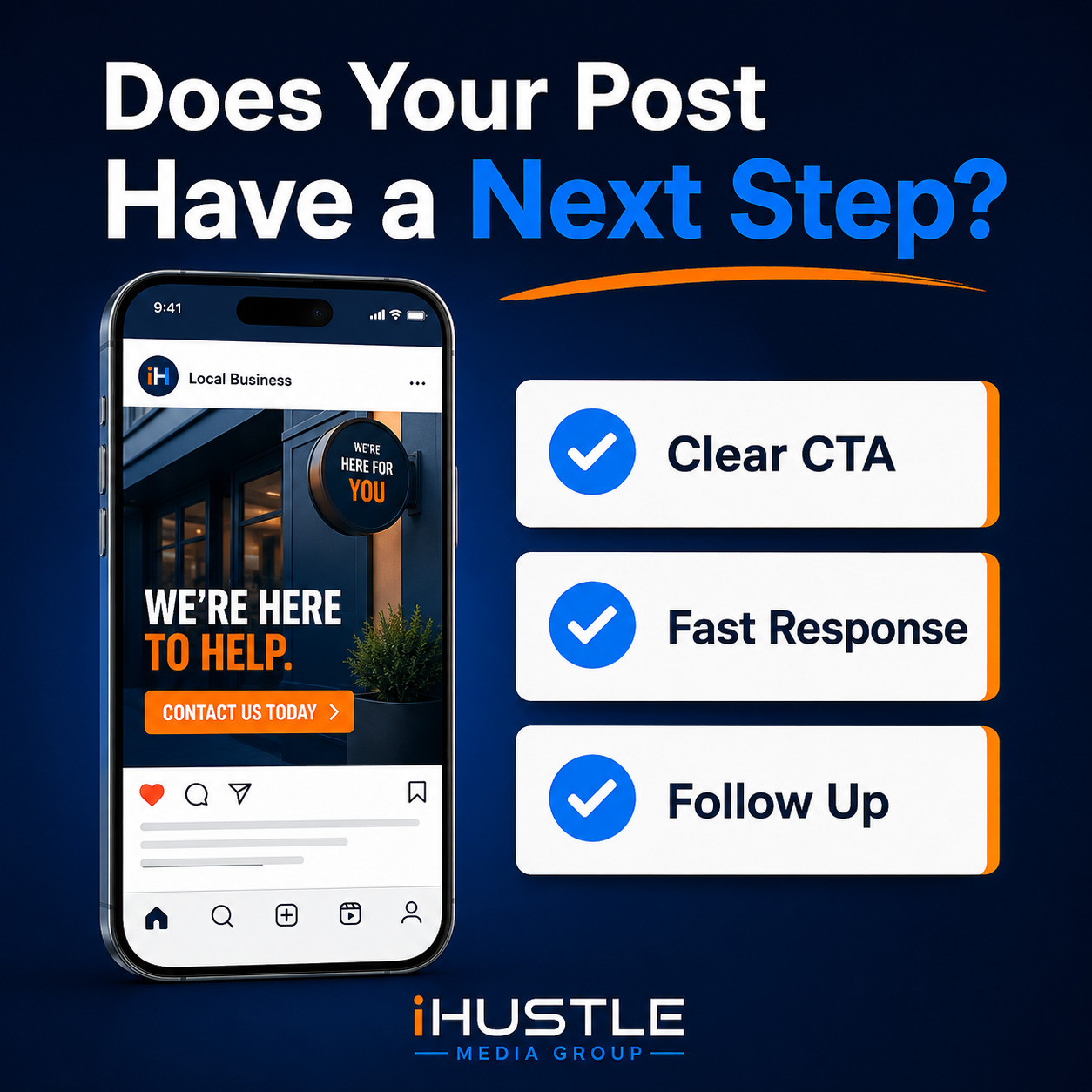
[Insert Image 3: Does Your Post Have A Next Step Checklist Graphic]
Blog Action Checklist
Content Goal
[ ] Choose one business goal for this week’s content.
[ ] Decide whether the goal is quote requests, bookings, guide downloads, scorecard completions, or consultations.
[ ] Make sure every strategic post supports that goal.
CTA Clarity
[ ] Add one clear CTA to each strategic post.
[ ] Match the CTA to the buyer’s level of readiness.
[ ] Avoid sending people to a generic homepage when a specific next step is better.
[ ] Use action language that tells people exactly what to do.
Lead Capture
[ ] Create a form, quiz, booking link, or landing page for the CTA.
[ ] Keep the lead capture step simple.
[ ] Ask only for the information needed to move the conversation forward.
[ ] Make sure the thank you message tells people what happens next.
CRM Setup
[ ] Send every new lead into your CRM.
[ ] Add the lead source.
[ ] Create simple pipeline stages.
[ ] Assign the next action.
[ ] Make sure no lead sits without a status.
Automation And Follow Up
[ ] Send an immediate confirmation message.
[ ] Notify the team when a lead comes in.
[ ] Create a short follow up sequence.
[ ] Make follow up helpful, not pushy.
[ ] Use automation to protect relationships, not replace them.
Weekly Review
[ ] Review which posts created interest.
[ ] Review which CTAs converted.
[ ] Review which leads entered the CRM.
[ ] Review which leads got stuck.
[ ] Fix one leak before creating more content.