


Zendesk vs AI System Diagnostic: Are You Managing Tickets or Building Growth?
The most expensive mistake you can make is mistaking activity for progress. Most high-level service providers believe that a growing pile of support tickets is a badge of honor or a sign of scale. It isn't. It's usually evidence of a structural leak in your lead flow.
You probably feel like a slave to your own help desk, watching operational overhead climb while leads slip through the cracks in the follow-up phase. It's a frustrating cycle that keeps you trapped in the weeds of your own business. When evaluating a Zendesk vs AI system diagnostic, the choice isn't just about software. It's about whether you want to manage fires or build a fireproof engine.
This article reveals why a support-heavy help desk might be masking the profit leaks that an AI system diagnostic is designed to fix. You'll learn how to stop the manual grind and start building a scalable business engine. We'll explore the shift from reactive ticket management to a proactive system that converts social engagement into revenue with mechanical precision.
Key Takeaways
- Stop treating symptoms and start fixing the underlying architecture of your business growth.
- Understand the fundamental difference between a Zendesk vs AI system diagnostic to determine if you are managing tickets or building revenue.
- Shift your focus from simple customer satisfaction metrics to high-impact ROI by optimizing your digital infrastructure first.
- Eliminate the manual DM grind and replace it with an automated engine that converts social engagement into qualified leads.
- Identify the hidden profit leaks in your current follow-up phase before investing in reactive support software.
The Support Trap: Why Zendesk Might Be Masking Your Profit Leaks
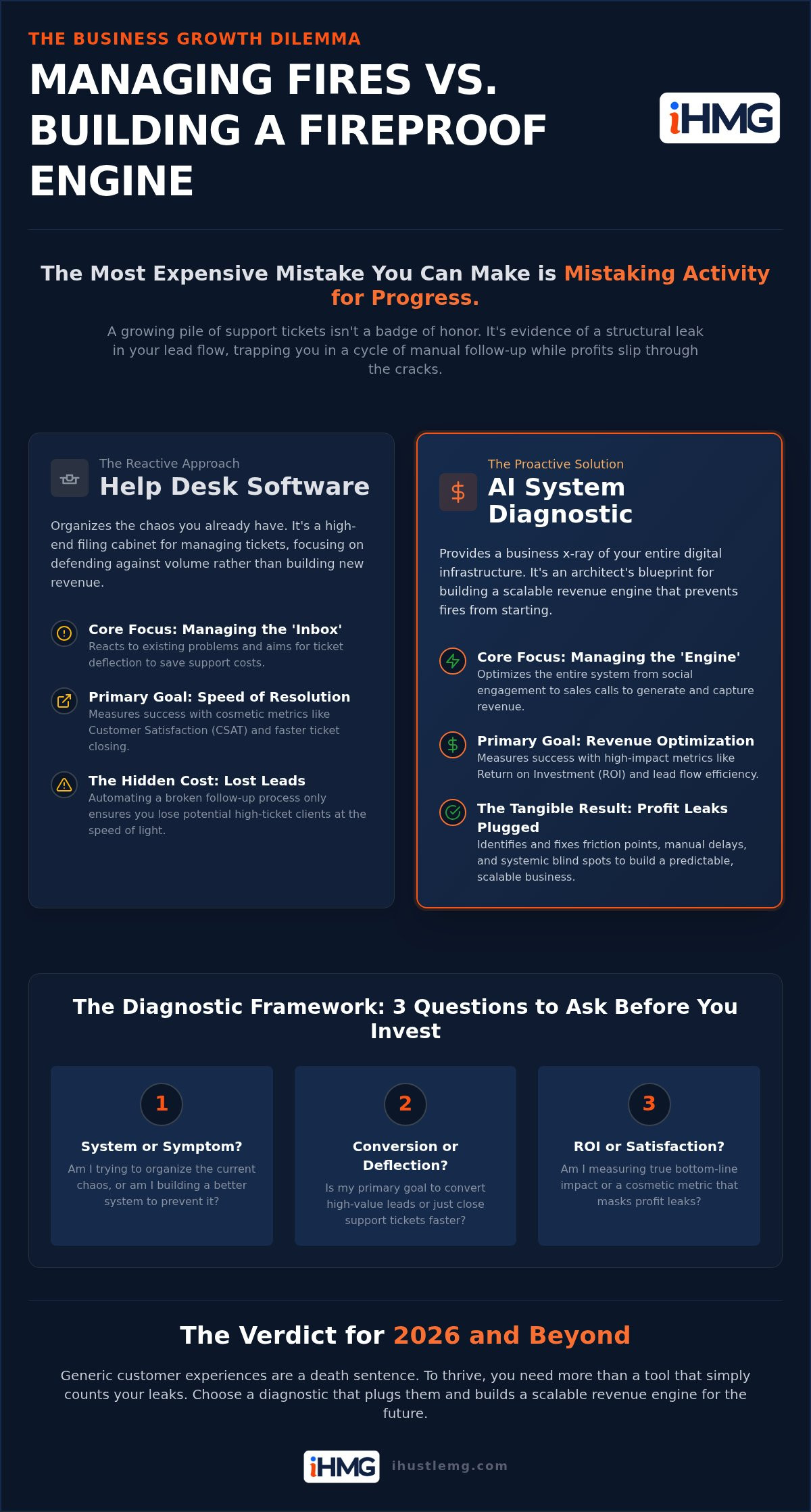
Efficiency is a seductive trap. Many high-level service providers believe that if they can just respond to tickets faster, they'll grow. They buy the "furniture" of a help desk before checking the structural integrity of their business foundation. This is the Support Trap. Automating a broken process only makes it break faster. If your lead follow-up is manual and messy, adding automation through a help desk just ensures you lose leads at the speed of light.
Zendesk is a reactive tool. It's built to handle the volume you already have by organizing chaos into tickets. It's defensive. In contrast, an AI System Diagnostic is a proactive mechanism designed to change the volume you get. It's offensive. Many St. Louis business owners, from Chesterfield to St. Charles, often confuse "better support" with "better systems." They invest in managing fires rather than installing a system that prevents the fire from starting in the first place.
Reactive Support vs. Proactive Architecture
Zendesk's primary goal is ticket deflection and resolution speed. It wants to keep people away from your team to save costs. That's a logical goal for a software giant, but for a high-level service provider, it's often a disaster. You don't want to deflect leads; you want to convert them. When you compare Zendesk vs AI system diagnostic, you're choosing between managing an inbox and managing an engine.
- Zendesk Goal: Speed of resolution and "closing" the interaction.
- AI System Diagnostic Goal: Revenue optimization and lead flow efficiency.
The hidden cost of managing tickets instead of closing leads is staggering. While your team celebrates a "resolved ticket," you might actually be losing a potential high-ticket client who got stuck in a generic, slow support loop.
When 'Standard' Isn't Enough for 2026
By 2026, generic customer experiences are a death sentence for authority-based businesses. Standard tools lead to mediocre, generic interactions that fail to build trust. You need an AI-first diagnostic before you commit to any platform. This ensures your infrastructure is built for growth, not just maintenance.
In a service-based business, a profit leak is any point in your digital infrastructure where a qualified lead loses momentum or vanishes due to friction, manual delays, or systemic blind spots. Don't settle for a tool that simply counts your leaks. Choose a diagnostic that plugs them and builds a scalable engine for your future.
Zendesk AI vs. AI System Diagnostic: A Structural Comparison
Choosing between a Zendesk vs AI system diagnostic is the difference between buying a high-end filing cabinet and hiring a master architect. One organizes the mess you've already made. The other ensures your business structure is built for expansion. Zendesk manages the 'Inbox' by optimizing how you talk to existing problems. The Diagnostic manages the 'Engine' by optimizing how you generate and capture revenue.
Zendesk: The Digital Filing Cabinet
Zendesk excels at organizing chaos. It offers multi-channel ticketing that keeps your support team sane and your threads organized. However, it's fundamentally reactive. It tracks what happened in the past to help you repeat those actions slightly faster today. Features like 'Copilot' are designed to assist agents in being more efficient, but they don't replace the manual steps that shouldn't exist in a high-performance business. It focuses on Customer Satisfaction (CSAT), which is a cosmetic metric. It doesn't tell you if that satisfied customer actually contributed to your bottom line or if they were just happy to have a ticket closed.
AI System Diagnostic: The Business X-Ray
An AI System Diagnostic doesn't just look at your tickets. It looks at your entire digital infrastructure to identify automation opportunities that actually move the needle. While Zendesk ignores the gaps between your social media engagement and your sales calls, this AI business diagnostic tool finds the leaks where profit is quietly draining away. It provides a strategic blueprint focused on Return on Investment (ROI) rather than just resolution speed.
- Implementation: You can turn on a Zendesk bot instantly, but it is just a bandage on a broken arm. When comparing a Zendesk vs AI system diagnostic, remember that a strategic blueprint offers a permanent structural fix while a bot just hides the symptoms.
- Data Usage: Zendesk relies on historical ticket data to train its models. It learns how you solved problems yesterday so it can suggest those same solutions today. A Diagnostic analyzes the friction points in your current lead flow to build a roadmap for authority and lead generation.
Instead of just managing the noise, you can start building a scalable business engine. If you're ready to stop guessing where your leads go, exploring a professional AI System Diagnostic is your first step toward total optimization.
The St. Louis Service Provider’s Dilemma: Scaling Without the Grind
High-level service providers in St. Charles and Chesterfield often hit a ceiling they can't see. They have the expertise. They have the demand. Yet, they remain shackled to a manual workflow that prevents true expansion. In the local market, being "busy" is often confused with being "profitable." It's a dangerous distinction. Scaling a service business in 2026 requires more than a standard "contact us" form or a polite auto-responder.
The manual DM grind is a relic of the past. If you're still personally chasing every notification on LinkedIn or Instagram, you aren't an owner; you're an operator. When you weigh the benefits of Zendesk vs AI system diagnostic, you must look at where your business actually lives. A help desk is great for managing existing clients, but it does nothing to solve a lack of market authority or a broken lead flow.
Authority over Automation
Local experts in Florissant are increasingly losing market share to competitors with superior lead architecture. It's not because those competitors are better at their jobs. It's because they've built a system that commands trust before a human ever speaks. Our Authority Accelerator program is designed to build that trust. AI shouldn't just automate tasks; it should position you as the undisputed leader in your niche. While Zendesk tries to automate "conversations," we focus on automating "authority."
- Positioning: Moving from a "service provider" to a "strategic architect."
- Infrastructure: Replacing manual follow-ups with high-authority AI frameworks.
- Results: Higher conversion rates because the trust is already established.
Bridging the Gap from Social to Sales
Your leads don't start in a support ticket. They start on social media. Zendesk doesn't live where your leads are, which creates a massive friction point in your sales cycle. This is where social media lead automation outpaces traditional ticketing every time. You need to transition from visibility to qualified conversations automatically. Our Social Lead Web framework ensures that every social interaction is a step toward revenue, not just another notification to clear. A Zendesk vs AI system diagnostic comparison reveals that while one handles the aftermath of a sale, the other builds the engine that creates the sale.
Diagnostic Framework: 3 Questions to Ask Before You Buy
Most business owners skip the diagnostic phase because they're in a rush to "do something." They buy the software their peers use, hoping it's the magic pill. Six months later, they're paying for a platform that their team hates and their leads ignore. Before you commit to a Zendesk vs AI system diagnostic path, you must interrogate your current infrastructure with three critical questions.
First, are you solving a volume problem or a conversion problem? Zendesk is built for volume. It's for when you have too many people talking to you and you need to keep them organized. But if your problem is that leads aren't becoming clients, a help desk is just a high-tech graveyard for potential revenue. Second, does your current system identify where profit is leaking? If you can't point to the exact moment a lead loses interest, you're flying blind. Third, is your technology stack building your authority or just managing your time? Managing time is a defensive play. Building authority is how you dominate your market.
Step 1: Audit Your Lead Flow
You can't fix what you haven't measured. Use this fix lead conversion leaks checklist to find the immediate gaps in your process. There's a massive difference between "busy work" and "revenue work." Clearing an inbox is busy work. Building a mechanism that qualifies a lead while you sleep is revenue work. Efficiently losing money is still losing money.
Step 2: Evaluate Your Authority
Does your current system make you look like an expert or a commodity? In markets like St. Peters, the "Authority Gap" is the primary reason high-level providers struggle to raise their prices. If your automated support feels "cheap" or generic, you're actively eroding your brand foundation. A Zendesk vs AI system diagnostic helps you decide if you want to be seen as a replaceable service or a strategic architect. Automated support without a strong brand foundation is just a robot telling your customers you're too busy to care.
Don't build your future on a shaky foundation. If you're ready for a blueprint that actually drives growth, it's time to book your AI System Diagnostic today and start building a scalable business engine.
The Verdict: Why iHustle’s AI System Diagnostic is the 2026 Choice
Software is a commodity. Architecture is a competitive advantage. When you weigh a Zendesk vs AI system diagnostic, you're deciding between a tool that helps you work harder and a system that helps you scale faster. iHustle doesn't sell software. We sell architectural evolution. We don't just give you a new dashboard to stare at; we give you a new way to exist in the marketplace. While others are busy tweaking ticket deflection settings, we're rebuilding your digital infrastructure from the ground up.
The AI System Diagnostic serves as the foundation for everything we build. It's the primary mechanism that identifies exactly where your current lead flow is failing. It's the prerequisite for the Social Lead Web and the Authority Accelerator. Without this blueprint, you're just guessing. With it, you have a roadmap for total digital infrastructure optimization. You move from being a reactive operator to a strategic architect.
From Diagnostic to Domination
The transition from a diagnostic to a fully integrated system is where the real movement happens. A diagnostic identifies the leaks; the Social Lead Web plugs them and turns your social presence into a conversion engine. This is why local St. Louis businesses are abandoning generic SaaS platforms. They don't need another subscription. They need a system that moves them from the manual outreach grind to a position of automated authority.
Experts in the Midwest are realizing that "hustle" isn't a sustainable business model. It's a symptom of a broken process. By identifying automation opportunities across your entire digital infrastructure, we remove the friction that keeps you small. You aren't just responding to people faster. You're positioning yourself as the undisputed leader in your niche before the first conversation even begins.
Your Next Move
The "Hustle" is a choice. The system is the cure. You can continue to be a slave to your inbox, or you can choose to build a business that works for you. The future of your business architecture depends on the decisions you make today. Don't settle for a help desk when you need an engine.
Request Cortez for a personalized diagnostic session to see exactly where your profit is leaking. It's time to stop managing the hustle and start scaling the system. The 2026 marketplace won't wait for you to catch up. Build the engine now, or get left behind by those who did. Your first step toward a scalable business engine starts with a professional AI System Diagnostic.
Build a System That Outpaces the Hustle
The choice is clear. You can continue to automate your chaos with reactive tools, or you can choose to rebuild your business on a foundation of precision. Real growth doesn't happen in a support queue. It happens when you identify the structural leaks in your lead flow and replace manual hustle with mechanical efficiency. When you evaluate the Zendesk vs AI system diagnostic, remember that one manages the noise while the other builds the engine.
Leveraging proprietary AI frameworks and St. Louis local expertise, iHustle provides the architectural blueprint you need to scale without the grind. We prioritize results-oriented systems over manual tasks. This ensures your business is built for 2026 and beyond. Don't let profit leak through the cracks of a generic help desk.
Your business deserves an engine that matches your ambition. It's time to take control and build your future.
Frequently Asked Questions
Is an AI System Diagnostic better than Zendesk for a small business?
Yes, if your goal is growth rather than just ticket management. Most small businesses struggle with conversion leaks rather than just support volume. When deciding between a Zendesk vs AI system diagnostic, the latter identifies revenue opportunities that a help desk simply ignores. It's the difference between fixing your engine and just cleaning your windshield.
How long does a full AI System Diagnostic take to complete?
A comprehensive diagnostic typically takes 7 to 14 business days. This isn't a surface-level scan. It's a deep dive into your digital infrastructure to identify every friction point in your lead flow. We deliver a complete blueprint that outlines exactly where your profit is leaking and how to plug those gaps with mechanical precision.
Can I use an AI System Diagnostic if I'm already using Zendesk?
Absolutely. An AI System Diagnostic is the perfect first step if you already have Zendesk. It acts as the architect's blueprint for your existing software "furniture." We help you determine if you're using your tools to build authority or if you're just paying for expensive digital filing cabinets that don't drive revenue.
What is the main difference between support automation and lead flow automation?
Support automation is defensive; it's designed to deflect people and resolve problems. Lead flow automation is offensive; it's built to capture interest and convert it into qualified conversations. While Zendesk focuses on closing tickets, our systems focus on opening revenue streams by automating the journey from social engagement to a sales call.
Does iHustle Media Group help with the implementation after the diagnostic?
Yes, we provide the complete roadmap and the mechanisms to build it. After the AI System Diagnostic, we offer implementation through our Social Lead Web and Authority Accelerator programs. We don't just hand you a list of problems. We build the automated systems that turn your business into a high-performance growth engine.
Why is authority building included in a business system diagnostic?
Trust is the lubricant of any automated system. If your brand feels "cheap" or generic, automation will only alienate your prospects. We include authority building because it ensures that when your AI engages a lead, that lead already views you as a strategic expert rather than a commodity service provider.
What kind of ROI can I expect from an AI-driven growth system?
You can expect a significant reduction in manual overhead and a higher conversion rate from social visibility. By plugging profit leaks and automating the follow-up phase, businesses often see more qualified conversations without increasing their ad spend. The ROI comes from reclaiming your time and capturing the revenue you're currently leaving on the table.
Is this diagnostic only for businesses in St. Louis?
No, our systems scale globally. While we have deep St. Louis local expertise and love working with providers in Chesterfield or St. Charles, our AI-driven frameworks work for any high-level service provider. If you have a digital infrastructure and a desire to scale without the grind, our diagnostic is built for you.