


Strategic Business Automation Audit: Myth-Busting the Path to Scalability in 2026
Your business doesn't need more "shiny object" software; it needs a nervous system that actually works. Most high-level service providers are currently drowning in manual tasks while their expensive tech stacks sit idle and unintegrated. A strategic business automation audit is the necessary evolution for anyone tired of being a slave to the DM grind. It's the difference between a chaotic, manual hustle and a scalable growth engine.
You already know that inconsistent lead follow-up is costing you revenue every single month. It's frustrating to watch potential clients slip through the cracks simply because you didn't have the bandwidth to respond. We're going to stop that leak. This guide promises to transform your perspective on efficiency by showing you how to diagnose the architectural flaws in your lead flow and authority.
We'll move beyond basic tactics to explore a clear roadmap of what to automate first so you can reclaim your time for high-level strategy. You'll learn how a professional-grade diagnostic reveals the path to a lead flow system that works while you sleep. Prepare to shift from passive observation to active, mechanical precision in your business operations.
Key Takeaways
- Stop treating software like a solution. Learn why your current tech stack might be the very thing strangling your efficiency and scalability.
- Discover how a strategic business automation audit separates profit-driving architecture from simple IT maintenance and bug fixing.
- Reclaim your authority by automating the mundane. Systems don't make you impersonal; they buy you the time to be truly present with your clients.
- Master the four critical checkpoints to audit your lead sources and response times. Map your path from a chaotic hustle to a streamlined engine.
- Pivot from manual guesswork to mechanical precision. See how high-performance diagnostic tools turn audit insights into scalable business growth.
The 'More Software' Myth: Why an Audit Isn't a Shopping Trip
Most founders treat business growth like a trip to the Apple Store. They buy the newest CRM, the trendiest AI bot, and a dozen Chrome extensions. Then they wonder why they're still working 14-hour days. Buying software to fix a broken business is like buying a high-performance engine for a car with no wheels. You're just spinning faster in place while your competitors pass you by.
A strategic business automation audit is the antidote to this "shiny object" syndrome. It isn't a shopping trip. It's a high-precision diagnostic of your growth architecture. We don't start by asking what you can buy. We start by analyzing how Business process automation (BPA) can eliminate what you're currently wasting. This represents a fundamental shift from managing a checklist of tasks to building a self-sustaining engine.
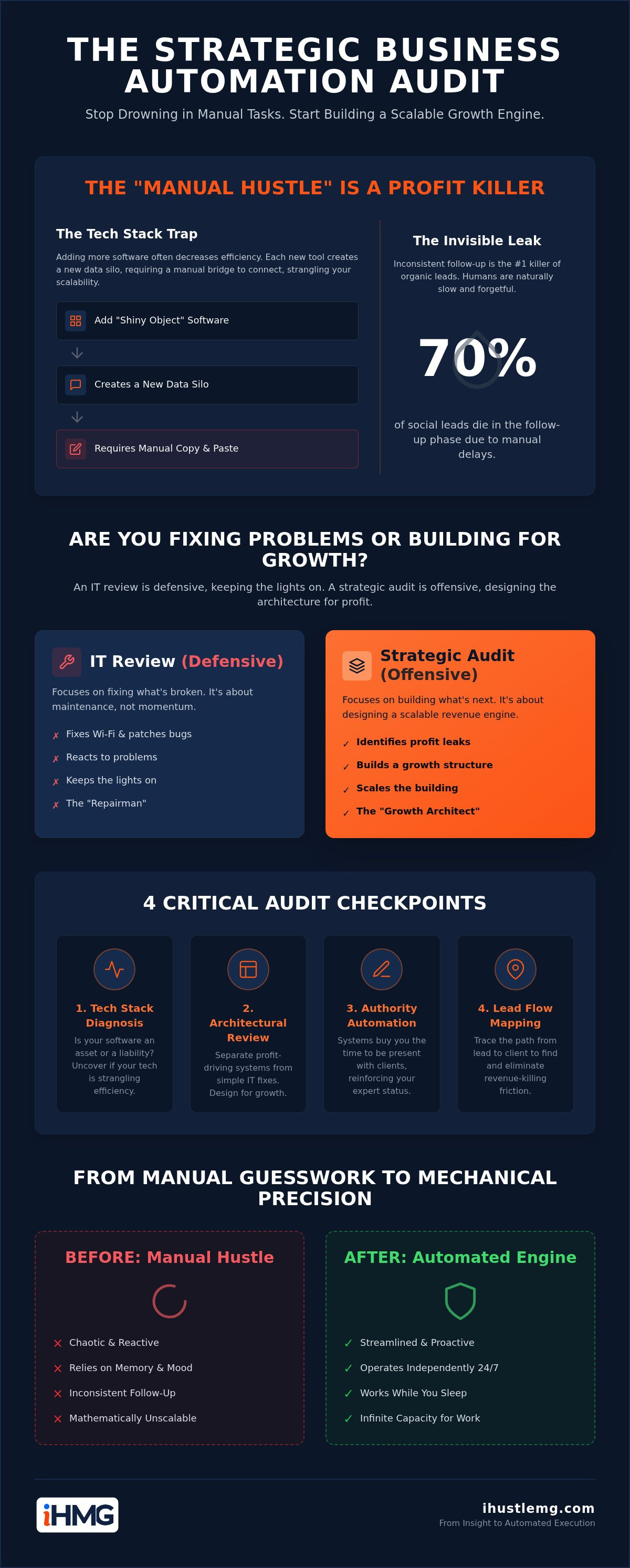
Adding more apps usually decreases efficiency. Every new tool creates a new silo. Every silo requires a manual bridge. This is the "Tech Stack Trap." Many St. Louis founders are software rich but system poor. They have the tools, but they lack the underlying engine that a strategic business automation audit is designed to build. They're managing chaos with a credit card instead of solving it with strategy.
What a Strategic Audit Actually Examines
We map the data flow with clinical precision. It's about tracking how a simple comment on LinkedIn transforms into a high-ticket discovery call. If that path requires you to manually copy-paste names into a spreadsheet, your architecture is fundamentally flawed. We expose the friction points where leads fall through the cracks. More importantly, we identify authority gaps. These are the moments where your systems fail to reinforce your expert status, leaving prospects to wonder if you're actually as professional as your content claims.
The Cost of the 'Manual Hustle' in 2026
Manual work is a luxury you can't afford. If you're a high-level consultant performing $20/hour data entry, you're effectively lighting your profit margins on fire. The "invisible leak" is devastating for organic growth. Industry data suggests that nearly 70% of social leads die in the follow-up phase because humans are naturally slow and forgetful. Manual scaling is a mathematical impossibility for solo experts. You only have 24 hours in a day. A well-built system has an infinite capacity for work.
Strategic Audit vs. IT Review: Identifying the Architecture of Growth
IT support is defensive. It fixes the Wi-Fi and patches the bugs. A strategic business automation audit is offensive. It identifies where your profits are leaking and builds a structure to catch them. One keeps the lights on; the other scales the building. If you're only looking for someone to "fix the tech," you're missing the point of high-level architecture. You don't need a repairman; you need a growth architect.
Your current "workflow" is likely just a series of habits. If a process relies on your memory or your mood to function, it isn't a system. It's a liability. True systems operate independently of your daily energy levels. They don't get tired, and they don't forget to follow up. Moving beyond the Zendesk vs AI system diagnostic logic means shifting your focus from managing support tickets to building a revenue engine. We focus on the three pillars of a growth audit: Lead Capture, Lead Nurture, and Authority Positioning.
Diagnosing the Lead Capture Mechanism
Is your social media presence a billboard or a bridge? Engagement is a vanity metric that doesn't pay the bills. If 1,000 people like your post but zero enter your ecosystem, your capture mechanism is broken. You need an automated transition from a casual comment to a qualified conversation. Systems like Social Lead Web bridge this gap, ensuring that organic interest results in a booked call rather than a lost opportunity.
Auditing Your Authority Infrastructure
Most follow-up sequences make you look like a desperate solicitor. True authority is built through consistent, high-level positioning that reinforces your expert status at every touchpoint. Your current newsletter isn't an authority-building system if it's just a random broadcast. High-performance automation uses AI to maintain that "expert-in-the-room" feel even when you're sleeping. It's about creating a closed-loop environment where every interaction increases your perceived value.
If you're ready to stop playing defense with your technology, it's time for a professional AI System Diagnostic. Stop guessing where the leaks are and start building an engine that actually converts.
The 'Impersonal Automation' Myth: How Systems Build Deeper Authority
The biggest lie in the service industry is that manual work equals "personal touch." It doesn't. If you're exhausted, slow, and struggling to keep up with your inbox, you aren't being personal. You're being a bottleneck. Neglecting a prospect for 48 hours because you're busy with "manual hustle" feels like a rejection, not a premium experience. A strategic business automation audit flips this script by identifying where systems can actually deepen your human connection.
Automation buys you "time-wealth." This isn't about being lazy. It's about having the bandwidth to be human where it actually moves the needle. Consider the "Expert Paradox." Your high-ticket clients aren't paying for your ability to manually type a DM. They're paying for your unique insights and the results you deliver. When you automate the repetitive infrastructure, you free up your cognitive energy to focus on high-level architecture and deep client transformations.
Personalization at Scale
There's a massive difference between being automated and being robotic. High-level lead nurturing uses AI to mimic your unique voice and professional edge across every touchpoint. A two-minute automated response that provides immediate value is infinitely more personal than a two-day manual reply that arrives after the prospect has already moved on to a competitor. AI-driven lead qualification identifies high-intent prospects by analyzing behavioral triggers and semantic patterns within seconds of interaction, ensuring you only spend your manual time on the most qualified opportunities.
The Authority Accelerator Framework
Position yourself as the architect, not the laborer. When your systems handle the heavy lifting, you create an "illusion of omnipresence" that makes you appear everywhere at once. For experts in areas like Chesterfield, this consistent visibility builds massive trust. Your strategic business automation audit should view "Authority" as your highest-converting asset. By building a system that reinforces your expertise while you sleep, you aren't just saving time. You're scaling your reputation. True authority comes from being the strategic visionary who owns the engine, not the mechanic who's constantly covered in the grease of manual tasks.
Executing Your Own Audit: 4 Critical Checkpoints for St. Louis Business Owners
Efficiency is born from brutal honesty. Most founders are flying blind; they're guessing which activities drive revenue and which ones just feel like work. A strategic business automation audit is the process of stripping away the noise to see the mechanical truth of your operations. It's time to stop playing business and start building an engine that actually scales.
- Step 1: The Lead Source Audit. Map every entry point. Whether it's an Instagram DM, a LinkedIn comment, or a referral from a colleague, you must know exactly where the data enters your world. If a lead source isn't connected to a tracking mechanism, it doesn't exist.
- Step 2: The Response Time Audit. Measure your "speed to lead." For a service provider in Ferguson, a 30-minute delay is often the difference between a booked discovery call and a ghosted prospect. Seconds matter in 2026.
- Step 3: The Tech Redundancy Audit. Identify which three apps you can kill today. If you're paying for software that doesn't talk to your primary CRM, you're paying for friction. Stop subsidizing "shelfware" that complicates your life.
- Step 4: The Content-to-Conversion Audit. Does your content actually trigger a system? A post without a call-to-action that feeds into an automated sequence is just a diary entry. Your content should be the fuel for your automation, not a standalone distraction.
Localizing the Audit: St. Peters to Hazelwood
St. Louis service providers need localized automation signals to maintain a competitive edge. Connecting with local partners in St. Charles and Florissant requires systems that can manage high-touch relationships without manual oversight. In 2026, a lead flow diagnostic is no longer about tracking traffic; it's about measuring the mechanical integrity of the bridge between curiosity and capital. You need a system that understands the nuances of the local market while operating at global speeds.
The 'Truth Hurts' Checklist
It's time to confront the leaks. Refer to the Fix Lead Conversion Leaks checklist to see how your current infrastructure stacks up. Identify your number one bottleneck immediately. Is it a lack of traffic, or is the plumbing simply broken? For Hazelwood agency owners, the five-minute "Manual Grind" test is simple: if you can't leave your inbox for an hour without losing a prospect, you don't have a business; you have a job. Stop the manual hustle and get your AI System Diagnostic to start building a real growth engine.
From Insight to Execution: Turning Your Audit into an Automated Engine
Knowledge without execution is just expensive trivia. A DIY audit identifies the leaks; professional execution plugs them forever. Many founders finish a self-assessment and then stall because they lack the technical architecture to build the solution. A strategic business automation audit is only as valuable as the engine it inspires. It's time to stop treating your business like a series of fires to be put out and start treating it like a machine to be optimized.
We move beyond the basic logic of simple problem-fixing. We focus on accelerating your authority. This transition requires a professional-grade assessment like our AI Business Diagnostic Tool. It provides the actionable blueprints you need to transform manual chaos into mechanical precision. Most entrepreneurs are stuck in a loop of "fixing the plumbing." We want you to own the entire waterworks.
The Path Forward for High-Level Pros
Social Lead Web is the definitive antidote to the "Manual DM" plague. It bridges the gap between high-level engagement and qualified conversations without requiring you to live in your inbox. When combined with the Authority Accelerator, you aren't just saving time; you're scaling your reputation. This is about building a system that works while you're focused on high-level strategy or simply enjoying your life. The 2026 mandate is clear. You either automate your lead flow or you get outpaced by the competitors who treat their systems as high-performance assets. Speed is a weapon; don't leave yours on the shelf.
Requesting Your Professional Diagnostic
Our AI System Diagnostic isn't a coffee chat with a business coach. We don't offer vague advice or "mindset shifts" that lead to zero ROI. We provide a hard-data deep dive into your operational plumbing. When you "Request Cortez" for a system deep-dive, you're getting a strategic architect who understands the underlying mechanics of success. We don't just tell you what's wrong. We show you how to build the growth engine that replaces the hustle. It's a clinical examination of your business process that results in a clear roadmap for scalability.
It's time to choose. You can continue the manual grind, or you can stop the manual hustle and audit your way to freedom. Let iHustle Media Group build the engine while you focus on the vision. Stop guessing where your profits are leaking. Start building.
Secure Your Scalable Engine for 2026
The manual hustle is a choice, and in 2026, it's a choice that leads to stagnation. You've seen that adding more software doesn't solve the problem; only a robust architecture does. By prioritizing a strategic business automation audit, you move from managing tasks to owning a high-performance engine. You protect your expert authority and ensure no lead is left behind in the DM grind.
Whether you're in St. Louis, St. Charles, or the surrounding metro area, the mandate is clear. You can continue to let profits leak through manual follow-up, or you can build a system that converts engagement to revenue automatically. Our Social Lead Web and Authority Accelerator programs are designed to position you as a market leader who values substance over mere appearances. High-level service providers don't just work harder; they build smarter.
Stop guessing where your growth is stalling. Request Cortez for your AI System Diagnostic today and transform your operational plumbing into a scalable asset. It's time to build the infrastructure your ambition deserves.
Frequently Asked Questions
What exactly is a strategic business automation audit?
It's a clinical diagnostic of your growth architecture. It goes beyond checking tools to analyzing how data flows between your social engagement and your bank account. A strategic business automation audit identifies mechanical flaws in your lead capture and authority positioning. It's the blueprint you need to stop the manual hustle and start building a scalable engine that operates independently of your daily mood or energy.
How often should a St. Louis service business perform an automation audit?
You should conduct a deep-dive audit at least once every six months. Technology and social algorithms evolve rapidly; a system that worked last year is likely leaking profits today. Frequent reviews ensure your lead flow stays tight and your "speed to lead" remains competitive. If you've recently added new software or shifted your primary lead source, an immediate diagnostic is required to prevent technical debt.
Will automating my lead flow make my business feel less personal to clients?
Automation actually makes your business feel more personal by ensuring no prospect is ignored. A slow, manual response feels like a rejection. A fast, automated response providing immediate value feels like professional excellence. By automating the mundane infrastructure, you reclaim the "time-wealth" needed to be truly present during high-level strategy sessions. You aren't replacing the human; you're removing the exhausted version of yourself from the inbox.
Can I perform a business automation audit myself, or do I need a pro?
You can perform a basic check of your checkpoints, but a professional diagnostic reveals the invisible leaks you've grown used to. Most founders are too close to their own chaos to see the architectural flaws. A professional strategic business automation audit uses advanced AI diagnostics to map data flow with clinical precision. It's the difference between checking your own oil and getting a full engine diagnostic from a master mechanic.
What are the most common automation 'leaks' found in service businesses?
The most devastating leaks occur in the transition from social media engagement to qualified conversations. Most leads die because there isn't an automated bridge between a DM and a CRM. Other common leaks include:
- Inconsistent follow-up sequences that fail to reinforce authority.
- Manual data entry that wastes high-value cognitive energy.
- Redundant software subscriptions that create data silos and friction.
Is automation expensive for small businesses in St. Charles or Chesterfield?
The expense isn't in the automation; it's in the manual hustle you're currently subsidizing with your time. Performing $20 tasks while you should be doing $500 work is the most expensive mistake you can make. Modern systems are highly accessible and provide a measurable ROI by reclaiming billable hours. For businesses in Chesterfield or St. Charles, a streamlined system is a strategic investment that pays for itself by plugging profit leaks.
How long does it take to see results after an automation audit and implementation?
You'll see an immediate shift in your bandwidth within the first week of implementation. Your "speed to lead" improves instantly, which typically results in higher conversion rates for discovery calls. Long-term results, such as reclaimed time and consistent authority positioning, become measurable within 30 to 60 days. The goal isn't just a quick fix; it's the creation of a self-sustaining engine that compounds your growth over time.
What is the difference between an IT audit and a strategic automation audit?
An IT audit is defensive; it focuses on security, bug fixes, and keeping the hardware running. This strategic diagnostic is offensive. It focuses on revenue generation, lead flow optimization, and authority positioning. One keeps the lights on while the other scales the building. Don't confuse technical maintenance with strategic architecture. You don't need someone to fix your Wi-Fi; you need someone to build your growth engine.